All species › Passerines › Weavers › Sociable Weaver
Sociable Weaver | Philetairus socius
Republikeinwever | Tejedor Republicano
The Sociable Weaver builds the largest nests of any bird: huge thatched roofs in camelthorn trees or on telephone poles, with dozens to hundreds of chambers occupied for years by a whole colony. The species is endemic to the arid west of southern Africa.

Voice
An almost incessant, busy chirping and chattering from the colony, chip-chip and tcheep, audible from afar. Flushed groups give sharp, metallic calls.
Recording: Dawie de Swardt — CC BY-NC-SA 4.0 · shortened to the first 60 s, mono · xeno-canto
Identification
13 to 14 cm, stocky and sparrow-like, with a short, pale blue-grey to horn-coloured conical bill. Crown and nape are warm brown, the face paler. A black chin and throat patch and a black lore stand out. Back and wings are brown with dark feather centres and pale fringes, giving a scaled look. The flanks are strikingly black with white fringes, the rest of the underparts pale buff. The sexes are alike; juveniles lack the black throat patch.
Confusion species
Scaly-Feathered Weaver (Sporopipes squamifrons) is smaller, with a pink bill, a black moustachial stripe instead of a throat patch, and a black-and-white scaled forehead. Female House Sparrow (Passer domesticus) and Cape Sparrow (Passer melanurus) lack the black throat and scaled flanks. White-Browed Sparrow-Weaver (Plocepasser mahali) is larger, with a broad white supercilium and a white rump.
Habitat
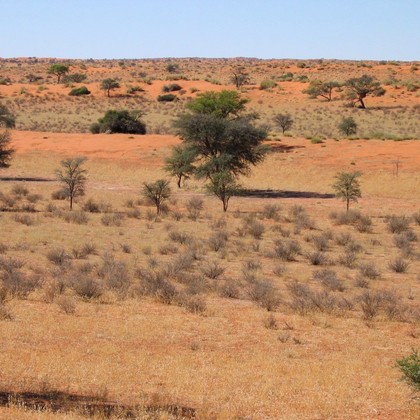
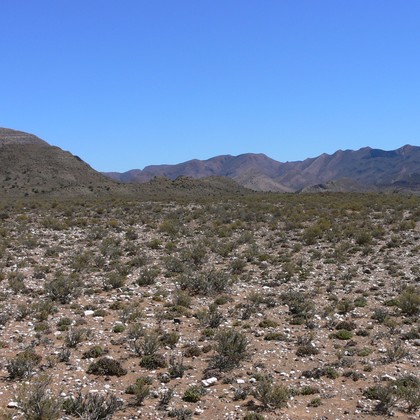
Arid savanna with scattered large trees, especially camelthorn (Vachellia erioloba), Kalahari thornveld and the transition to Nama Karoo; it also builds on telephone and power poles and windmills. It forages in groups on the ground for seeds and insects and hardly needs drinking water.
Where the bird is most at home, classified by the vegetation units of southern Africa.
Range and movements
Endemic to the region: central and southern Namibia (not in the Namib or the north-east), south-western Botswana, the Northern Cape and adjacent parts of North West Province and the extreme western edge of the Free State. Not found outside the region.
- Resident
- Summer visitor (c. Oct–Mar)
- dark = core range, pale = thinly spread
How and when to look
In the Kgalagadi Transfrontier Park and along the roads of the Northern Cape and southern Namibia the nests can be seen from far off. Look out for co-tenants too: Pygmy Falcon (Polihierax semitorquatus) breeds almost exclusively in Sociable Weaver nests, and Rosy-Faced Lovebirds and Red-Headed Finches also use the chambers. Cape cobras and boomslangs sometimes raid an entire nest.
Conservation status
Not threatened. Common within its range. Colonies on telephone poles are sometimes removed, and felling of old camelthorns locally reduces nest sites. Climate change bringing hotter, drier summers is seen as a risk to breeding success.
Scientific name
Philetairus socius | (Latham, 1790)
Latham described the species in 1790 as Loxia socia; because it was later moved to another genus, the author and year stand in brackets. The genus Philetairus was introduced in 1837 by Smith. Philetairus comes from the Greek philetairos, 'loving one's comrades' — for the huge communal nest in which dozens of pairs live together. socius is Latin for 'companion, ally' — for its colonial life in a single large communal nest. The specimen the first description was based on came from Warmbad, southern Namibia.