All species › Passerines › Weavers › Chestnut-Backed Sparrow-Weaver
Chestnut-Backed Sparrow-Weaver | Plocepasser rufoscapulatus
Roodrugwever | Tejedor-gorrión Dorsicastaño
The Chestnut-Backed Sparrow-Weaver is the sparrow-weaver of miombo: a large, stocky weaver with a chestnut back, a striped head and white wingbars. Small groups live together all year and build straw nests high in the trees of open woodland.

Voice
A loose, metallic trill, chrrr-chrrr, and soft chirping contact notes within the group. The species is much quieter than White-Browed Sparrow-Weaver and often goes unnoticed until a group flushes from the ground.
Recording: Dries Van de Loock — CC BY-NC-SA 4.0 · converted to mono · xeno-canto
Identification
17–18 cm, large and sparrow-like, with a heavy, pale horn-coloured conical bill. The head is boldly patterned, with a dark crown and dark stripes through the eye and along the throat on a pale ground. Mantle and back are warm chestnut, the wings dark with two clear white wingbars. The underparts are white to off-white. The sexes are alike; juveniles are duller, with a less contrasting head and a browner back.
Confusion species
White-Browed Sparrow-Weaver (Plocepasser mahali) of dry acacia savanna has a brown, not chestnut, back, a broad white eyebrow and a bright white rump, and overlaps only locally in Zambia and Angola. Southern Grey-Headed Sparrow (Passer diffusus) is smaller, with a plain grey head and only a single narrow white wingbar. The pale bill, striped head and chestnut back together are diagnostic in miombo.
Habitat
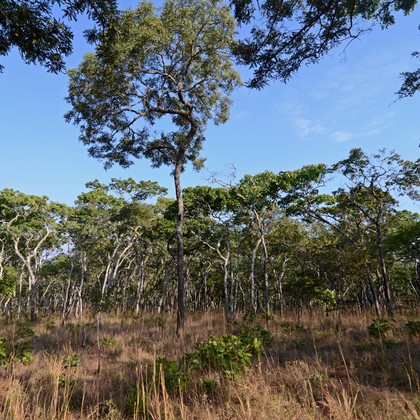
Open miombo woodland and adjoining light broadleaf woodland, especially on plateaus with Brachystegia and Julbernardia; at times near villages and field edges within woodland. It forages mostly on the ground for insects and seeds and flies up to the lower branches when disturbed. It builds untidy straw nests on the outer branches of miombo trees, often several together.
Where the bird is most at home, classified by the vegetation units of southern Africa.
Range and movements
Within the region in northern and central Zambia (from North-Western Province and the Copperbelt to Northern, Central and Eastern Provinces), in northern Malawi (around Vwaza and Rumphi District) and on the central and southern plateau of Angola (Bié, Huíla). Beyond the region only in southern DR Congo (Katanga).
- Resident
- dark = core range, pale = thinly spread
How and when to look
One of the species birders travel to the miombo of northern Zambia for. Drive or walk slowly through open woodland and watch for small groups flushing from the ground and landing in a tree; the white wingbars and rusty back are then the first things to show. The nests often reveal where a group lives.
Conservation status
Not threatened. Fairly common locally, but tied to intact miombo; clearing for charcoal and expanding agriculture reduce its habitat in parts of Zambia and Angola.
Scientific name
Plocepasser rufoscapulatus | Büttikofer, 1888
Büttikofer described the species in 1888 and placed it straight away in the genus where it still stands. The genus Plocepasser was introduced in 1836 by Smith. Plocepasser combines Ploceus (weavers, from the Greek plokeus, 'plaiter') with Passer, 'sparrow' — a sparrow-like weaver. rufoscapulatus is Latin for 'rufous-shouldered', from rufus, 'rufous', and scapulae, 'shoulders' — for the chestnut back and shoulders. The specimen the first description was based on came from Kasinga River, southern Angola.