All species › Hoopoes and hornbills › Hornbills › Black-Casqued Hornbill
Black-Casqued Hornbill | Ceratogymna atrata
Blauwkeelneushoornvogel | Cálao Casquinegro
The Black-Casqued Hornbill is a large black hornbill of the Central African rainforest, reaching the region only in the far north-west of Angola. The male carries an enormous black casque on the bill and blue skin wattles on the throat.

Voice
A powerful nasal braying, aank-aank-aank, audible up to two kilometres, deeper and louder in the male than in the female. Also soft chuckling and, in flight, the loud whoosh of the wings.
Recording: Matthew L. Brady — CC BY-NC-SA 4.0 · shortened to the first 60 s, mono · xeno-canto
Identification
About 65 cm, largely glossy black. The tail is black with broad white tips to the outer feathers; the wings are wholly black. The male has a heavy black bill with a tall, cylindrical black casque and bare cobalt-blue skin around the eye and on the throat, with hanging wattles. The female is smaller, with a chestnut head and neck, a much smaller casque and likewise blue facial skin. Juveniles have a pale bill without a casque. The wingbeats are loud and whooshing.
Confusion species
Black-and-White-Casqued Hornbill (Bycanistes subcylindricus) has much white in the wings, a white belly and a black-and-white casque. Piping Hornbill (Bycanistes fistulator) is much smaller, with a white belly and white wing edges. Trumpeter Hornbill (Bycanistes bucinator) has white underparts and pink facial skin and lives in different forest.
Habitat
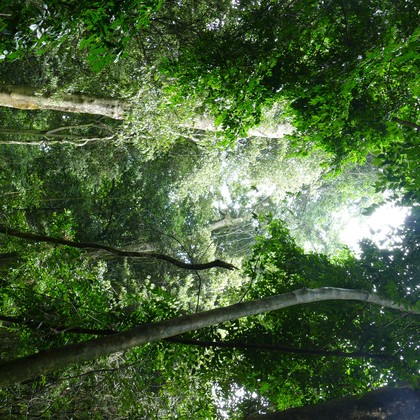
Evergreen lowland rainforest and hill forest, also old secondary forest and plantations with large trees, up to about 1,500 m. It lives high in the canopy, feeding mainly on fruit, especially figs and oil-palm fruit, with insects and small vertebrates. Groups wander in pursuit of fruiting trees. It nests in cavities in large trees.
Where the bird is most at home, classified by the vegetation units of southern Africa.
Range and movements
In the region only in the far north-west of Angola: the Mayombe forest of Cabinda and the forests of the northern provinces. Beyond the region from Guinea and Sierra Leone through West and Central Africa to South Sudan, Uganda and the Congo Basin, and on Bioko.
How and when to look
Best sought in the Mayombe forest of Cabinda, where the braying call and whooshing wings often give the birds away before they are seen. Groups settle in fruiting figs and fly across clearings and rivers.
Conservation status
Near Threatened according to the IUCN. The rainforest it depends on is being lost to logging and farming, and the large birds are hunted for meat. In Angola its small habitat is also fragmented.
Scientific name
Ceratogymna atrata | (Temminck, 1835)
Temminck described the species in 1835 as Buceros atratus; because it was later moved to another genus, the author and year stand in brackets. The genus Ceratogymna was introduced in 1854 by Bonaparte. Ceratogymna comes from the Greek keras, 'horn', and gymnos, 'bare' — for the horny casque on the bill and the bare blue skin around the eye and throat. atrata comes from the Latin atratus, 'clothed in black, in mourning' — for the mainly black plumage. The specimen the first description was based on came from Ashanti, Ghana.