All species › Hoopoes and hornbills › Hoopoes › Common Hoopoe
Common Hoopoe | Upupa epops
Hop | Abubilla
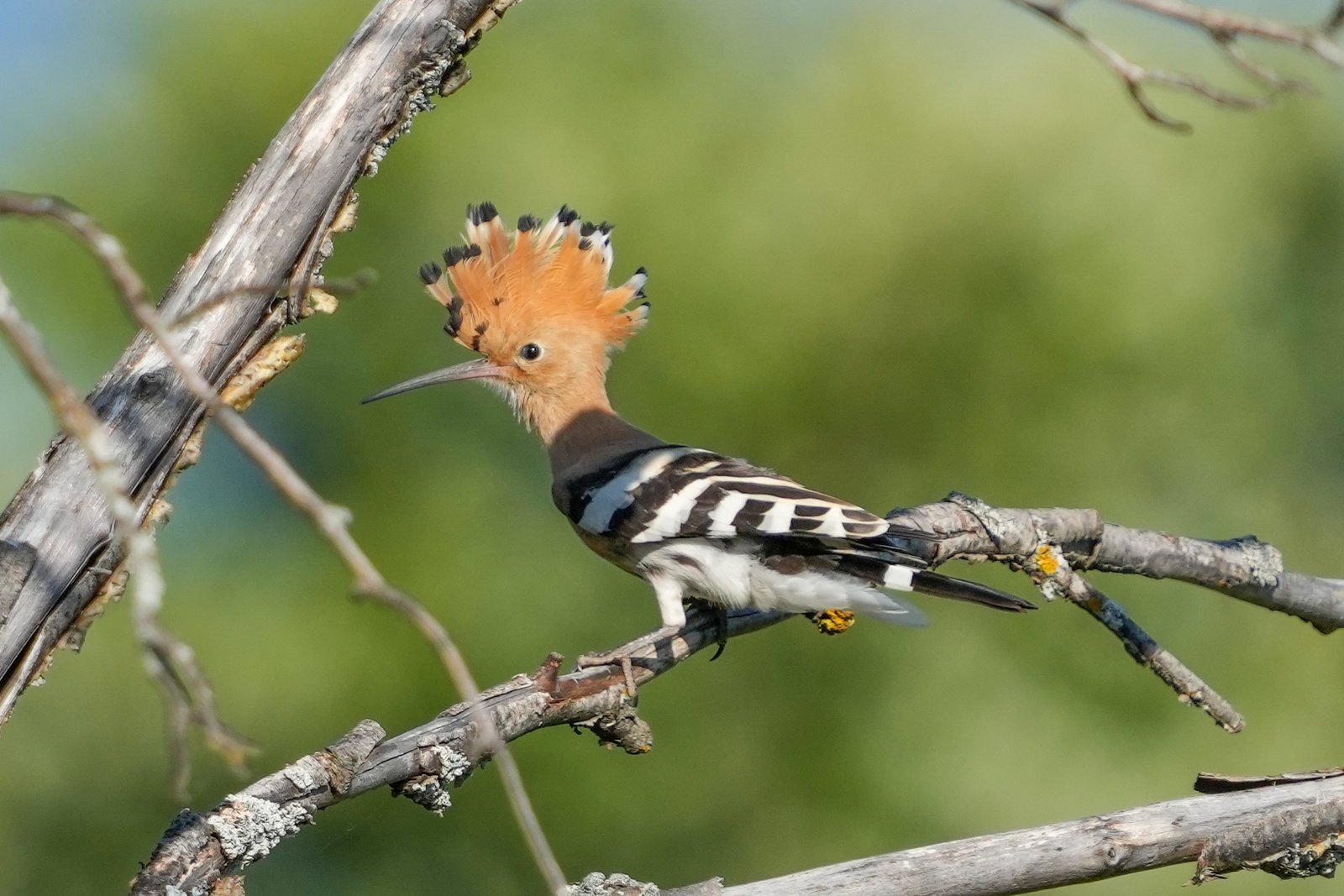
The hoopoe of southern Africa belongs to the resident form africana, treated by many authors as a separate species, African Hoopoe. With its cinnamon plumage, black-and-white barred wings and fan-shaped crest it is unmistakable, and it is a familiar sight in gardens, parks and open woodland.
Voice
A soft, hollow, far-carrying hoop-hoop or hoop-hoop-hoop, often repeated for long spells from a hidden branch, with the neck puffed out and the bill pointing down. Slightly faster and more often in pairs of notes than in European birds. Also a harsh, rasping shairr in alarm and soft screeching from begging young in the nest cavity.
Recording: Zsombor Károlyi — CC BY-NC-SA 4.0 · converted to mono · xeno-canto
Identification
25–28 cm. Head, neck and underparts are deep cinnamon to orange-brown, warmest in the male. The long crest is tipped black and is raised like a fan when excited, but usually lies flat. The bill is long, thin and slightly decurved. Mantle cinnamon, wings and tail black with broad white bars; the tail has a single white band. Unlike the European forms, the male's inner secondaries are wholly white with a black tip, so no second row of white bars shows on the inner wing in flight; the female is duller and shows more grey and white in the inner wing. Flight is slow and butterfly-like, on broad rounded wings that almost close at each beat.
Confusion species
Not confusable in the region. Green Wood Hoopoe Phoeniculus purpureus and Common Scimitarbill Rhinopomastus cyanomelas are relatives with long curved bills, but they are dark and metallic with long graduated tails. At a distance a flying hoopoe can suggest a large butterfly or a jay, but the black-and-white wing pattern is decisive. European birds of the nominate form are possible as vagrants in the north of the region but are hard to establish in the field.
Habitat
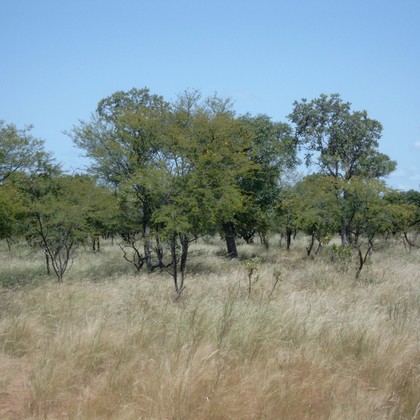
Open woodland, thornveld, parkland savanna, orchards, gardens, sports fields and lawns: anywhere short vegetation or bare ground alternates with trees. It walks on the ground and probes deeply into sand or dung for larvae, pupae, crickets, beetles and ants. It nests in a tree hole, a wall, a termite mound or a nest box; the female and young defend the nest with a foul-smelling secretion.
Where the bird is most at home, classified by the vegetation units of southern Africa.


Range and movements
Found across almost the whole region: from the Western Cape to Angola and Malawi, common in the bushveld and gardens of South Africa, Eswatini, Zimbabwe, Botswana, Zambia and Mozambique. Absent from the true Namib and scarce in the barest parts of the western Karoo and in dense forest. Birds on the cold Highveld and in the south partly move away in winter. The form africana extends north to DR Congo, Uganda and Kenya; the species as a whole breeds across Europe, Asia and most of Africa.
- Resident
- Summer visitor (c. Oct–Mar)
- Winter visitor (c. Apr–Sep)
- Passage (Mar–Apr, Oct–Nov)
- dark = core range, pale = thinly spread
How and when to look
Search a lawn, a park or a campsite in the early morning; the bird walks over the ground with nodding head and, if disturbed, flies to a low branch where it briefly raises its crest. Its calling gives it away from afar in spring, from August. A nest box or a hole in an old wall often attracts the same pair year after year.
Conservation status
Not threatened and common; the species benefits from gardens and parks. Locally it suffers from insecticide use on lawns and in agriculture, and from the loss of old trees with cavities; nest boxes partly make up for this.
Scientific name
Upupa epops | Linnaeus, 1758
Linnaeus described the species in 1758 and placed it straight away in the genus where it still stands. He introduced the genus Upupa in that same work. Upupa is the Latin name of the hoopoe, formed in imitation of its call oop-oop-oop. epops is the Greek word for the hoopoe, likewise formed in imitation of the call. The specimen the first description was based on came from Sweden.