All species › Hoopoes and hornbills › Wood-hoopoes and Scimitarbills › Green Wood Hoopoe
Green Wood Hoopoe | Phoeniculus purpureus
Groene kakelaar | Abubilla Arbórea Verde
The Green Wood Hoopoe is a long, darkly glossed bird with a red curved bill and red legs that moves through bushveld in noisy family groups. The cackling chorus the group sets up has earned it its Afrikaans name 'kakelaar'.

Voice
A loud, cackling and chattering chorus, kek-kek-kek-kakakaka, swelling and breaking off as the whole group joins in, often with rocking tails and bowing bodies. Also a sharp kak contact call.
Recording: Walter Wallner — CC BY-NC-SA 4.0 · shortened to the first 60 s, mono · xeno-canto
Identification
About 34 cm, half of it tail. The plumage is black with a strong green gloss on head, mantle and breast and a purple-blue gloss on back and tail. The wings show a white bar across the primaries and the long graduated tail has white spots near the tip; both are most obvious in flight. Bill and legs are red. The male's bill is longer and more curved than the female's; juveniles have a shorter blackish bill and duller plumage.
Confusion species
Violet Wood Hoopoe (Phoeniculus damarensis) of north-western Namibia and south-western Angola is larger, with a purple rather than green gloss on the mantle; where the two meet intermediates occur. Common Scimitarbill (Rhinopomastus cyanomelas) is much smaller, with a black, strongly sickle-shaped bill and black legs, and does not live in groups.
Habitat
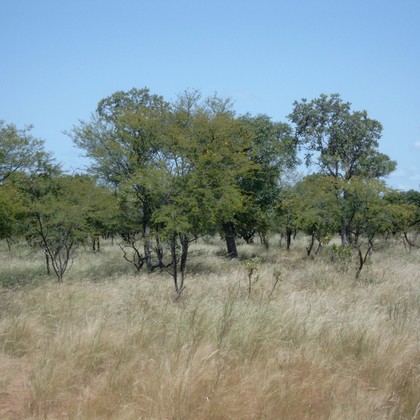
Bushveld, acacia savanna, riverine woodland and the edges of coastal forest, also large gardens, parks and plantations with old trees. It clambers over trunks and thick branches and probes insects, larvae, spiders and millipedes out of bark and crevices. It roosts and nests in tree holes; the group helps to raise the young cooperatively.
Where the bird is most at home, classified by the vegetation units of southern Africa.


Range and movements
Across most of the region: South Africa (mainly east and north, along the coast into the Western Cape), Eswatini, Mozambique, Zimbabwe, Botswana, Zambia, Malawi, Angola and northern Namibia. Absent from the dry Karoo, the Namib and the highest parts of Lesotho. Beyond, over much of sub-Saharan Africa.
- Resident
- Summer visitor (c. Oct–Mar)
- Winter visitor (c. Apr–Sep)
- Passage (Mar–Apr, Oct–Nov)
- dark = core range, pale = thinly spread
How and when to look
Present all year and often heard first: the exuberant cackling betrays a group of five to ten birds moving from tree to tree. In gardens and rest camps the species passes by at regular times; follow the group at dusk to find its roost hole.
Conservation status
Not threatened and common. The species benefits from gardens and plantations with old trees, but depends on tree holes for roosting and breeding; where dead and hollow trees are removed, groups disappear. Nest boxes are readily accepted.
Scientific name
Phoeniculus purpureus | (Miller, 1784)
Miller described the species in 1784 as Promerops purpureus; because it was later moved to another genus, the author and year stand in brackets. The genus Phoeniculus was introduced in 1821 by Jarocki. Phoeniculus is a diminutive of the Greek phoinix, 'crimson, red', for the thin red bill. purpureus is Latin for 'purple' — for the purple and green metallic gloss of the plumage. The specimen the first description was based on came from 'India and Africa' (not specified further).