All species › Hoopoes and hornbills › Wood-hoopoes and Scimitarbills › Violet Wood Hoopoe
Violet Wood Hoopoe | Phoeniculus damarensis
Damarakakelaar | Abubilla Arbórea Violeta
The Violet Wood Hoopoe is the large, purple-glossed counterpart of the Green Wood Hoopoe in arid north-western Namibia and south-western Angola. There it lives in family groups in the gallery woodland along dry riverbeds.
Voice
A cackling group chorus, kek-kek-kakakaka, as in Green Wood Hoopoe but on average somewhat lower and harsher in tone, with a sharp kak contact call.
Recording: James Lidster — CC BY-NC-SA 4.0 · converted to mono · xeno-canto
Identification
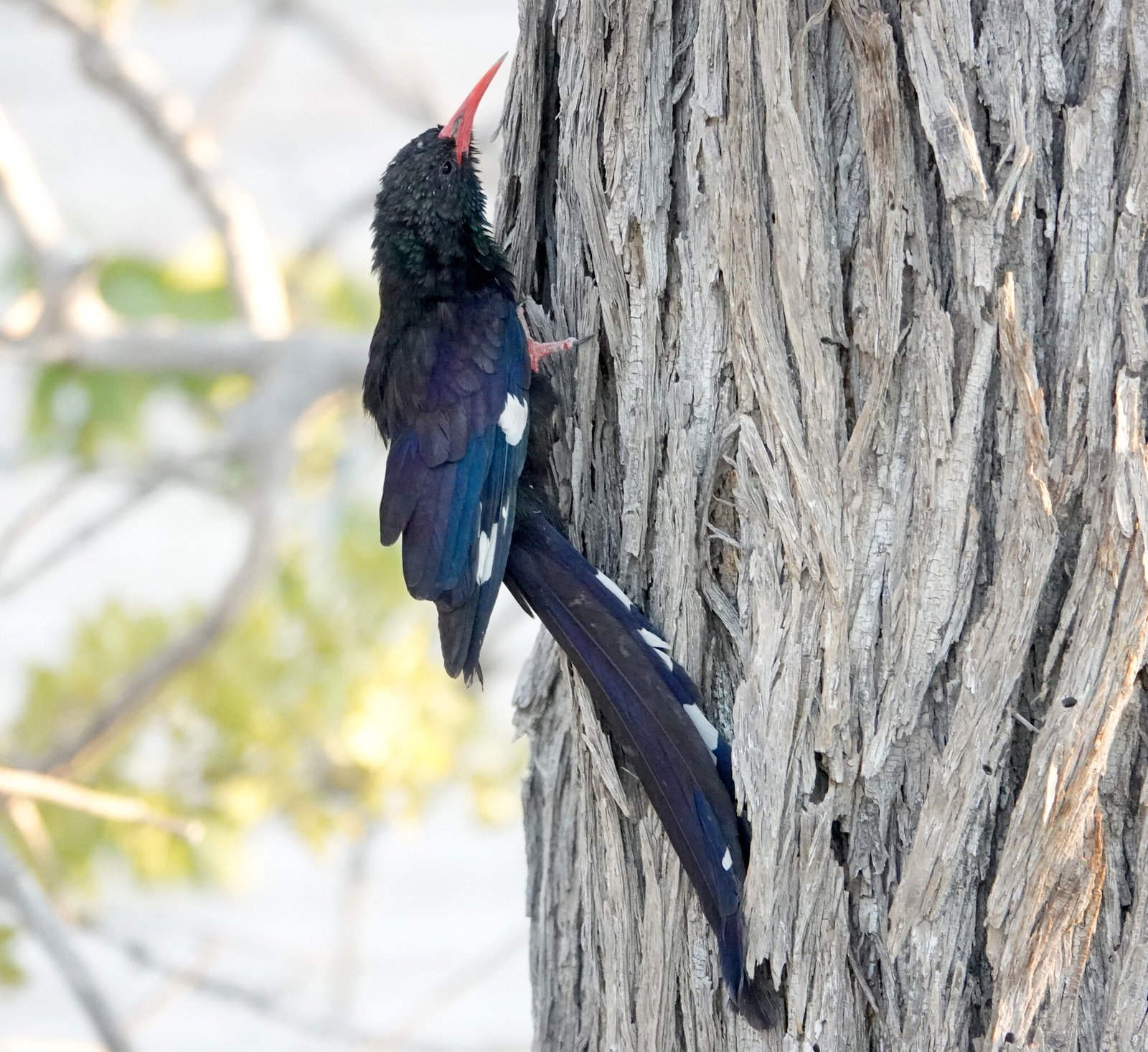
About 38 cm, larger and longer-tailed than Green Wood Hoopoe. The plumage is black with a purple to violet gloss on mantle, back and tail and only a weak green gloss on head and throat. The white wing bar and white tail spots are as in Green Wood Hoopoe. Bill and legs are red, the bill long and curved, longer in the male than in the female. Juveniles have a blackish bill.
Confusion species
Green Wood Hoopoe (Phoeniculus purpureus) is smaller, with a clearly green gloss on mantle and breast; in northern Namibia, including around Etosha, both species and intermediates occur, so not every bird can be named with certainty. Common Scimitarbill (Rhinopomastus cyanomelas) is much smaller, with a black bill and black legs.
Habitat
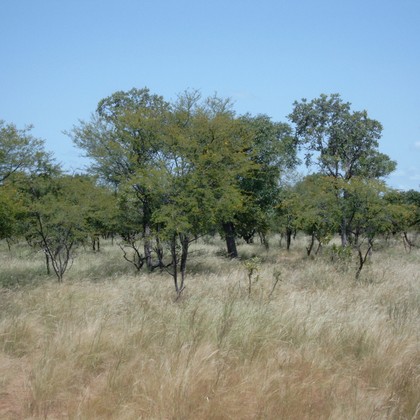
Riverine woodland of tall acacias and ana trees along dry riverbeds in semi-desert and thornveld, locally also mopane woodland and farmyards with old trees. It forages by climbing on trunks and branches for insects and larvae. It roosts and nests in tree holes and breeds cooperatively.
Where the bird is most at home, classified by the vegetation units of southern Africa.

Range and movements
In the region confined to north-western and northern Namibia (Kaokoveld, Damaraland, the Etosha area) and adjacent south-western Angola. Beyond, a separate population occurs in Kenya and Tanzania.
- Resident
- Summer visitor (c. Oct–Mar)
- Passage (Mar–Apr, Oct–Nov)
- dark = core range, pale = thinly spread
How and when to look
Look for it along the dry rivers of Damaraland and the Kaokoveld, such as the Hoanib, Huab and Ugab, and at the rest camps of western Etosha. Groups are best found by following the cackling in the early morning.
Conservation status
Not threatened. Its range within the region is small, but it is locally fairly common there. Its dependence on large old trees along riverbeds makes it vulnerable to woodcutting and to the die-back of riverine woodland as groundwater falls.
Scientific name
Phoeniculus damarensis | (Ogilvie-Grant, 1901)
Ogilvie-Grant described the species in 1901 as Irrisor damarensis; because it was later moved to another genus, the author and year stand in brackets. The genus Phoeniculus was introduced in 1821 by Jarocki. Phoeniculus is a diminutive of the Greek phoinix, 'crimson, red', for the thin red bill. damarensis refers to Damaraland in Namibia, where the types were collected. The specimen the first description was based on came from Damaraland, Namibia.