All species › Hoopoes and hornbills › Wood-hoopoes and Scimitarbills › Black Scimitarbill
Black Scimitarbill | Rhinopomastus aterrimus
Zwarte boomhop | Abubilla Arbórea Negra
The Black Scimitarbill is a small, wholly black scimitarbill with a curved bill, known in the region only from Angola. It forages by climbing in the canopy of open woodland and is there the northern counterpart of the Common Scimitarbill.
Voice
High plaintive whistles, pee-pee-pee or wee-wee-wee, in a slow series, and a soft chattering.
Recording: Andrew Spencer — CC BY-NC-SA 4.0 · converted to mono · xeno-canto
Identification
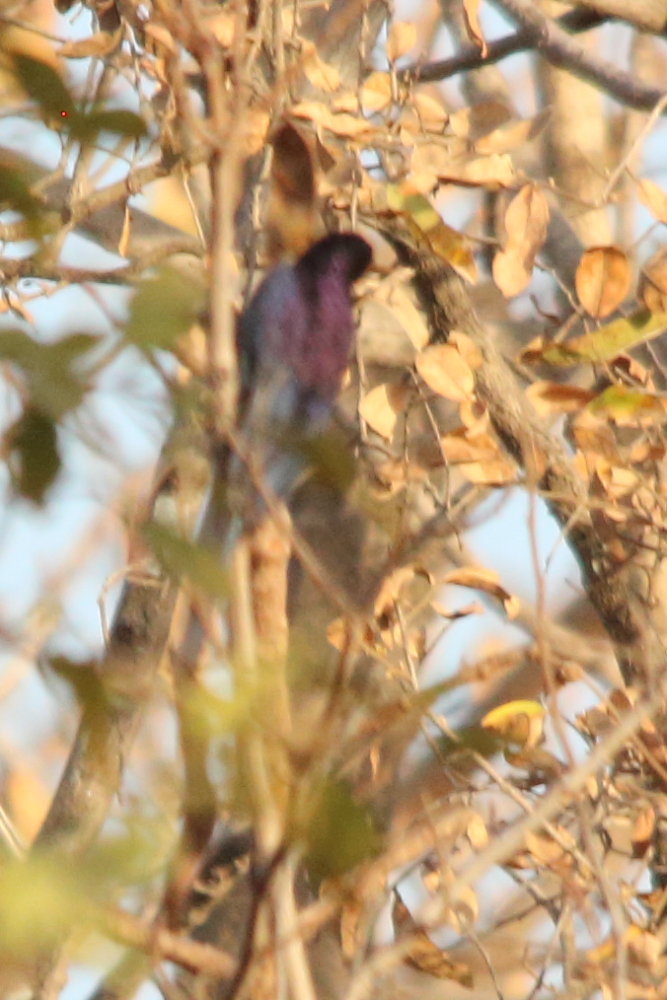
About 24 cm, with a long graduated tail. The plumage is black with a blue to purple gloss; the amount of white in the primaries varies between forms and is often small. The bill is black, thin and clearly curved, but less strongly than in Common Scimitarbill. The female is duller, with a brownish-black head. It climbs and hangs from branches and flies on fast wingbeats.
Confusion species
Common Scimitarbill (Rhinopomastus cyanomelas) has a longer, more strongly sickle-shaped bill and a clear white wing bar; it occurs in southern Angola, so the two may meet there. Green Wood Hoopoe (Phoeniculus purpureus) is much larger, with a red bill and red legs.
Habitat
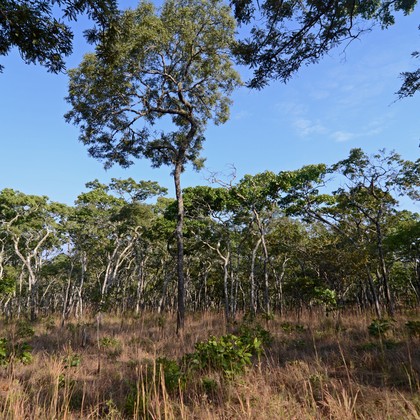
Miombo and other open broadleaved woodland, wooded savanna and forest edges. It forages in pairs or small groups in the canopy for insects and larvae, which it extracts with its bill from bark and dead twigs. It nests in tree holes.
Where the bird is most at home, classified by the vegetation units of southern Africa.

Range and movements
In the region only in Angola, mainly in the north and centre of the country. Beyond, across a broad savanna belt from Senegal to Ethiopia and south to the Democratic Republic of the Congo and Tanzania.
- Resident
- dark = core range, pale = thinly spread
How and when to look
In Angola best searched for in miombo on the central plateau, often in mixed foraging flocks. Listen for the slow series of high whistles and note the less curved bill.
Conservation status
Not threatened and widespread over its large range, although the species is poorly studied and little reported in Angola.
Scientific name
Rhinopomastus aterrimus | (Stephens, 1826)
Stephens described the species in 1826 as Promerops aterrimus; because it was later moved to another genus, the author and year stand in brackets. The genus Rhinopomastus was introduced in 1828 by Jardine. Rhinopomastus comes from the Greek rhis, genitive rhinos, 'nostrils', and pōma, 'lid, cover' — for the nostrils, which are almost concealed by a scale-like operculum (Jardine 1828). aterrimus is Latin for 'very black', the superlative of ater — for the dark, glossy black plumage. The specimen the first description was based on came from Senegal (originally just 'Africa').