All species › Hoopoes and hornbills › Wood-hoopoes and Scimitarbills › Common Scimitarbill
Common Scimitarbill | Rhinopomastus cyanomelas
Zuid-Afrikaanse boomhop | Abubilla Arbórea Cimitarra
The Common Scimitarbill is a slender black climber with a long, strongly sickle-shaped bill and a long graduated tail. Singly or in pairs it works its way up trunks and branches, probing insects out of bark crevices and holes.

Voice
A series of high whistled notes, sweep-sweep-sweep-sweep, often from high in a tree and repeated for some time, and a harsh chattering kekekeke when excited.
Recording: Tony Archer — CC BY-NC-SA 4.0 · converted to mono · xeno-canto
Identification
About 26 cm, almost half of it tail. The plumage is black with a blue-purple gloss, metallic in good light. A narrow white bar across the primaries is most obvious in flight. The bill is black, thin and very strongly curved, the legs black. Females and juveniles have a duller brown head and a shorter, less curved bill. Flight is on fast wingbeats in a slightly undulating path from tree to tree.
Confusion species
Green Wood Hoopoe (Phoeniculus purpureus) is much larger and greener-glossed, with a red bill, red legs and white spots in the tail, and lives in noisy groups. Black Scimitarbill (Rhinopomastus aterrimus) occurs only in Angola and has a shorter, less strongly curved bill. Sunbirds share the curved bill but are far smaller and shorter-tailed.
Habitat
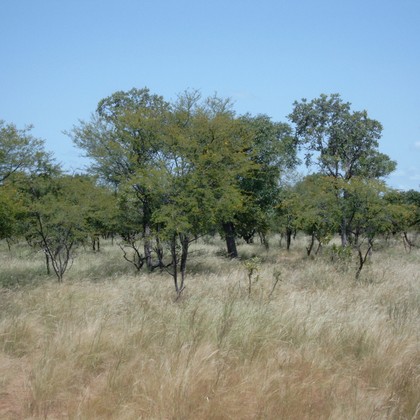
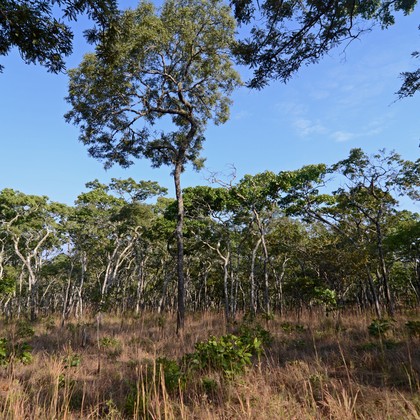
Dry bushveld, acacia savanna, mopane and miombo woodland and Kalahari sandveld, in the south also rank thicket. It forages in trees for insects, larvae, spiders and millipedes, and takes nectar from aloes and coral trees. It nests in natural tree holes or old woodpecker holes.
Where the bird is most at home, classified by the vegetation units of southern Africa.

Range and movements
Widespread across the north and centre of the region: Namibia (except the west and the Namib), Botswana, Zimbabwe, Mozambique, Zambia, Malawi, southern Angola, Eswatini and northern and eastern South Africa into the Eastern Cape. Absent from the Cape, the Karoo and Lesotho. Further north to Kenya and Tanzania.
- Resident
- Summer visitor (c. Oct–Mar)
- Winter visitor (c. Apr–Sep)
- Passage (Mar–Apr, Oct–Nov)
- dark = core range, pale = thinly spread
How and when to look
Present all year but often overlooked. Look for a slim black bird creeping along branches like a treecreeper, often in mixed foraging flocks of small passerines. The whistled series usually gives it away before it is seen.
Conservation status
Not threatened and fairly common over most of its range. It depends on tree cavities for nesting, so the felling of old trees can be harmful locally.
Scientific name
Rhinopomastus cyanomelas | (Vieillot, 1819)
Vieillot described the species in 1819 as Falcinellus cyanomelas; because it was later moved to another genus, the author and year stand in brackets. The genus Rhinopomastus was introduced in 1828 by Jardine. Rhinopomastus comes from the Greek rhis, genitive rhinos, 'nostrils', and pōma, 'lid, cover' — for the nostrils, which are almost concealed by a scale-like operculum (Jardine 1828). cyanomelas comes from the Greek kyanos, 'dark blue', and melas, 'black' — for the glossy blue-black plumage. The specimen the first description was based on came from Namaqualand.