All species › Pelicans, herons and ibises › Herons and bitterns › Black-Crowned Night Heron
Black-Crowned Night Heron | Nycticorax nycticorax
Kwak | Martinete Común
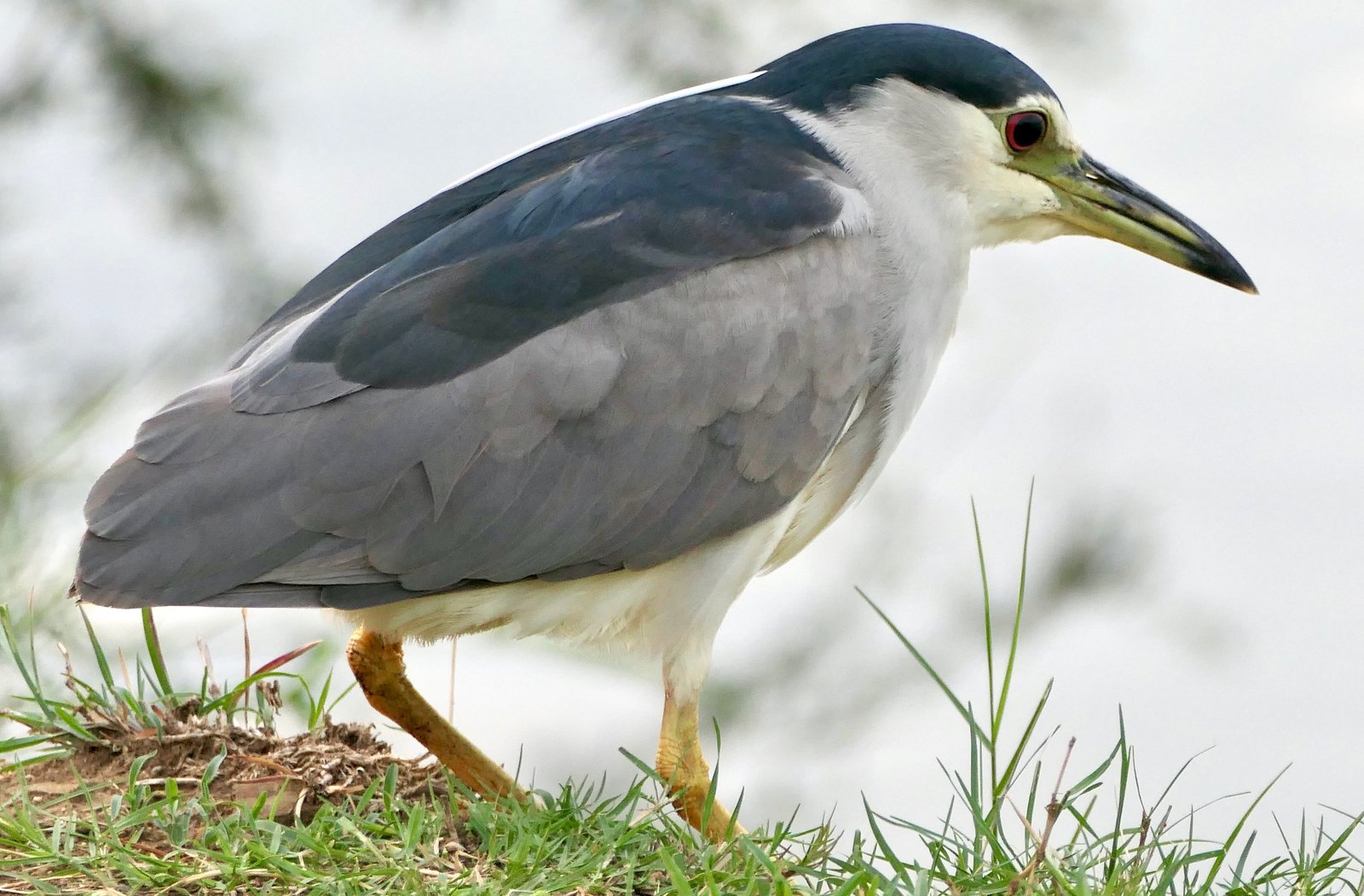
The Black-Crowned Night Heron is a stocky, short-necked heron that spends the day hidden in dense waterside trees and flies out at dusk to feed. The contrast of black cap and back with grey wings and white underparts is unmistakable, but the bird first has to be found.
Voice
Mainly at dusk and at night: a deep, hoarse, frog-like kwak or kwok, often in flight. At the colony a series of croaking and bill-clattering sounds.
Recording: Xavier Riera — CC BY-NC-SA 4.0 · converted to mono · xeno-canto
Identification
About 60 cm, heavily built, with a thick neck largely retracted at rest. Adults have a black crown and mantle with a blue-green gloss, ash-grey wings and tail, a white forehead band and white underparts, and two or three long white nape plumes. The bill is black and stout, the eye large and ruby-red, and the legs yellow, pink during display. The sexes are alike. Immatures are brown with large white drop-shaped spots on the upperparts and streaked underparts; they have an orange eye and a greenish-yellow bill base. It flies with the neck retracted, on broad rounded wings, with the toes just beyond the tail.
Confusion species
White-Backed Night Heron Calherodius leuconotus is smaller and darker, with a black head, a large white eye-ring, a rufous neck and a white back patch visible only in flight. Immature night herons can resemble Eurasian Bittern Botaurus stellaris, which is larger and warmer golden-brown, without white spots, and a young Striated Heron Butorides striata, which is much smaller and slimmer.
Habitat
Rivers, dams, marshes and lagoons with dense fringing vegetation or trees overhanging the water, including reedbeds and papyrus. By day the birds roost in groups in dense trees or bushes; at night they hunt fish, frogs, crayfish and insects. It breeds in colonies, often with other herons.
Where the bird is most at home, classified by the vegetation units of southern Africa.

Range and movements
Found over much of the region, but patchily and in fluctuating numbers: most numerous in northern Botswana, Zambia, Malawi, Zimbabwe, Mozambique and eastern South Africa; scattered as far as the Western Cape and along rivers in Namibia; absent from the driest parts of the interior. Beyond the region it occurs across large parts of Africa, Europe, Asia and the Americas.
- Resident
- Summer visitor (c. Oct–Mar)
- Winter visitor (c. Apr–Sep)
- Passage (Mar–Apr, Oct–Nov)
- dark = core range, pale = thinly spread
How and when to look
By day, search the dense overhanging trees around dams and lagoons, for example in the Okavango Delta, at Nylsvley or at dams around Gauteng. The best moment is just after sunset, when the birds fly off one by one and give their hoarse call.
Conservation status
Not threatened and widespread worldwide. Within the region it is locally sensitive to disturbance of breeding colonies and to the loss of fringing vegetation and wetlands.
Scientific name
Nycticorax nycticorax | (Linnaeus, 1758)
Linnaeus described the species in 1758 as Ardea Nycticorax; because it was later moved to another genus, the author and year stand in brackets. The genus Nycticorax was introduced in 1817 by Forster. Nycticorax is Greek, from nux, genitive nuktos, 'night' and korax 'raven': night raven. In Aristotle and Hesychius it is a bird of ill omen, perhaps an owl; Conrad Gessner used the word for this heron in 1555. The specific epithet repeats the genus name. The specimen the first description was based on came from southern Europe.