All species › Passerines › Larks › Black-Eared Sparrow-Lark
Black-Eared Sparrow-Lark | Eremopterix australis
Zwartoorleeuwerik | Terrera Orejinegra
The Black-Eared Sparrow-Lark is the darkest of the sparrow-larks: the male is all black on the head and underparts, with no white markings at all, and has a chestnut back. It is endemic to the Karoo and Kalahari and wanders in large, unpredictable flocks after the rains.

Voice
A dry, short chip or prrt, often repeated by a flock in flight. The male sings a simple chip-chip-cheewee in a high, undulating song flight and drops quickly back afterwards.
Recording: Lynette Rudman — CC BY-NC-SA 4.0 · converted to mono · xeno-canto
Identification
12–13 cm. A small, compact lark with a thick, pale finch-like bill. The male has an entirely black head, throat and underparts, with no white cheek or crown patch, and warm chestnut back and wings with black feather centres. The female is sandy brown and dark-streaked all over, including densely on the breast and belly, and lacks the black belly patch of other female sparrow-larks. In flight both sexes show black underwings.
Confusion species
Grey-Backed Sparrow-Lark Eremopterix verticalis has a white cheek and crown patch and a grey back; its female has a black belly patch. Chestnut-Backed Sparrow-Lark Eremopterix leucotis also has white cheek and nape patches and lives further north in savanna. Females resemble Lark-Like Bunting Emberiza impetuani, which is plain brown without heavy streaking below. Look for the black underwing and the dense breast streaking of the female.
Habitat
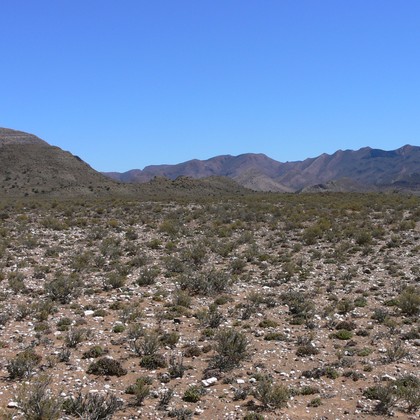
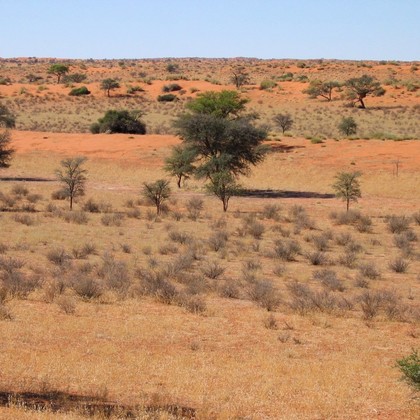
Gravel plains and open, sparsely vegetated flats in the Nama Karoo, with scattered dwarf shrubs and some grass, and red Kalahari sand with grass tufts. It appears in numbers after rain where there are fresh seeds and insects, sometimes with Grey-Backed Sparrow-Lark.
Where the bird is most at home, classified by the vegetation units of southern Africa.
Range and movements
Endemic to southern Africa: the Nama Karoo and Bushmanland of the Northern Cape, the western Free State and the Eastern Cape Karoo, southern and central Namibia and south-western Botswana (Kalahari). In dry years it is absent from large parts of its range and turns up unexpectedly elsewhere.
- Resident
- Winter visitor (c. Apr–Sep)
- Passage (Mar–Apr, Oct–Nov)
- dark = core range, pale = thinly spread
How and when to look
Year-round, but best after good summer rains in the Karoo and Kalahari, when flocks settle to breed. Drive slowly across gravel plains and watch for small dark birds scuttling away on the ground; the all-black head without any white rules out the other sparrow-larks.
Conservation status
Not threatened; numbers fluctuate strongly with rainfall. Overgrazing alters the vegetation locally, but the species seems tolerant of open, heavily grazed ground.
Scientific name
Eremopterix australis | (Smith, 1836)
Smith described the species in 1836 as Megalotis australis; because it was later moved to another genus, the author and year stand in brackets. The genus Eremopterix was introduced in 1836 by Kaup. Eremopterix comes from the Greek erēmos, 'desert', and pterux, 'wing' — birds of dry, open country. australis is Latin for 'southern' — for its range in southern Africa. The specimen the first description was based on came from Along the Orange River.