All species › Passerines › Larks › Grey-Backed Sparrow-Lark
Grey-Backed Sparrow-Lark | Eremopterix verticalis
Grijsrugvinkleeuwerik | Terrera Dorsigrís
The Grey-Backed Sparrow-Lark is the commonest sparrow-lark of the arid west. The male stands out with its black-and-white head and a white spot on the crown, to which the scientific name verticalis refers. Outside the breeding season they wander in flocks of tens to hundreds of birds.

Voice
A dry, chirping chip-chip and a soft prrrt from flocks in flight. The song is a short, repeated whistled phrase, chip-choo-wee, given on the ground, from a small bush or in a short, undulating song flight.
Recording: Lynette Rudman — CC BY-NC-SA 4.0 · converted to mono · xeno-canto
Identification
12–13 cm. A small lark with a thick, pale finch-like bill. The male has a black head with a large white cheek patch, a white spot in the centre of the crown and a white nape patch; the throat, breast and belly are black, the flanks grey. The back and wings are grey with dark streaks, without any chestnut. The female is grey-brown and streaked, with a pale cheek and a small black patch in the centre of the belly. Juveniles resemble females but are paler and scaly.
Confusion species
Chestnut-Backed Sparrow-Lark Eremopterix leucotis has a chestnut back and wings and no white crown spot; it lives in savanna in the north and east. Black-Eared Sparrow-Lark Eremopterix australis has an all-black head without white and a chestnut back. Females may be confused with Lark-Like Bunting Emberiza impetuani, which lacks the black belly patch and the stocky build.
Habitat
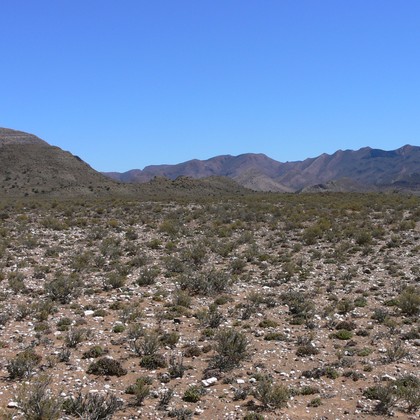
Bare and sparsely vegetated plains in the Nama Karoo and Succulent Karoo, gravel flats, dry pans, short grass in the Kalahari and fallow or freshly harvested fields. It forages in tight flocks on the ground for seeds and insects and regularly comes to water.
Where the bird is most at home, classified by the vegetation units of southern Africa.


Range and movements
Within the region in Namibia, southern and western Botswana, south-western Angola and, in South Africa, the Northern, Western and Eastern Cape, the Free State and North West; nomadic into the western Highveld. Not found outside the region: the species is endemic to southern Africa.
- Resident
- Summer visitor (c. Oct–Mar)
- Winter visitor (c. Apr–Sep)
- Passage (Mar–Apr, Oct–Nov)
- dark = core range, pale = thinly spread
How and when to look
Year-round, but highly variable at any one site. Check flocks that drop in at a waterhole or on a gravel plain: Black-Eared Sparrow-Larks sometimes mix in, and Chestnut-Backed Sparrow-Larks in the north-east. The male with its white crown spot is the reference point.
Conservation status
Not threatened; common and widespread. Heavily grazed ground and fallow fields provide more rather than less suitable habitat; numbers track rainfall above all.
Scientific name
Eremopterix verticalis | (Smith, 1836)
Smith described the species in 1836 as Megalotis verticalis; because it was later moved to another genus, the author and year stand in brackets. The genus Eremopterix was introduced in 1836 by Kaup. Eremopterix comes from the Greek erēmos, 'desert', and pterux, 'wing' — birds of dry, open country. verticalis is Latin for 'of the crown', from vertex — for the male's white crown patch. The specimen the first description was based on came from Both banks of the Orange River (uncertain).