All species › Pelicans, herons and ibises › Herons and bitterns › Black-Headed Heron
Black-Headed Heron | Ardea melanocephala
Zwartkopreiger | Garza Cabecinegra
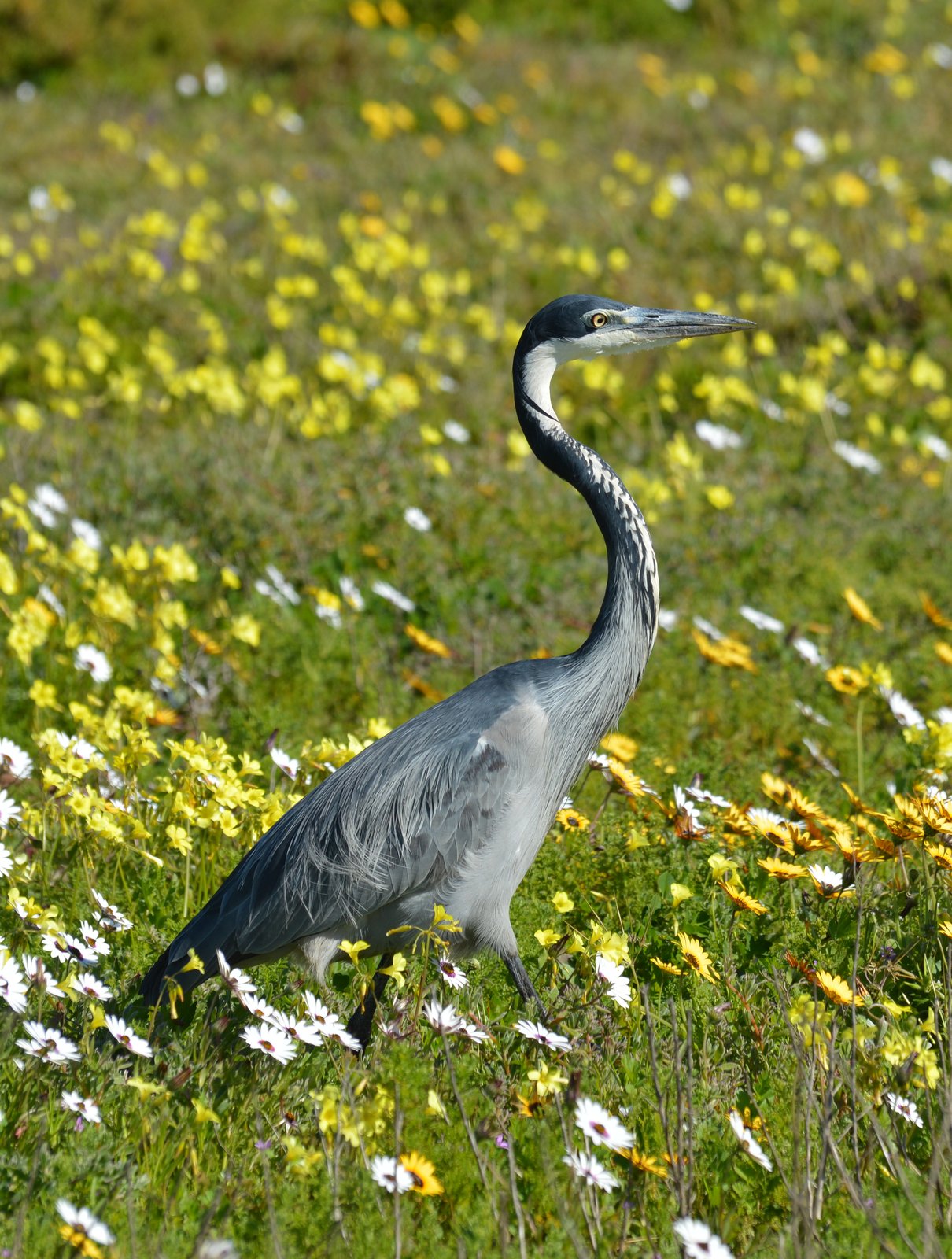
The Black-Headed Heron is a large grey heron that, unlike most of its relatives, has largely freed itself from water. It stalks through grassland, farmland and dry savanna hunting rodents, grasshoppers and lizards, and in many parts of the region is the heron most often seen.
Voice
A loud, nasal kuark, often on take-off; at the colony a variety of cackling, croaking and bill-clappering sounds.
Recording: Jonathan Onongo — CC BY-NC-SA 4.0 · converted to mono · xeno-canto
Identification
About 92 cm. The crown, hindneck and side of the head are black, the throat and chin white, giving the head a sharp black-and-white contrast. The body is slate grey and the foreneck streaked. The bill is dark above and yellowish below, and the legs blackish. Juveniles have a grey rather than black head and neck. In flight the contrast between the white underwing coverts and the black flight feathers is very striking.
Confusion species
Grey Heron Ardea cinerea has a white head with only a black stripe over the eye, a white neck, a yellow bill and paler legs; its underwing is uniform grey without black-and-white contrast. Grey-headed juvenile Black-Headed Herons differ from young Grey Herons in their dark legs and two-toned underwing. Goliath Heron Ardea goliath is much larger and rufous.
Habitat
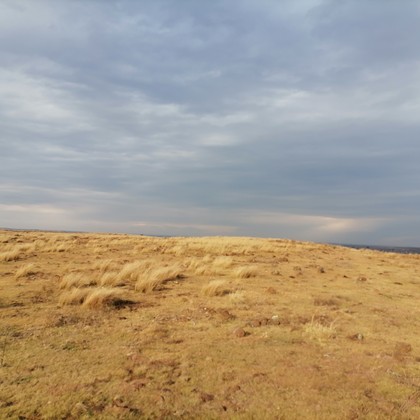
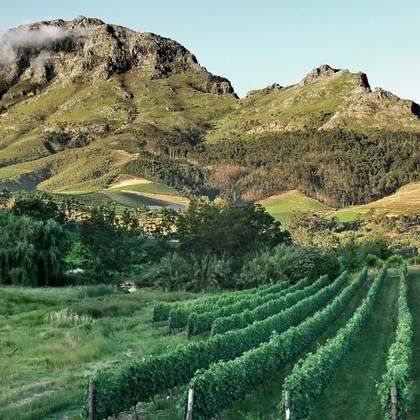
Open grassland, pasture, cultivated fields, vleis, savanna and even sports fields and road verges, often far from water; also feeds along dams and in marshes. It takes rats and mice, grasshoppers, frogs, lizards and occasionally small birds. It breeds colonially in tall trees, often in villages or near water, or in reedbeds.
Where the bird is most at home, classified by the vegetation units of southern Africa.

Range and movements
Widespread and common throughout almost the entire region, from Angola and Zambia to the Cape, including Lesotho and Eswatini; scarcer in the Namib, the Kalahari and the driest parts of the Karoo. Beyond the region across almost all of sub-Saharan Africa.
- Resident
- Summer visitor (c. Oct–Mar)
- Winter visitor (c. Apr–Sep)
- Passage (Mar–Apr, Oct–Nov)
- dark = core range, pale = thinly spread
How and when to look
Search along roads through grassland and farmland: the bird often stands motionless in a field or walks with measured steps through short grass. Breeding colonies in trees in villages or on farmyards give good views.
Conservation status
Not threatened. It has benefited from the conversion of savanna to pasture and cropland and from dam construction, and has increased in numbers and range in southern Africa over the past century.
Scientific name
Ardea melanocephala | Children & Vigors, 1826
Children & Vigors described the species in 1826 and placed it straight away in the genus where it still stands. The genus Ardea was introduced in 1758 by Linnaeus. Ardea is the Latin word for 'heron'. melanocephala comes from the Greek melas, 'black', and kephalē, 'head' — for the black head and hindneck. The specimen the first description was based on came from unknown; possibly near Lake Chad.