All species › Waders, gulls and terns › Buttonquails › Black-Rumped Buttonquail
Black-Rumped Buttonquail | Turnix nanus
Natalvechtkwartel | Torillo Enano
The Black-Rumped Buttonquail is a small, very shy buttonquail of moist, dense grassland, identified by its rufous-orange face and by the blackish back and rump that show only in flight. As in other buttonquails, the larger female calls and displays while the male incubates.

Voice
A low, hollow, repeated hooting by the female, oooo-oooo-oooo, very like that of Common Buttonquail but somewhat softer; mainly at dusk and at night in the breeding season.
Recording: Marna Buys — CC BY-NC-SA 4.0 · converted to mono · xeno-canto
Identification
14–15 cm. The face, throat and breast are warm rufous-orange, deeper and more extensive in the female; the flanks carry black arrow-shaped spots and bars, and the belly is white. The upperparts are dark brown, scaled with creamy edges, with a blackish back and rump. The eye is dark, the bill bluish grey and the legs flesh-coloured. In its short, low flight the pale wing coverts stand out against the dark flight feathers and the black back.
Confusion species
Common Buttonquail Turnix sylvaticus has a pale eye, round black spots on the breast sides, a less orange face and a brown, not black, back. Fynbos Buttonquail Turnix hottentottus of the Cape fynbos is very similar but has less rufous on the head and breast and a paler, more spotted breast; the ranges barely overlap. Quails (Coturnix) are larger and fly further and more strongly.
Habitat
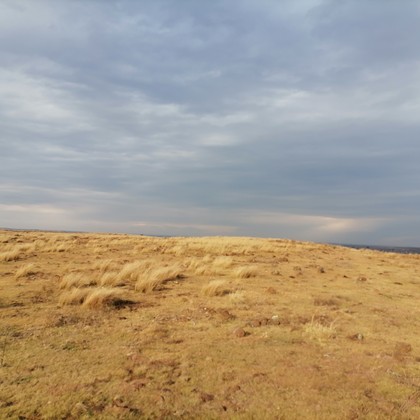
Dense, moist grassland in hills and mountains, grassland with bracken and scattered shrubs, the margins of vleis and grassland left unburnt for one or two years. It avoids short, heavily grazed grass. It eats seeds and insects on the ground and, like its relatives, leaves small scratched scrapes.
Where the bird is most at home, classified by the vegetation units of southern Africa.


Range and movements
In South Africa mainly in the east: the Eastern Cape, KwaZulu-Natal (especially the midlands), Mpumalanga and eastern Limpopo, and in Eswatini. Further north locally in the eastern highlands of Zimbabwe, in Mozambique, Malawi, Zambia and Angola. Beyond the region scattered across sub-Saharan Africa, from Nigeria and Cameroon to Kenya and Tanzania.
- Resident
- Summer visitor (c. Oct–Mar)
- dark = core range, pale = thinly spread
How and when to look
Search in summer, ideally after rain, in dense grassland of the KwaZulu-Natal midlands or eastern Mpumalanga, walking through the grass with a few people abreast. A flushed bird is in view only briefly: look for the black back and orange face. It is rarely seen on the ground and may run between your feet in long grass.
Conservation status
Not globally threatened. In South Africa it is inconspicuous, poorly known and probably declining because of afforestation with exotic trees, agriculture, overgrazing and too-frequent burning of moist grassland.
Scientific name
Turnix nanus | (Sundevall, 1850)
Sundevall described the species in 1850 as Hemipodius nanus; because it was later moved to another genus, the author and year stand in brackets. The genus Turnix was introduced in 1791 by Bonnaterre. Turnix is an abbreviation of the genus name Coturnix, the Latin word for 'quail'. nanus is Latin for 'dwarf' — for the small size of this buttonquail. The specimen the first description was based on came from Durban, KwaZulu-Natal.