All species › Tubenoses › Petrels and shearwaters › Blue Petrel
Blue Petrel | Halobaena caerulea
Blauwe stormvogel | Petrel Azulado
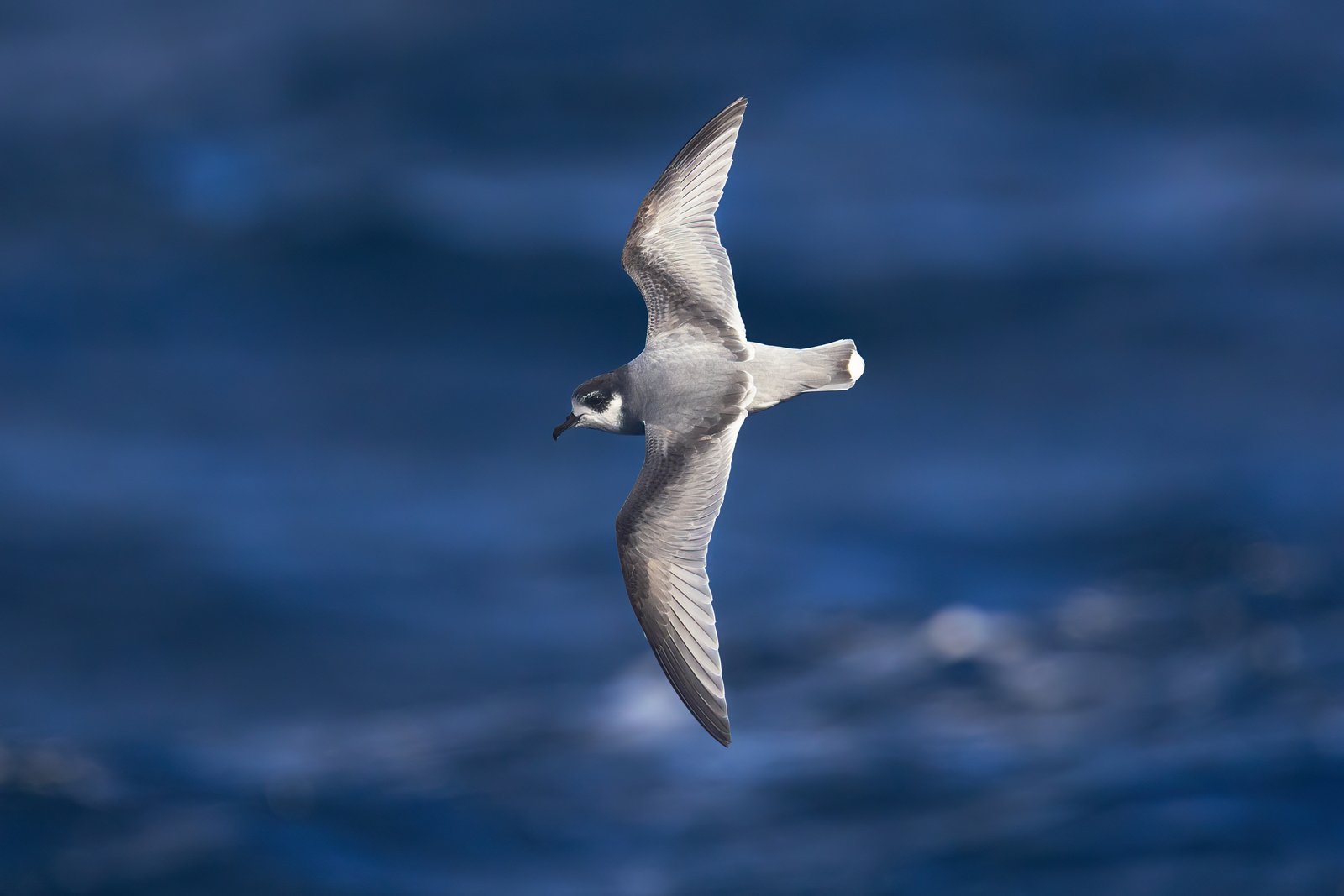
The Blue Petrel looks at first sight like a large prion, but it is a separate species in its own genus, identified by the white tail tip and the dark cap. It breeds on the Prince Edward Islands and in some winters reaches the waters off the Cape in numbers.
Voice
Silent at sea. At the breeding sites a soft, dove-like cooing, koo-koo-koo-ooh, at night from the burrows.
Recording: cgemard — CC BY-NC-SA 4.0 · converted to mono · xeno-canto
Identification
About 30 cm, a slim blue-grey petrel with white underparts. A dark M-pattern runs across the upperwing from wingtip to wingtip, as in the prions. The crown and hindneck are blackish, forming a dark cap, with a white forehead and a dark patch below the eye; there is a dark half-collar on the side of the breast. The tail is square with a broad white terminal band, the best feature of the species. The bill is slender and black, the legs blue with flesh-coloured webs. It flies in wide arcs and shearing glides, gliding more than prions do.
Confusion species
All prions, such as Antarctic Prion (Pachyptila desolata) and Broad-Billed Prion (Pachyptila vittata), have a black rather than a white tail tip, lack the dark cap and fly with a more erratic, twisting flight. Soft-Plumaged Petrel (Pterodroma mollis) and Kerguelen Petrel (Aphrodroma brevirostris) are larger and much darker above, without an M-pattern.
Habitat
Cold open ocean south of the Subtropical Convergence, in winter north as far as the cool Benguela Current. It feeds mainly on krill, small fish and squid taken close to the surface. It breeds in burrows in peaty soil among vegetation on subantarctic islands.
Where the bird is most at home, classified by the vegetation units of southern Africa.
Range and movements
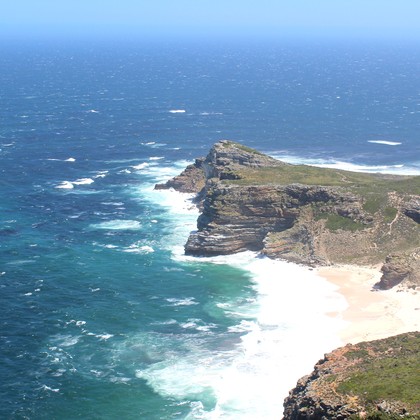
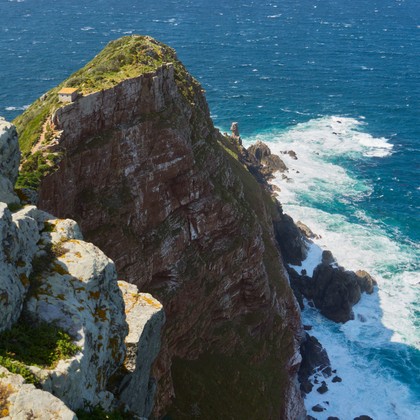
In the region a breeder on Marion and Prince Edward, where birds attend the colonies from September to February. Outside the breeding season an irregular winter visitor far off the Western and Southern Cape, numerous in some years and then also washed up on beaches after severe storms, rarely east to KwaZulu-Natal. Beyond the region it breeds on the Crozet and Kerguelen islands, South Georgia, Macquarie and the islands off Cape Horn, and wanders around the entire Southern Ocean.
How and when to look
Best from pelagic trips out of Cape Town in July and August, ideally after a cold front from the south-west. Search among the prions for a slightly larger bird with a bright white tail tip, which is quickest to see on birds flying away. After storms it pays to check the tideline along the coast of the Cape Peninsula.
Conservation status
Not threatened, with a world population probably exceeding a million pairs. On Marion predation by cats long suppressed the colonies; since the cats were eradicated they are recovering. Mice and climate change in the Southern Ocean remain concerns.
Scientific name
Halobaena caerulea | (Gmelin, 1789)
Gmelin described the species in 1789 as Procellaria caerulea; because it was later moved to another genus, the author and year stand in brackets. The genus Halobaena was introduced in 1856 by Bonaparte. Halobaena comes from the Greek hals, 'sea', and bainō, 'to walk, tread' — for a bird that seems to walk on the sea. caerulea is Latin for 'blue' — for the blue-grey upperparts. The specimen the first description was based on came from Southern Ocean (not specified).