All species › Tubenoses › Petrels and shearwaters › Southern Fulmar
Southern Fulmar | Fulmarus glacialoides
Grijze stormvogel | Fulmar Sureño
The Southern Fulmar is the southern counterpart of the Northern Fulmar: a silvery-grey, gull-like petrel of the pack ice that reaches the Cape in cold winters. For birders in southern Africa it is a sought-after, irregular visitor.
Voice
Silent at sea except for harsh cackling in squabbles over food. At the colony cackling and grating calls between partners.
No recording with a suitable Creative Commons licence is available for this species yet.
Identification
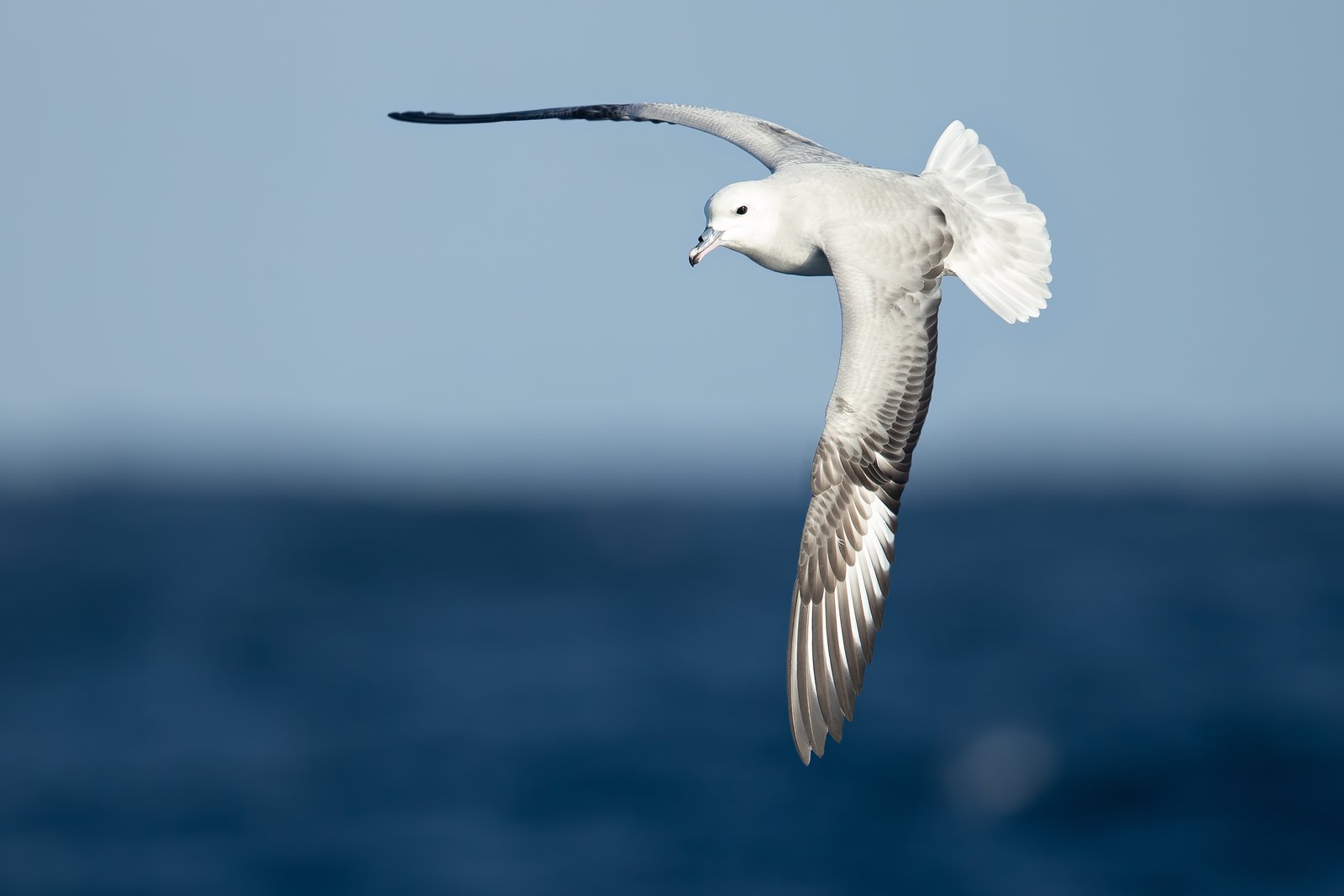
45–50 cm, bulky and short-necked, with a rounded head and a thick bill. Upperparts pale silver-grey, the primaries dark grey to blackish with a conspicuous white panel at the base of the inner primaries. Head and underparts are white, the underwing white with a narrow grey trailing edge. The bill is pink with a blue-grey tube and a dark tip; the legs are flesh-coloured. Sexes and ages are alike. It flies with stiff, rapid wingbeats and long glides, arcing high in strong wind.
Confusion species
Gulls such as Hartlaub's Gull Chroicocephalus hartlaubii and Kelp Gull Larus dominicanus fly with bent wings and lack the tubenosed bill and stiff petrel flight. Blue Petrel Halobaena caerulea and the prions, such as Antarctic Prion Pachyptila desolata, are much smaller and blue-grey, with a dark M across the upperwing. Pintado Petrel Daption capense is chequered black and white.
Habitat
Cold waters of the Southern Ocean, along the pack-ice edge and over the continental shelf; in winter to cold currents such as the Benguela. It takes krill, fish, squid and offal, while swimming or by shallow dives, and follows ships. It breeds on steep cliffs and rock ledges along the Antarctic coast and nearby islands.
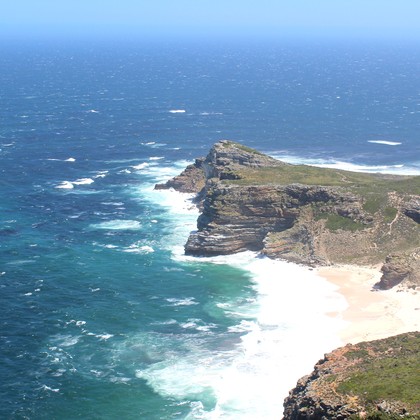
Where the bird is most at home, classified by the vegetation units of southern Africa.
Range and movements
Irregular winter visitor off the Western Cape, usually in small numbers but in some cold winters in tens; further along the west coast to Namibia, rare along the south coast and in KwaZulu-Natal. Vagrant around the Prince Edward Islands. It breeds circumpolarly along the Antarctic coast and on the South Orkney, South Shetland and South Sandwich Islands, Bouvet and Peter I Island, wintering north into the Humboldt Current, off Argentina and around southern Australia and New Zealand.
- Winter visitor (c. Apr–Sep)
- dark = core range, pale = thinly spread
How and when to look
The best chance is a pelagic trip out of Cape Town in July to September after a series of cold fronts. The bird mixes with Pintado Petrels and albatrosses behind trawlers and stands out by its pale grey colour and white wing panels. Records often come in waves: once one is reported, more usually follow.
Conservation status
Not threatened, with a world population estimated at several million birds. Because the species depends largely on krill and ice-associated prey, declining sea ice may affect it in the long term; bycatch plays a minor role.
Scientific name
Fulmarus glacialoides | (Smith, 1840)
Smith described the species in 1840 as Procellaria glacialoides; because it was later moved to another genus, the author and year stand in brackets. The genus Fulmarus was introduced in 1826 by Stephens. Fulmarus goes back to Old Norse fúlmár 'foul gull', after the birds' habit of ejecting a foul-smelling oil. glacialoides means 'resembling glacialis' — for its likeness to the northern Fulmar Fulmarus glacialis, the 'icy' one. The specimen the first description was based on came from Seas off the Cape, South Africa.