All species › Tubenoses › Petrels and shearwaters › Pintado Petrel
Pintado Petrel | Daption capense
Kaapse stormvogel | Petrel Pintado
The Pintado Petrel is the black-and-white chequered petrel that gathers in winter in flocks behind trawlers off the Cape. The chequerboard pattern on the upperwing makes it the most easily identified petrel of the southern oceans.

Voice
At sea mostly heard during squabbles over fish offal: a harsh, fast rattling cackle, kak-kak-kak-kak or cac-carrr, as birds push each other away on the water with spread wings. At the colony cooing and grating calls.
Recording: Mike Bell/Dave Boyle — CC BY-NC-SA 4.0 · shortened to the first 60 s, mono · xeno-canto
Identification
36–40 cm, a compact, pigeon-like petrel with a short neck and rounded head. Head, neck and mantle are sooty black; back and rump white with black spots, so the upperparts look chequered. Each upperwing shows two white patches, a large one at the base of the primaries and a smaller one on the inner wing, separated by black. The tail is white with a broad black terminal band. The underparts are white, with a dark margin to the underwing. The bill is short and black. Sexes and ages are alike. It flies with fast, stiff wingbeats interspersed with short glides, low over the water.
Confusion species
No confusion is possible within the region: no other petrel has the chequered black-and-white upperwing pattern. The Antarctic Petrel (Thalassoica antarctica) is brown and white but without chequering, and does not occur in the region. At long range a worn bird might suggest a Southern Fulmar Fulmarus glacialoides, but that species is pale grey with a single white panel in the primaries.
Habitat
Cold, productive waters over and along the continental shelf, especially in the Benguela Current. It takes krill, small fish, squid and discards from fishing vessels, picked up while swimming or by shallow dives. It breeds on bare rock ledges and cliffs of Antarctic and subantarctic islands.
Where the bird is most at home, classified by the vegetation units of southern Africa.
Range and movements
In winter numerous off the Western Cape and along the west coast into Namibia; less common along the south and east coasts, in cold years reaching KwaZulu-Natal and occasionally southern Mozambique. Also in the waters around the Prince Edward Islands, but it does not breed there. It breeds circumpolarly on the Antarctic Peninsula, the Antarctic coast and islands such as South Georgia, the South Orkneys and South Shetlands, Bouvet, Crozet and Kerguelen; outside the breeding season it ranges north to about the tropic in the Humboldt and Benguela Currents.
- Winter visitor (c. Apr–Sep)
- Passage (Mar–Apr, Oct–Nov)
- dark = core range, pale = thinly spread
How and when to look
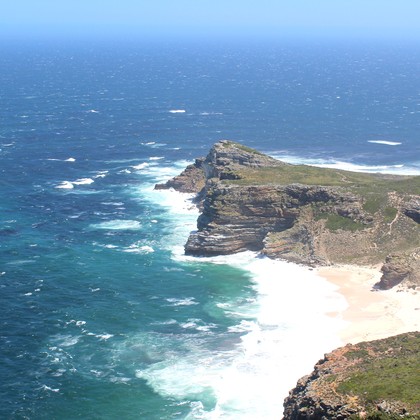
A pelagic trip from Cape Town or Simon's Town between June and September almost guarantees tens to hundreds of birds behind a trawler. They land close to the boat and allow close-range photography. During north-westerly winter gales it can sometimes be seen from headlands such as Cape Point or Kommetjie.
Conservation status
Not threatened, with a world population estimated at some two million birds. Birds die as bycatch in longline and trawl fisheries, but no clear population decline has been established. Changes in krill abundance through warming of the Southern Ocean are a long-term risk.
Scientific name
Daption capense | (Linnaeus, 1758)
Linnaeus described the species in 1758 as Procellaria capensis; because it was later moved to another genus, the author and year stand in brackets. The genus Daption was introduced in 1826 by Stephens. Daption is an anagram of 'pintado', Portuguese and Spanish for 'painted' — the name sailors gave the bird for its pied black-and-white plumage. capense means 'of the Cape' — for the Cape of Good Hope, where the type specimen was collected. The specimen the first description was based on came from Cape of Good Hope.