All species › Gamebirds › Pheasants and partridges › Blue Quail
Blue Quail | Synoicus adansonii
Blauwe kwartel | Codorniz Africana
The Blue Quail is the smallest gamebird of the region, an inconspicuous and scarce summer visitor to wet grassland and vleis. With its slate-blue plumage and black-and-white throat pattern the male is one of the most sought-after species among birders in southern Africa.

Voice
A soft, whistled, descending tee-tee-tee of three or four notes, and sometimes a squeaky kee-kee when flushed. It calls little and is therefore hard to locate.
No recording with a suitable Creative Commons licence is available for this species yet.
Identification
About 15 cm, round and almost tailless. The male is dark slate-blue on head, breast and flanks, with a chestnut wing patch and chestnut undertail coverts. The throat is black with a broad white band below it, and a white stripe runs below the eye; the upperparts are brown with dark markings. The female is warm brown, with a pale throat and clear black barring on breast and flanks. The legs are yellow. It flushes low and briefly on rapid wingbeats and drops straight back into the grass.
Confusion species
The male Harlequin Quail (Coturnix delegorguei) is larger, with a black breast patch, chestnut flanks and a black-and-white patterned head, but lacks blue tones. The female Common Quail (Coturnix coturnix) is larger and streaked rather than barred. Common Buttonquail (Turnix sylvaticus) shows a pale wing panel contrasting strongly with dark flight feathers and has no barring on the underparts.
Habitat
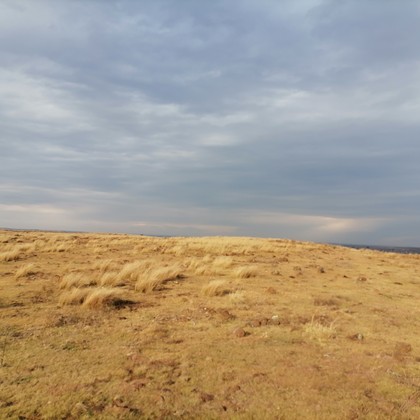
Moist to marshy grassland on the edges of vleis, dams and floodplains, rank vegetation along watercourses and wet fallow fields, also rice paddies. It lives hidden in dense grass and eats seeds, grass buds and insects.
Where the bird is most at home, classified by the vegetation units of southern Africa.

Range and movements
Scarce and irregular in the north and east: Angola, Zambia, Malawi, Mozambique, Zimbabwe, northern Botswana and eastern South Africa, especially KwaZulu-Natal and Mpumalanga, rarely south to the Eastern Cape. Beyond the region in Africa south of the Sahara, from Senegal to Ethiopia and Tanzania.
- Summer visitor (c. Oct–Mar)
- dark = core range, pale = thinly spread
How and when to look
A rare find. In summer after good rains, walk slowly along wet grassy margins of vleis in KwaZulu-Natal, Zimbabwe or Zambia; birds flush only right at your feet. Walking in a spaced line improves the odds, but avoid trampling nests.
Conservation status
Globally not threatened, but rare and poorly known in the region. Its habitat is declining through the drainage and overgrazing of vleis and wet grassland. The species was formerly lumped with the Asian King Quail (Synoicus chinensis).
Scientific name
Synoicus adansonii | (Verreaux & Verreaux, 1851)
Verreaux & Verreaux described the species in 1851 as Coturnix Adansonii; because it was later moved to another genus, the author and year stand in brackets. The genus Synoicus was introduced in 1843 by Gould. Synoicus comes from the Greek sunoikos, 'living together', from sun, 'together', and oikos, 'dwelling'. adansonii honours the French naturalist Michel Adanson (1727–1806), who worked in Senegal. The specimen the first description was based on came from Gabon.