All species › Gamebirds › Pheasants and partridges › Shelley's Francolin
Shelley's Francolin | Scleroptila shelleyi
Shelleys frankolijn | Francolín de Shelley
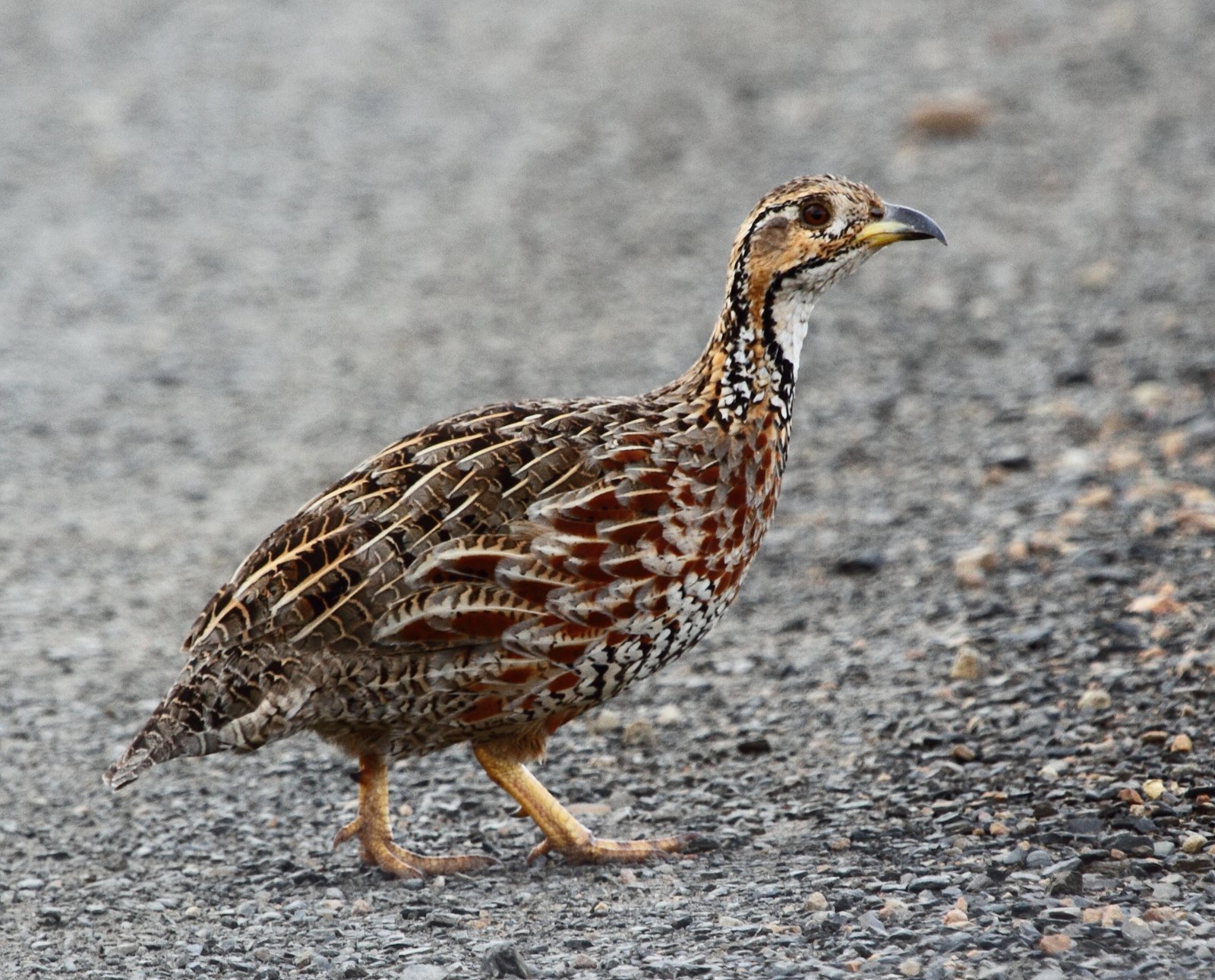
Shelley's Francolin is the red-winged francolin of grassy woodland in the east of the region, often on rocky hills. Its rhythmic morning call, rendered as I'll drink yer beer, is one of the familiar sounds of the lowveld.
Voice
A rhythmic four-syllable phrase, kerrik-kik-keerrik, often rendered as I'll drink yer beer, repeated several times at dawn and in the late afternoon, usually from a boulder or termite mound. Pairs and neighbours call antiphonally.
Recording: Ehren Eksteen — CC BY-NC-SA 4.0 · converted to mono · xeno-canto
Identification
About 33 cm. The throat is white, bordered by a black line that continues as a thin, speckled band across the upper breast. The breast carries large chestnut blotches, and the belly is distinctively densely barred black and white, which separates the species from all its relatives. The head shows a pale supercilium and moustachial stripe. The upperparts are brown with chestnut and black blotches and pale shaft streaks. The primaries are rufous in flight. The legs are yellow. The sexes are alike.
Confusion species
Red-Winged Francolin (Scleroptila levaillantii) of open grassland has a creamy throat with a broad speckled necklace and lacks the black-and-white barred belly. Orange River Francolin (Scleroptila gutturalis) also has a white throat, but a pale, nearly unmarked belly, and lives in drier western grassland. Coqui Francolin (Campocolinus coqui) is smaller, with fully barred underparts and a plain orange-buff head in the male.
Habitat
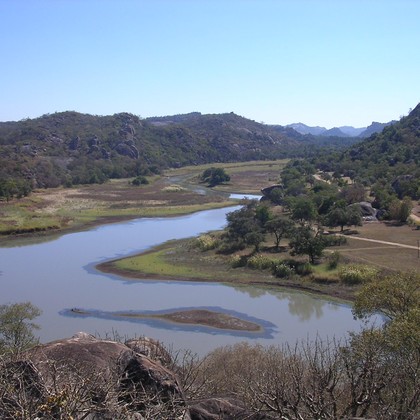
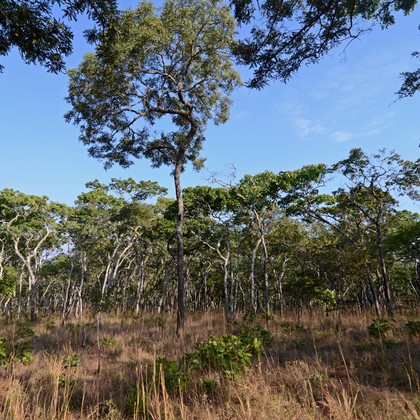
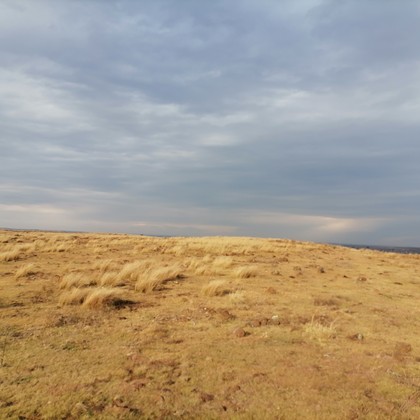
Grassy open woodland, miombo and mixed broadleaf woodland, preferably on hills and slopes with boulders and short grass, also grassy vleis and woodland edge. It scratches for bulbs, tubers, seeds and insects; sedge tubers are a particularly important food.
Where the bird is most at home, classified by the vegetation units of southern Africa.
Range and movements
In the east and north-east of the region: Zimbabwe, Mozambique, eastern South Africa (Limpopo, Mpumalanga and northern KwaZulu-Natal), Eswatini, the far east of Botswana, and further Zambia and Malawi. Beyond the region to Tanzania, Kenya, Uganda and south-eastern DR Congo.
- Resident
- Summer visitor (c. Oct–Mar)
- Winter visitor (c. Apr–Sep)
- Passage (Mar–Apr, Oct–Nov)
- dark = core range, pale = thinly spread
How and when to look
At dawn, listen on rocky woodland hills in places such as Kruger National Park, the Matobo Hills or eastern Eswatini for the distinctive four-syllable call. The birds often then walk over bare patches between the rocks and flush late.
Conservation status
Not threatened and locally common. It loses habitat where woodland gives way to crops and where grassland becomes rank through too little or too much grazing. It is hunted as a gamebird; stable in protected areas.
Scientific name
Scleroptila shelleyi | (Ogilvie-Grant, 1890)
Ogilvie-Grant described the species in 1890 as Francolinus shelleyi; because it was later moved to another genus, the author and year stand in brackets. The genus Scleroptila was introduced in 1849 by Blyth. Scleroptila comes from the Greek sklēros, 'stiff', and ptilon, 'feather' — 'stiff-feathered'. shelleyi honours the British ornithologist George Ernest Shelley (1840–1910), an authority on African birds. The specimen the first description was based on came from Umvuli River, Matabeleland (Zimbabwe).