All species › Gamebirds › Pheasants and partridges › Orange River Francolin
Orange River Francolin | Scleroptila gutturalis
Archers frankolijn | Francolín del Orange
The Orange River Francolin is the red-winged francolin of the drier grasslands and grassy savannas of the western interior, from the Highveld to the Kalahari and the Namibian highlands. Pairs and small coveys live hidden in tall grass and give themselves away mainly by their call at dawn.
Voice
A rhythmic, repeated kibitele-kibitele or kwee-kwee-kweekirrie, mainly in the first hours of the day from a termite mound or grass tuft; neighbours answer one another. A high chik-chik when flushed.
Recording: Tony Archer — CC BY-NC-SA 4.0 · converted to mono · xeno-canto
Identification
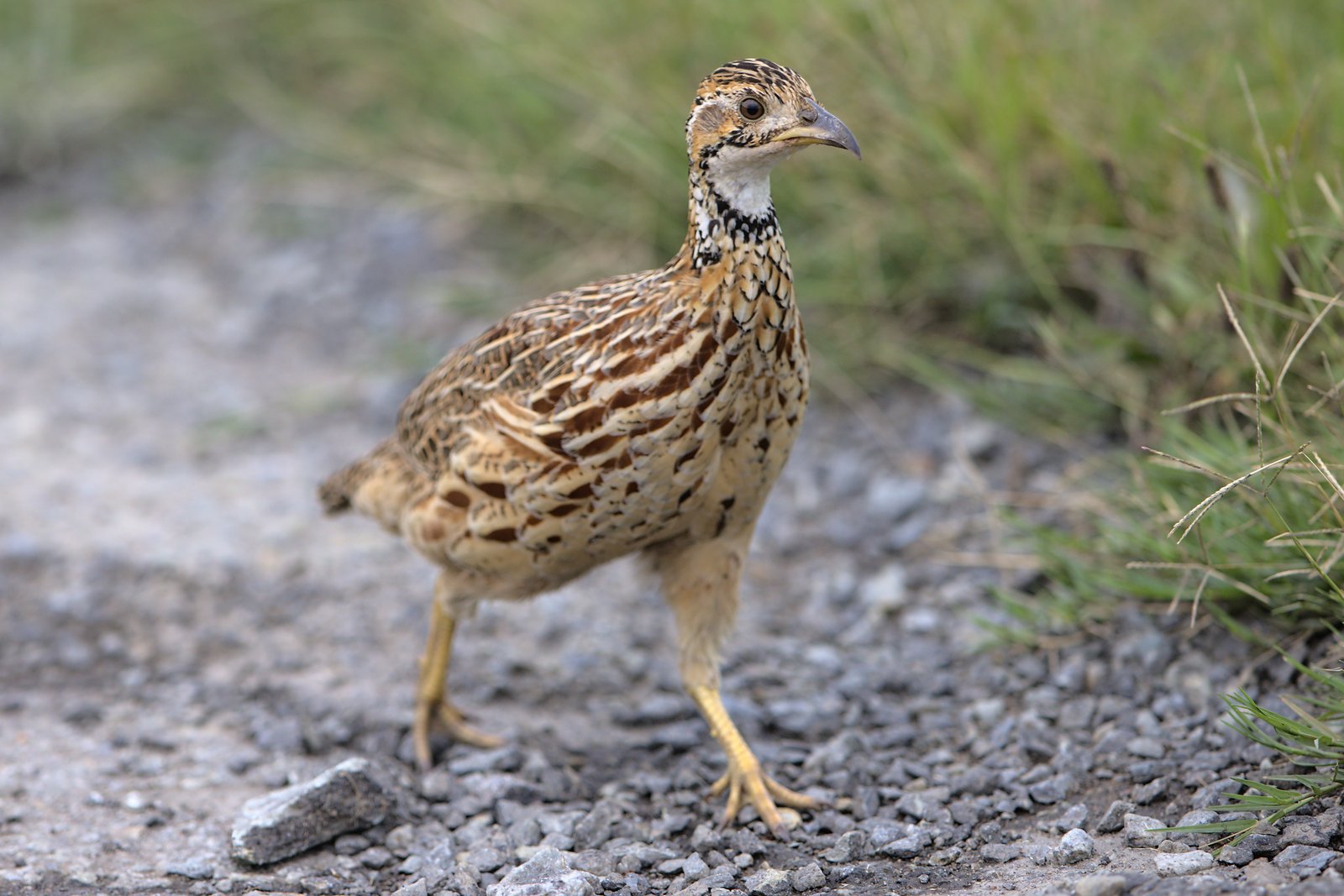
About 34 cm, paler and warmer-toned than related species. The throat is bright white, framed by a narrow black line that breaks into rufous spots towards the neck. The head has a creamy-white supercilium and moustachial stripe and a rufous eye-stripe. The breast is pale brown with chestnut blotches, and the belly is pale sandy with little marking. The upperparts are sandy brown with black and pale streaks. The rufous primaries stand out in flight. The legs are yellow. The sexes are alike.
Confusion species
Red-Winged Francolin (Scleroptila levaillantii) of moister, eastern grassland has a broad black-and-white speckled necklace across the upper breast and darker, more barred underparts. Grey-Winged Francolin (Scleroptila afra) has a grey-speckled throat. Shelley's Francolin (Scleroptila shelleyi) also has a white, black-bordered throat, but a strikingly black-and-white barred belly, and lives in eastern woodland.
Habitat
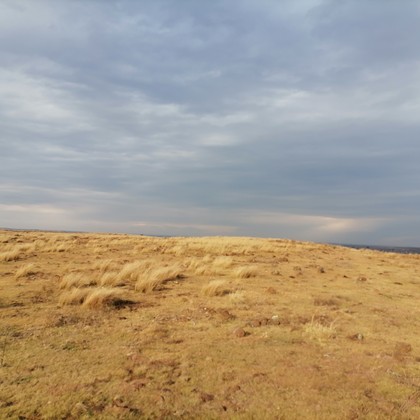
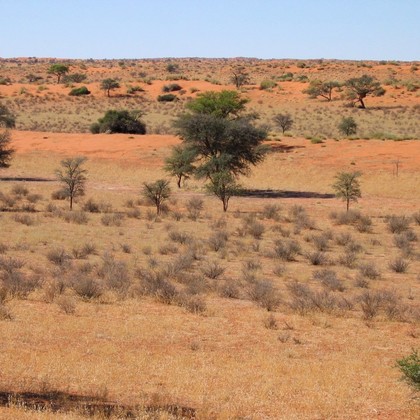
Open grassland and grassy savanna on sand or red Kalahari sand, with scattered bushes, termite mounds and rocky ridges, also fallow land and grain fields on the edge of natural grassland. It scratches for seeds, bulbs, tubers and insects.
Where the bird is most at home, classified by the vegetation units of southern Africa.
Range and movements
In South Africa in the Free State, North West, Gauteng, western Mpumalanga and the Northern Cape, and further in western Lesotho, in Botswana mainly in the south and centre, and in the highlands of central and northern Namibia into south-western Angola. Beyond the region, depending on taxonomy, in the grasslands of East Africa to Ethiopia and Somalia.
- Resident
- Summer visitor (c. Oct–Mar)
- Winter visitor (c. Apr–Sep)
- Passage (Mar–Apr, Oct–Nov)
- dark = core range, pale = thinly spread
How and when to look
At dawn, listen along sand roads through Free State grassland or in the Central Kalahari for the calling male on a termite mound. Drive slowly and scan the verges in the first hour after sunrise, when pairs come out into the open.
Conservation status
Not threatened. It has declined locally with the conversion of grassland to cropland and with heavy overgrazing, but remains common on large ranches and in protected areas. The taxonomy is in flux: the southern forms were formerly treated as a separate species (Scleroptila levaillantoides).
Scientific name
Scleroptila gutturalis | (Rüppell, 1835)
Rüppell described the species in 1835 as Perdix gutturalis; because it was later moved to another genus, the author and year stand in brackets. The genus Scleroptila was introduced in 1849 by Blyth. Scleroptila comes from the Greek sklēros, 'stiff', and ptilon, 'feather' — 'stiff-feathered'. gutturalis is Latin for 'of the throat', from guttur 'throat', for the distinctively marked throat. The specimen the first description was based on came from Tigray, Ethiopia.