All species › Gamebirds › Pheasants and partridges › Grey-Winged Francolin
Grey-Winged Francolin | Scleroptila afra
Grijsvleugelfrankolijn | Francolín Aligrís
The Grey-Winged Francolin is the francolin of the cool uplands and montane grasslands of South Africa and Lesotho, one of the few gamebirds almost wholly confined to the region. Coveys hide in short grass and on rocky slopes and flush noisily only at the last moment.

Voice
A high, squeaky, rising kwi-kwi-kwikkievee, often from several birds at once in the half-light of dawn and dusk, audible over long distances on still mountainsides. A high cackle when flushed.
Recording: JJSUN — CC BY-NC-SA 4.0 · converted to mono · xeno-canto
Identification
About 32 cm, compact and brown, with a finely grey-and-black speckled throat and breast that give a greyish cast at close range. The upperparts are brown with pale shaft streaks and black blotches, and the belly is creamy with chestnut and grey barring. The head shows a pale supercilium and a dark eye-stripe. In flight the primaries are rufous with greyish, mottled outer webs, so the wing looks duller red than in related species. The legs are yellow. The sexes are alike.
Confusion species
Red-Winged Francolin (Scleroptila levaillantii) has a creamy throat framed by a broad black-and-white speckled necklace and much brighter rufous primaries. Orange River Francolin (Scleroptila gutturalis) of drier western grassland has a white throat with a thin black border and paler, sandier underparts. The grey throat speckling is the best feature of Grey-winged.
Habitat
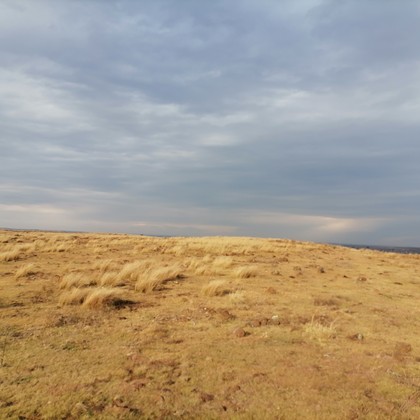
Short montane grassland, grassy rocky slopes and upland plateaus with scattered stones, in the east to over 3000 m in Lesotho; in the Western Cape also fynbos, renosterveld and wheatland. It scratches for bulbs, tubers, seeds and insects and digs with the bill. It readily uses short, recently burnt grassland.
Where the bird is most at home, classified by the vegetation units of southern Africa.


Range and movements
Endemic to South Africa and Lesotho: from the Drakensberg and Eastern Cape highlands across the eastern Highveld to Mpumalanga, with a separate population in the mountains and wheatlands of the Western and Northern Cape. It does not occur beyond the region.
- Resident
- Winter visitor (c. Apr–Sep)
- dark = core range, pale = thinly spread
How and when to look
Walk grassy slopes in the Drakensberg or the eastern Free State early in the morning and listen for the chorus of squeaky calls; a covey often flushes right at your feet. After a veld fire the species is easier to see on the short grass.
Conservation status
Not threatened, but dependent on natural grassland and lost where this gives way to timber plantations, crops or heavily overgrazed pasture. It is hunted as a gamebird; in the Western Cape it has benefited from wheat farming on the edges of renosterveld.
Scientific name
Scleroptila afra | (Latham, 1790)
Latham described the species in 1790 as Perdix afra; because it was later moved to another genus, the author and year stand in brackets. The genus Scleroptila was introduced in 1849 by Blyth. Scleroptila comes from the Greek sklēros, 'stiff', and ptilon, 'feather' — 'stiff-feathered'. afra is Latin for 'African'. The specimen the first description was based on came from Cape of Good Hope.