All species › Passerines › Waxbills › Bronze Mannikin
Bronze Mannikin | Spermestes cucullata
Gewoon ekstertje | Capuchino Bronceado
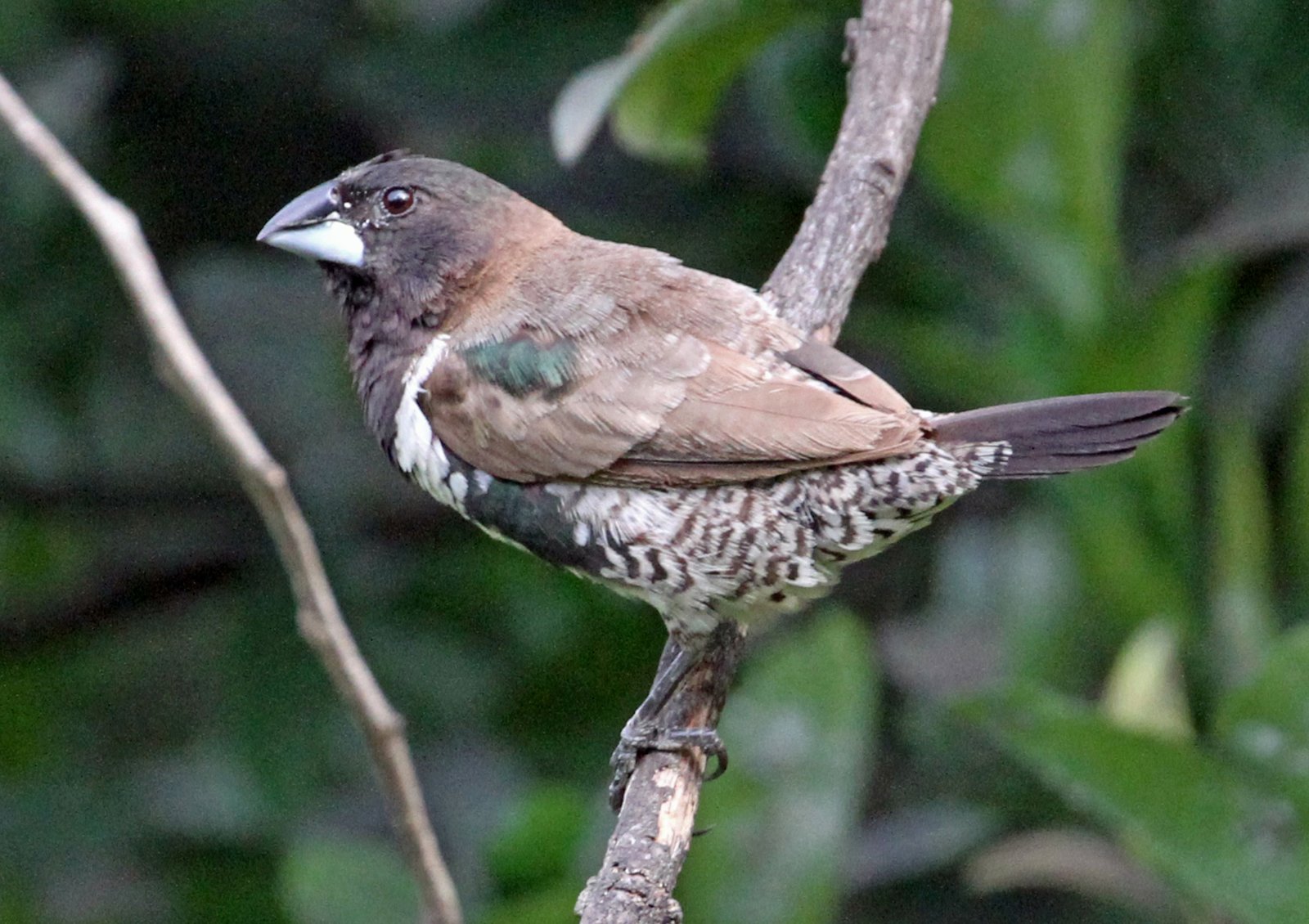
The Bronze Mannikin is the smallest and commonest mannikin of the region: a dark-headed, brown and white estrildid that moves through grassy margins, gardens and woodland edges in tight parties. It owes its English name to the glossy green shoulder patch.
Voice
A dry, buzzing chik-chik or krrr-krrr, especially on take-off and as a contact call within the flock. The song is a soft, squeaky and scratchy series of notes, delivered with fluffed feathers and a grass stem in the bill.
Recording: African Bioacoustics Community — CC BY-NC-SA 4.0 · shortened to the first 60 s, mono · xeno-canto
Identification
9–10 cm, small and compact, with a short, conical bill that is black above and blue-grey below. Head, throat and upper breast are dark blackish-brown with a green to purple gloss; on the shoulder is a small, glossy bottle-green patch. Back and wings are dull brown, the rump is finely barred black and white and the tail black. The underparts are white, with brown-black barring on the flanks. The sexes are alike. Juveniles are plain grey-brown above and dull buff-brown below, without the dark hood, and have a dark bill.
Confusion species
Black-and-White Mannikin (Spermestes bicolor) has, in the region, a chestnut-red back, an all-black head and breast and a blue-grey bill, and lacks the green shoulder patch. Magpie Mannikin (Spermestes fringilloides) is clearly larger and heavier-billed, with a black hood, a rufous-brown flank patch and a brown back with pale shaft streaks. Juveniles may recall young waxbills, but the two-toned bill and the company of adults make it clear.
Habitat
Grassy edges of forest and woodland, riverine scrub, field margins, fallow land, parks and gardens, especially in moist areas. It lives in parties of five to twenty birds that feed together on ripe grass seeds and roost together in old or purpose-built roosting nests. The nest is a loose ball of grass in a shrub or tree.
Where the bird is most at home, classified by the vegetation units of southern Africa.



Range and movements
The whole east and north of the region: from the Eastern Cape through KwaZulu-Natal, Mpumalanga and Limpopo to Eswatini, Zimbabwe, Mozambique, Malawi, Zambia and Angola, and in northern Botswana and the Caprivi Strip; absent from the dry west. Beyond the region across almost all of sub-Saharan Africa; introduced to Puerto Rico.
- Resident
- Summer visitor (c. Oct–Mar)
- Winter visitor (c. Apr–Sep)
- Passage (Mar–Apr, Oct–Nov)
- dark = core range, pale = thinly spread
How and when to look
All year in gardens and along grassy margins in moist areas, best at a feeder with millet or near seeding grass. Watch for parties sitting pressed together on one twig and preening each other. The green shoulder patch shows only in good light; the two-toned bill is the quickest feature.
Conservation status
Not threatened; common and benefits from gardens, field margins and rank roadsides. It is locally trapped for the cage-bird trade, with no noticeable effect on numbers.
Scientific name
Spermestes cucullata | Swainson, 1837
Swainson described the species in 1837 and placed it straight away in the genus where it still stands. He introduced the genus Spermestes in that same work. Spermestes comes from the Greek sperma, 'seed', and -estēs, 'eater' (from esthiō, 'to eat') — for the diet of grass seeds. cucullata is Latin for 'hooded' — for the dark head, which contrasts like a hood with the rest of the plumage. The specimen the first description was based on came from Senegal.