All species › Passerines › Waxbills › Orange-Winged Pytilia
Orange-Winged Pytilia | Pytilia afra
Wenerastrild | Estrilda Alinaranja
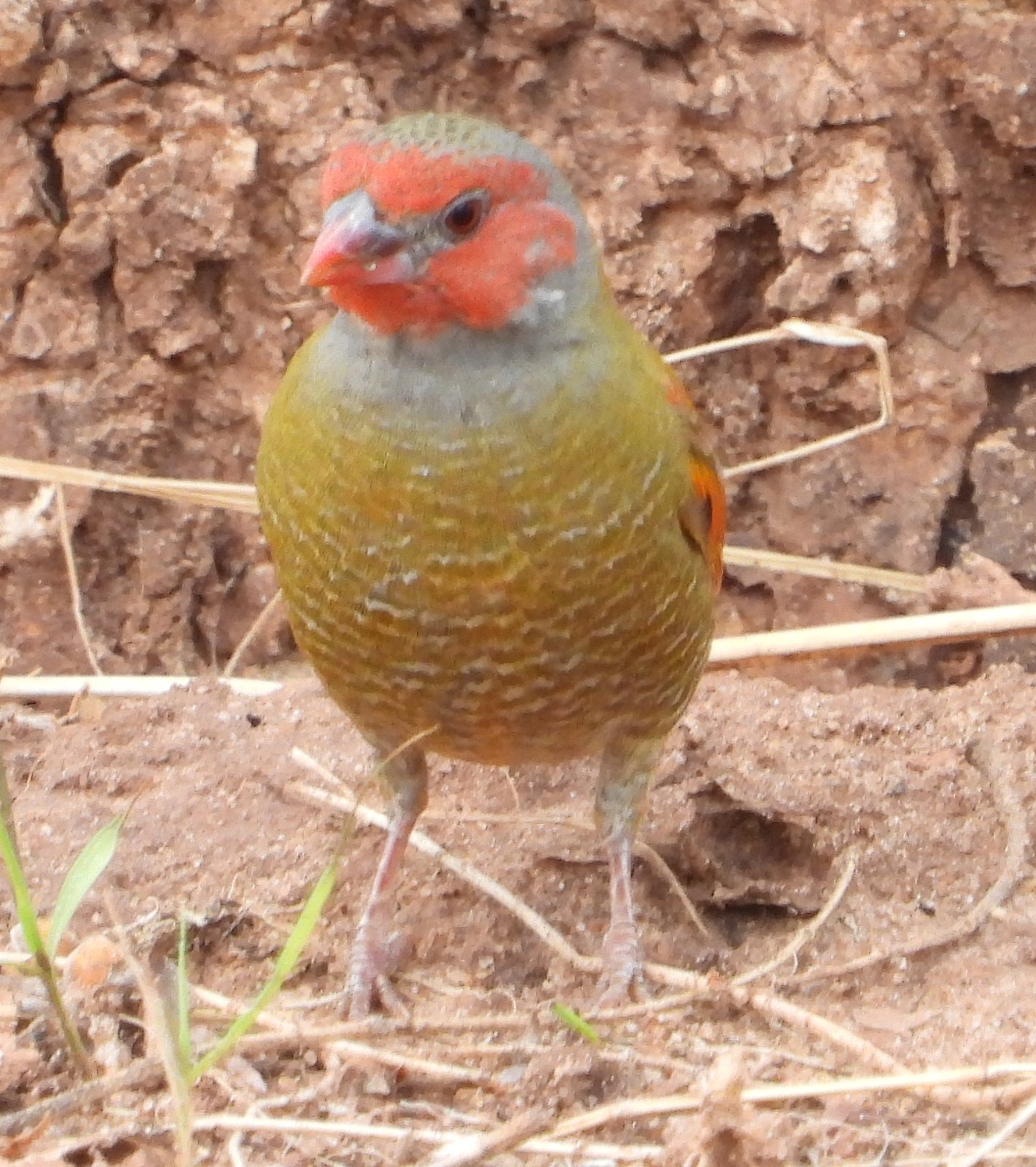
The Orange-Winged Pytilia is the pytilia of miombo and broadleaved woodland, recognised by its orange wing panel. It is the host of the Broad-Tailed Paradise Whydah and is less common and more retiring than the related Green-Winged Pytilia.
Voice
A soft, plaintive whistle, seeeh, sometimes double-toned, and a short chik. The song is a series of whistles, trills and chattering notes, simpler than that of Green-Winged Pytilia. Males of the Broad-Tailed Paradise Whydah mimic this song.
Recording: Thibaut Chansac — CC BY-NC-SA 4.0 · converted to mono · xeno-canto
Identification
11–13 cm, with a short, red conical bill. The male has a scarlet mask over forehead, lores, cheeks and chin, a grey crown, nape and throat and an olive-golden back; the flight feathers and greater coverts have broad orange edges, so that the closed wing looks orange. The breast is olive-yellow, the belly barred grey and white; rump and tail are dark red. The female lacks the red mask, is greyer on head and breast and has a duller orange wing. Juveniles are plain grey-olive with an orange tinge in the wing.
Confusion species
Green-Winged Pytilia (Pytilia melba) has green wings without orange; in the male the red extends over the throat onto the upper breast and the bill is longer. The female Green-winged is barred up to the breast. Green-winged lives mainly in dry thornveld, Orange-winged in broadleaved woodland; in transition zones the two occur together. Wing colour is always decisive.
Habitat
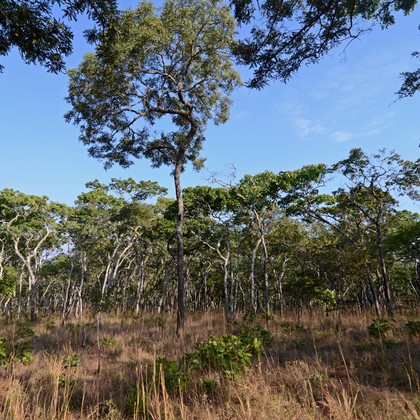
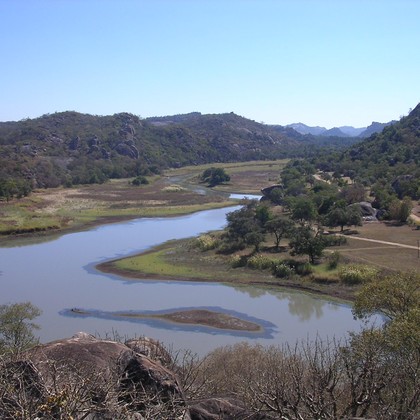
Miombo, mopane and mixed broadleaved woodland with dense bushes and rank grass, riverine forest edges and scrub along small streams. It lives unobtrusively in pairs or small groups and forages on the ground at the edge of cover for grass seeds and termites.
Where the bird is most at home, classified by the vegetation units of southern Africa.
Range and movements
Zambia, Malawi, Zimbabwe (mainly the north, east and Zambezi Valley), central and northern Mozambique and northern and central Angola; scarce in northern Botswana (Chobe), the Zambezi Region of Namibia and the north-eastern lowveld of South Africa (northern Kruger and Limpopo). Beyond the region from southern DR Congo and Tanzania north to Kenya, Uganda, South Sudan and Ethiopia.
- Resident
- dark = core range, pale = thinly spread
How and when to look
In Zimbabwe and Zambia best in the rains, when males sing from a low branch and Broad-Tailed Paradise Whydahs in breeding dress hang about in the same bushes. In South Africa the Pafuri area in northern Kruger is regarded as the most reliable site. Flush birds if you can: the orange wing panel and red rump are clearest in flight.
Conservation status
Not threatened; widespread but generally scarce and inconspicuous. In South Africa it is at the edge of its range and rare. It is parasitised by the Broad-Tailed Paradise Whydah.
Scientific name
Pytilia afra | (Gmelin, 1789)
Gmelin described the species in 1789 as Fringilla afra; because it was later moved to another genus, the author and year stand in brackets. The genus Pytilia was introduced in 1837 by Swainson. Pytilia is a diminutive of Pitylus, a genus name introduced by Cuvier for grosbeaks — thus 'little grosbeak'. afra is Latin for 'African', from Afer, 'an African'. The specimen the first description was based on came from Angola.