All species › Passerines › Waxbills › Magpie Mannikin
Magpie Mannikin | Spermestes fringilloides
Reuzenekstertje | Capuchino Pío
The Magpie Mannikin is the largest mannikin in Africa, a black-headed, white and brown estrildid with a strikingly heavy bill. It is a wanderer that goes unnoticed for long periods and then suddenly appears in numbers where bamboo or certain grasses are seeding.

Voice
A louder, lower and fuller chip or pee-oo than the other mannikins, often repeated in flight. The song is a soft, scratchy twittering with whistled notes.
Recording: Jonathan Onongo — CC BY-NC-SA 4.0 · converted to mono · xeno-canto
Identification
11–13 cm, robust, with a large, deep, blue-grey to blackish bill, darker on the upper mandible. Head, throat and nape are glossy blue-black; back and wings are dark brown with fine pale shaft streaks, rump and tail black. The underparts are bright white, with a conspicuous patch of black and rufous-brown feathers on the breast sides and flanks. The sexes are alike. Juveniles are brown above, pale dull white below, with a dark bill and no black hood.
Confusion species
Bronze Mannikin (Spermestes cucullata) is much smaller, with a finer, two-toned bill, a glossy green shoulder patch and finely barred flanks without a rufous patch. Black-and-White Mannikin (Spermestes bicolor) is also smaller, with a chestnut-red back and black-and-white barred flanks. The heavy bill, the size and the flank patch are decisive; in mixed flocks the Magpie Mannikin stands out at once as the bulkiest bird.
Habitat
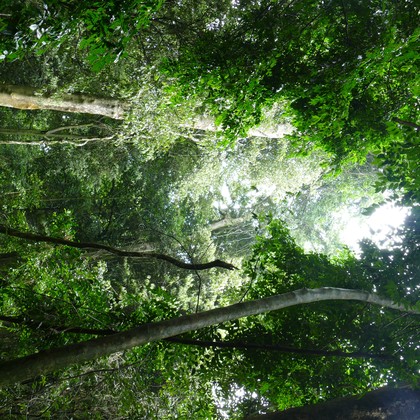
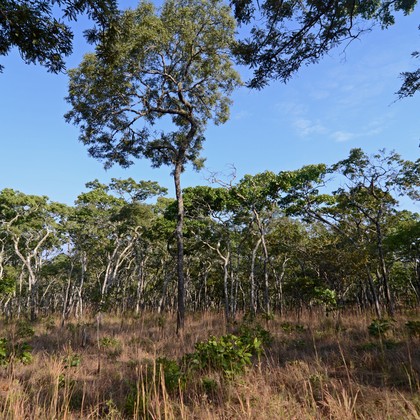
Edges of lowland and riverine forest, bamboo stands, dense thickets along rivers, woodland edges in miombo and overgrown fields and gardens at the forest edge. It eats mainly hard seeds, especially bamboo seed, but also rice and other grasses. It lives in pairs or small parties, in larger flocks when seed is abundant.
Where the bird is most at home, classified by the vegetation units of southern Africa.

Range and movements
Local and irregular in the north and east of the region: Angola, northern and eastern Zambia, Malawi, Mozambique and eastern Zimbabwe; in South Africa only as a rare vagrant or irregularly in north-eastern KwaZulu-Natal. Beyond the region patchily from Senegal to Kenya and south through Central and East Africa.
- Resident
- Summer visitor (c. Oct–Mar)
- Winter visitor (c. Apr–Sep)
- Passage (Mar–Apr, Oct–Nov)
- dark = core range, pale = thinly spread
How and when to look
Best found where bamboo or riverside grass is seeding: listen for the loud call, which stands out among the soft twittering of Bronze Mannikins. Records in the south of the region are often short-lived; anyone hearing of a report needs to be quick.
Conservation status
Not threatened, but scarce and local in the region. Because of its nomadic habits and its dependence on irregularly seeding bamboo, numbers fluctuate strongly. Loss of riverine forest and forest edges is the main threat.
Scientific name
Spermestes fringilloides | (de Lafresnaye, 1835) (GBIF: Lonchura fringilloides)
De Lafresnaye described the species in 1835 as Plocus fringilloides; because it was later moved to another genus, the author and year stand in brackets. The genus Spermestes was introduced in 1837 by Swainson. Spermestes comes from the Greek sperma, 'seed', and -estēs, 'eater' (from esthiō, 'to eat') — for the diet of grass seeds. fringilloides comes from the Latin fringilla, 'finch', and the Greek -oidēs, 'resembling' — hence 'finch-like'. The specimen the first description was based on came from Liberia (originally India in error).