All species › Passerines › Waxbills › Black-and-White Mannikin
Black-and-White Mannikin | Spermestes bicolor
Glansekstertje | Capuchino Bicolor
The Black-and-White Mannikin is a small black, white and chestnut estrildid of forest edges and clearings in moist forest. Over most of the region it is represented by the red-backed form nigriceps, which some authors treat as a separate species.

Voice
A soft, whistled cheep or twee-twee, higher and purer than the buzzing calls of Bronze Mannikin. The song is a soft series of squeaky and scratchy notes.
Recording: Rod Cassidy — CC BY-NC-SA 4.0 · converted to mono · xeno-canto
Identification
9–10 cm, with a conical, blue-grey bill. In the form nigriceps (from South Africa to Malawi and eastern Zambia) head, throat and breast are glossy black, back and scapulars warm chestnut-red, rump and tail black with fine white barring on the rump, and the flight feathers black with small white spots. The belly is white and the flanks barred black and white. In Angola and north-western Zambia forms with a dark brown to black back occur. The sexes are alike. Juveniles are plain dark brown above and dull buff-brown below.
Confusion species
Bronze Mannikin (Spermestes cucullata) has a dull brown back, a two-toned bill, a small green shoulder patch and a browner, less extensive hood. Magpie Mannikin (Spermestes fringilloides) is larger, with a much heavier bill, a brown back with pale streaks and a rufous-brown flank patch. In the south of the region the chestnut-red back is the decisive feature.
Habitat
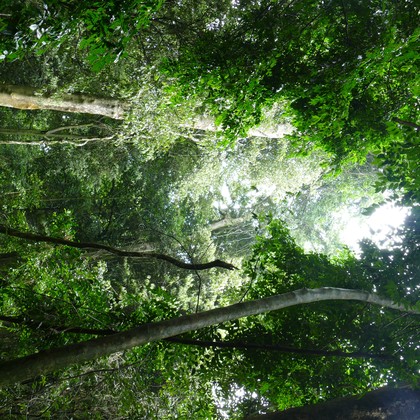
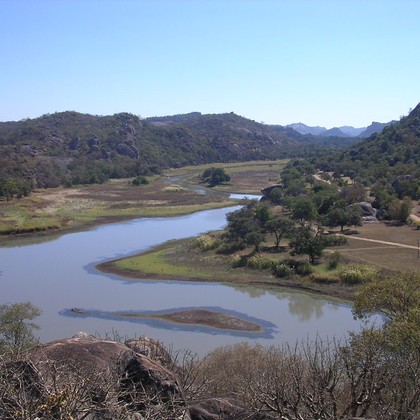
Edges of coastal, lowland and riverine forest, clearings in moist forest, dense thickets, well-wooded gardens and overgrown field margins. It feeds in small parties in grassy margins and the shrub layer, also plucking seeds directly from grass heads. It roosts in groups in grass nests.
Where the bird is most at home, classified by the vegetation units of southern Africa.

Range and movements
In the east and north of the region: the coastal belt of the Eastern Cape and KwaZulu-Natal, Eswatini, Mozambique, eastern Zimbabwe, Malawi and Zambia (mainly the east and north), and northern and western Angola. Beyond the region from West Africa to Ethiopia and south through East Africa.
- Resident
- Summer visitor (c. Oct–Mar)
- Winter visitor (c. Apr–Sep)
- Passage (Mar–Apr, Oct–Nov)
- dark = core range, pale = thinly spread
How and when to look
Best seen at the edge of coastal forest in KwaZulu-Natal or in well-wooded gardens in eastern Zimbabwe, often together with Bronze Mannikins. In any party of mannikins always check the back colour: a chestnut-red back among the brown ones stands out at once in good light.
Conservation status
Not threatened; locally fairly common, but vulnerable to the loss of coastal and riverine forest. In South Africa it is confined to a narrow coastal strip under pressure.
Scientific name
Spermestes bicolor | (Fraser, 1843) (GBIF: Lonchura bicolor)
Fraser described the species in 1843 as Amadina bicolor; because it was later moved to another genus, the author and year stand in brackets. The genus Spermestes was introduced in 1837 by Swainson. Spermestes comes from the Greek sperma, 'seed', and -estēs, 'eater' (from esthiō, 'to eat') — for the diet of grass seeds. bicolor is Latin for 'two-coloured' — for the sharp contrast between the glossy black upperparts and the white belly. The specimen the first description was based on came from Cape Palmas, Liberia.