All species › Passerines › Waxbills › Red-Headed Bluebill
Red-Headed Bluebill | Spermophaga ruficapilla
Roodkopblauwsnavel | Estrilda Piquigorda Cabecirroja
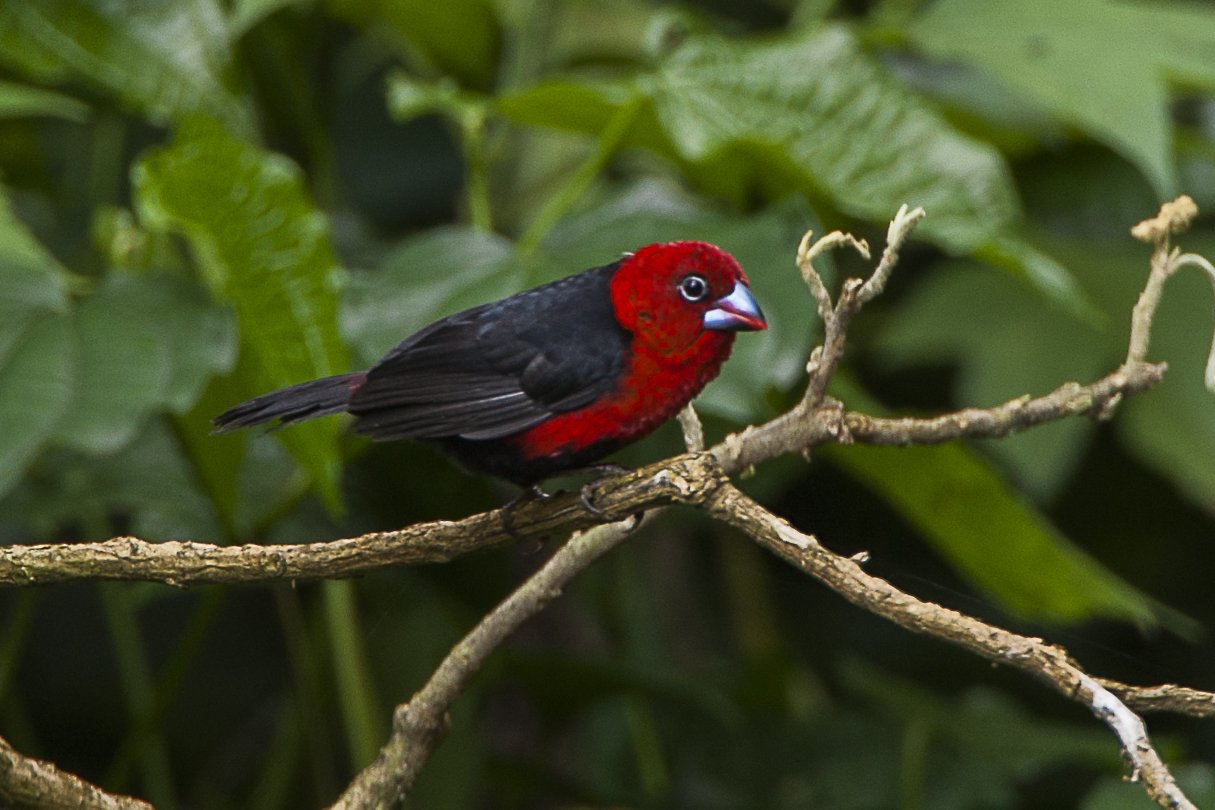
The Red-Headed Bluebill is a bulky, shy waxbill of tropical forest undergrowth, with a heavy, glossy steel-blue bill tipped red. Within the region it occurs only in the forests of north-western Angola, where it is one of the sought-after species of the escarpment forest.
Voice
A high, sharp tseet as a contact call and a dry, rapid chek-chek in alarm. The song is a soft, flowing series of high whistles running into a trill, often barely audible above the sounds of the forest.
Recording: Jonathan Onongo — CC BY-NC-SA 4.0 · converted to mono · xeno-canto
Identification
14–15 cm, stocky, with a heavy conical bill that is metallic blue with a red tip and red cutting edges. The male has a crimson head, throat and breast and red flanks; back and wings are dark slate to blackish, the belly is black, rump and uppertail coverts are red and the tail is black. The female has the same red head and breast, but the black belly and flanks are densely spotted with white. Juveniles are plain dark grey-brown with a duller bill and only a hint of red on the rump. It keeps low in the undergrowth and feeds much on the ground.
Confusion species
Black-Bellied Seedcracker (Pyrenestes ostrinus) also has a red head and breast on a black body, but an even heavier, blue-black bill without a red tip and a red rather than black tail; the female is brown with red on the head and rump and lacks white spots. No other bluebills occur in the region. Bill colour, tail colour and the white spots of the female always settle it.
Habitat
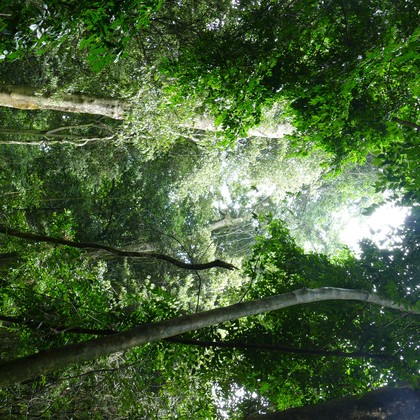
Undergrowth, edges and clearings of moist lowland and escarpment forest, gallery forest and dense thickets along forest streams, also overgrown coffee plantations under shade trees. It forages alone or in pairs on or just above the ground for the seeds of grasses and sedges, and also takes insects.
Where the bird is most at home, classified by the vegetation units of southern Africa.

Range and movements
Within the region only in Angola: the escarpment forests of Cuanza Sul (including around Gabela and Kumbira) and the forests of Cuanza Norte, Uíge and Malanje. Beyond the region from the Central African Republic and South Sudan through eastern DR Congo, Uganda, Rwanda and Burundi to western Kenya and Tanzania.
- Resident
- dark = core range, pale = thinly spread
How and when to look
In Kumbira Forest and around Gabela, search early in the morning along forest trails and clearings with seeding grasses, where birds of the undergrowth briefly come out into the open. The species is shy and dives for cover at once when disturbed; wait quietly near the spot where a bird vanished. The high tseet usually gives the bird away before the red does.
Conservation status
Not threatened and locally common in East Africa. In Angola the range is small and fragmented; clearance of escarpment forest for farming and the loss of old shade coffee are the main threats there.
Scientific name
Spermophaga ruficapilla | (Shelley, 1888)
Shelley described the species in 1888 as Spermospiza ruficapilla; because it was later moved to another genus, the author and year stand in brackets. The genus Spermophaga was introduced in 1837 by Swainson. Spermophaga comes from the Greek sperma, 'seed', and -phagos, '-eating' — 'seed-eater', for the heavy bill and seed-rich diet. ruficapilla comes from the Latin rufus, 'red', and capillus, 'hair of the head' — for the red head. The specimen the first description was based on came from Bellima, Uele district, DR Congo.