All species › Waders, gulls and terns › Gulls and terns › Brown Noddy
Brown Noddy | Anous stolidus
Noddy | Tiñosa Común
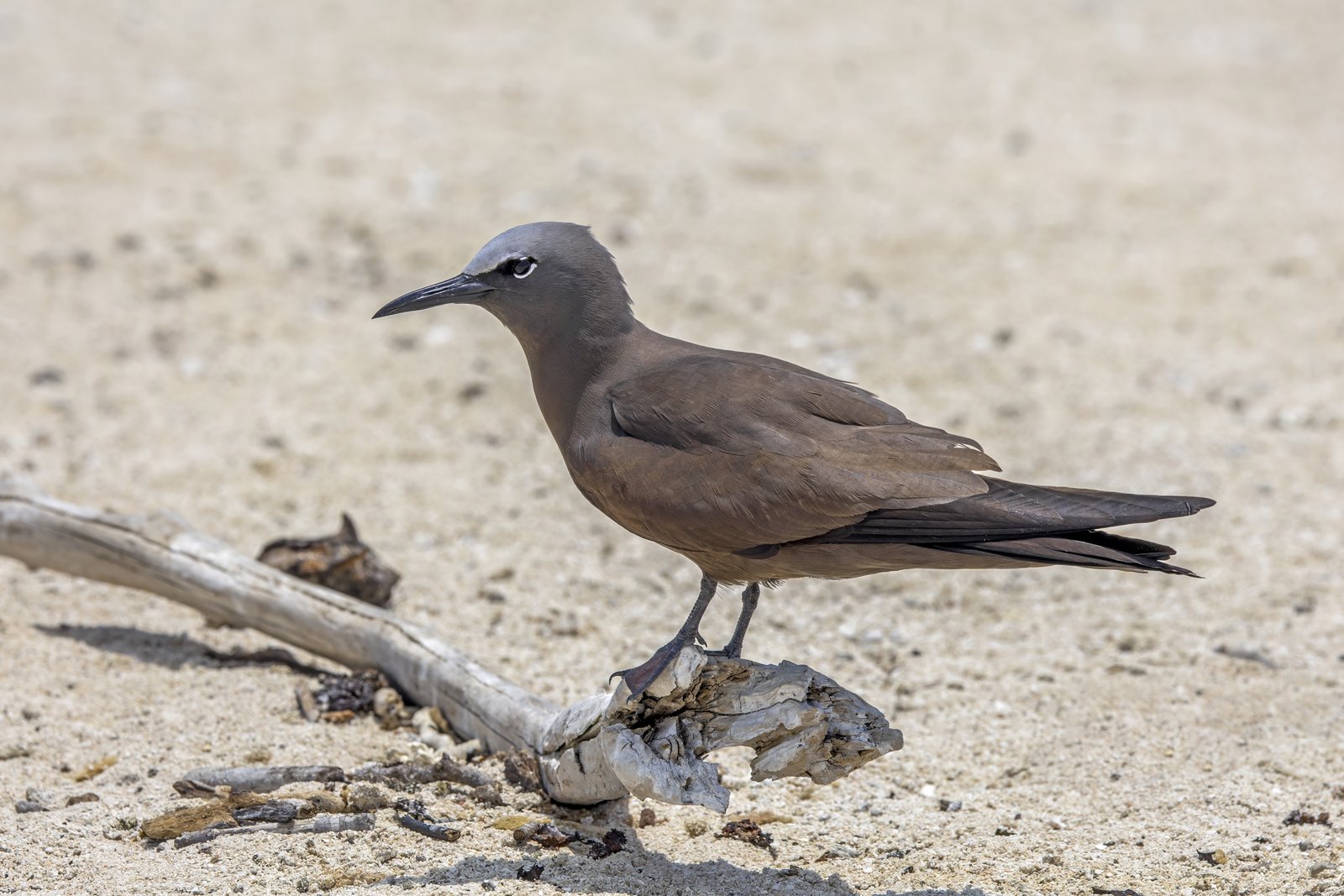
The Brown Noddy is a dark brown tern of tropical oceans, with a greyish-white crown and a wedge-shaped, unforked tail. In southern Africa it is a rare visitor that turns up mainly after cyclones off Mozambique and KwaZulu-Natal.
Voice
Usually silent at sea. At colonies a low, rasping, crow-like kraa or karrk and a soft growling chatter.
Recording: Alexander Schlatmann — CC BY-NC-SA 4.0 · converted to mono · xeno-canto
Identification
About 42 cm, a fairly large, uniform chocolate-brown tern with long wings and a long, wedge-shaped tail with a small central notch. The forehead and crown are greyish white, grading into the grey hindcrown; a narrow black loral line and a white crescent below the eye. In flight the paler brown underwing coverts contrast with the dark flight feathers, and the upperwing coverts are slightly paler than the primaries. The bill is black, stout and slightly decurved; the legs are blackish brown. Juveniles have a brownish crown and pale fringes to the coverts.
Confusion species
Lesser Noddy (Anous tenuirostris) is smaller and slighter, with a longer, thinner bill, a paler, greyer head sharply demarcated from the dark neck, and uniformly dark underwings without contrast. Juvenile Sooty Terns (Onychoprion fuscatus) are also dark brown, but have pale spots on the upperparts, a pale belly and undertail coverts and a deeply forked tail.
Habitat
Warm tropical ocean, often far offshore. It feeds in flocks over shoals of predatory fish and tuna that drive small fish and squid to the surface, picking prey from the surface in a brief dip or while fluttering. It rests on driftwood, buoys and ships. It breeds on rocky and coral islands, on ledges, in bushes and low in trees.
Where the bird is most at home, classified by the vegetation units of southern Africa.


Range and movements
In the region a rare visitor off Mozambique and KwaZulu-Natal, often after severe storms or cyclones in the Mozambique Channel; a few records farther south and exceptionally off the west coast. The nearest colonies lie off the coast of Tanzania, in the Seychelles and elsewhere in the western Indian Ocean. Elsewhere in all tropical oceans, in the Atlantic among others on St Helena and Ascension.
How and when to look
The best chance is on pelagic trips off Ponta do Ouro or from the coast at Durban and Richards Bay shortly after a summer cyclone. Look for a dark brown tern with a pale crown moving low over the waves, sometimes with a group of Sooty Terns.
Conservation status
Not threatened. The world population is large and spread over tropical islands. Locally colonies have suffered from introduced rats and cats, egg collecting and disturbance; eradication of predators on breeding islands has allowed several colonies to recover.
Scientific name
Anous stolidus | (Linnaeus, 1758)
Linnaeus described the species in 1758 as Sterna stolida; because it was later moved to another genus, the author and year stand in brackets. The genus Anous was introduced in 1826 by Stephens. Anous is Greek for 'stupid, silly' — for the tameness with which noddies allowed sailors to approach and catch them. stolidus is Latin for 'stupid, dull' — for the birds' tameness, which made them easy to catch at sea. The specimen the first description was based on came from West Indies.