All species › Passerines › Chats and flycatchers › Brown Scrub Robin
Brown Scrub Robin | Tychaedon signata
Bruine waaierstaart | Alzacola Pardo
The Brown Scrub Robin is a large, dark scrub robin of the dim forest floor in eastern South Africa, Eswatini and southern Mozambique. It lives hidden in dense undergrowth and is almost always first identified by its loud, clear song.

Voice
The song is a loud, clear and melancholy series of whistles, twee-choo-choo-tee, repeated with slightly different phrases, and it often sounds ventriloquial from the undergrowth. The bird sings most at dawn and dusk. The call is a hoarse krrr and a soft tchik.
No recording with a suitable Creative Commons licence is available for this species yet.
Identification
A robust scrub robin of 18 to 19 cm, the largest in the region. The upperparts are plain olive-brown to dark brown, without a rufous rump. A short white supercilium above the lores, a white mark below the eye and a white throat with a dark malar stripe form the head pattern. The wing coverts bear two narrow white lines. The breast and flanks are grey-brown and the belly off-white. The tail is dark brown with small white corners. The sexes are alike. The subspecies tongensis of Maputaland is smaller and paler brown, with warmer buff underparts and a more obvious supercilium and malar stripe.
Confusion species
Bearded Scrub Robin (Tychaedon quadrivirgata) has a rufous rump, orange-buff breast and flanks and a boldly black-and-white striped head; it lives in dry thicket and sand forest, not on the dark forest floor. White-Starred Robin (Pogonocichla stellata) is yellow below with a slate-grey head. Red-Capped Robin-Chat (Cossypha natalensis) and Chorister Robin-Chat (Cossypha dichroa) are orange below. Song and habitat are decisive.
Habitat
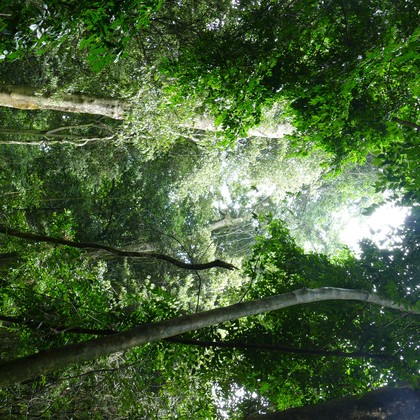
Undergrowth and floor of coastal forest, sand forest and dune forest, and inland of Afromontane forest and wooded ravines, always where there is a dense shrub layer and deep leaf litter. Forages on the ground by rummaging through leaf litter for insects, spiders and other invertebrates.
Where the bird is most at home, classified by the vegetation units of southern Africa.

Range and movements
Endemic to the south-east of the region. The nominate signata lives in the coastal and montane forests of the Eastern Cape and KwaZulu-Natal and the escarpment forests of Mpumalanga and Limpopo; tongensis inhabits the sand forest of Maputaland in northern KwaZulu-Natal and adjacent southern Mozambique. Also in eastern Eswatini. The species occurs nowhere outside this area.
- Resident
- Summer visitor (c. Oct–Mar)
- Passage (Mar–Apr, Oct–Nov)
- dark = core range, pale = thinly spread
How and when to look
Good sites are Dlinza Forest at Eshowe, the forests of iSimangaliso, Ngoye and Oribi Gorge, and the escarpment forests of Mpumalanga and Limpopo. Walk slowly along a forest trail early in the morning, listen for the song and watch for movement in the leaf litter: the bird often forages right beside the path.
Conservation status
Not threatened. The species is locally common but depends on forest with an intact shrub layer. Clearance of coastal forest for development and farming, cutting of undergrowth and overgrazing of forest edges have badly fragmented its habitat in parts of KwaZulu-Natal and the Eastern Cape.
Scientific name
Tychaedon signata | (Sundevall, 1850)
Sundevall described the species in 1850 as Cossypha signata; because it was later moved to another genus, the author and year stand in brackets. The genus Tychaedon was introduced in 1917 by Richmond. Tychaedon combines the Greek tukhē, 'chance, luck', with aēdōn, 'nightingale, songstress'; the name replaced the preoccupied Aedonopsis in 1917. signata is Latin for 'marked' — for the white markings in the wing and tail. The specimen the first description was based on came from Umhlanga, KwaZulu-Natal, South Africa.