All species › Passerines › Chats and flycatchers › Bearded Scrub Robin
Bearded Scrub Robin | Tychaedon quadrivirgata
Streepkopwaaierstaart | Alzacola Bigotudo
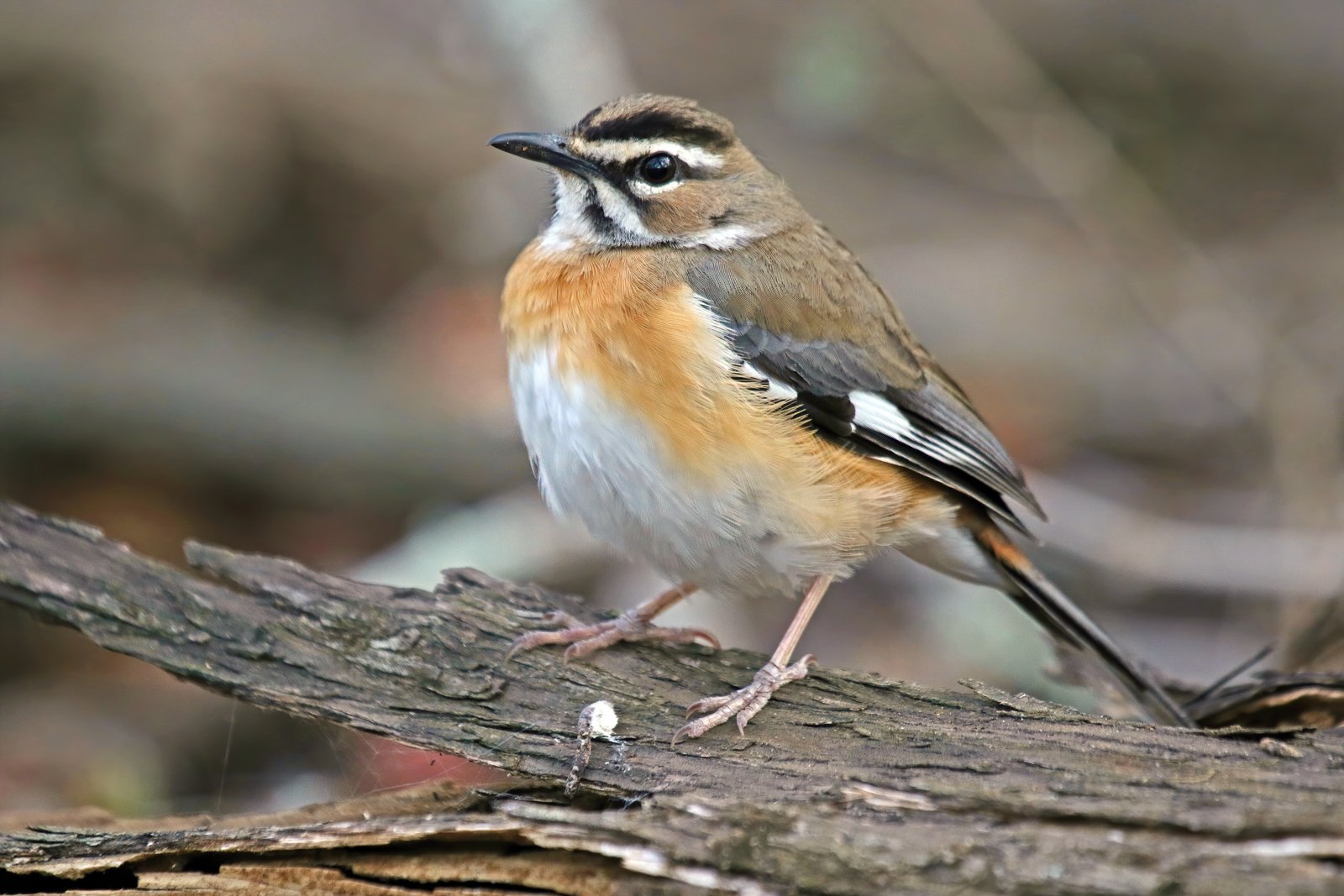
The Bearded Scrub Robin is the scrub robin of dense thicket and dry woodland in the lowveld of the east of the region. With its black-and-white striped head and warm orange flanks it is the most colourful of the group, and its rich, loud song is a characteristic sound of the bushveld.
Voice
The song is a rich, loud series of varied whistled phrases, often with repeated motifs and imitations of other birds, such as chee-choo-chee-chooee, delivered from a high, hidden perch in a tree above the thicket. It sings mainly in the breeding season, from September to January, and also in the heat of the day. The alarm is a harsh chrr or tchik-tchik.
No recording with a suitable Creative Commons licence is available for this species yet.
Identification
A medium-sized scrub robin of 17 cm. The upperparts are brown with a rufous rump and uppertail coverts. The head has a broad white supercilium topped by a black lateral crown stripe, a black eye-stripe, a white throat and a black malar stripe: four dark stripes, to which the scientific name quadrivirgata refers. There are two narrow white lines on the wing. Breast and flanks are orange-buff and the belly white. The tail is blackish with white tips. The sexes are alike.
Confusion species
Miombo Scrub Robin (Tychaedon barbata) is very similar but darker and more olive above, with a broader black malar stripe and richer orange on the breast; it lives in miombo and overlaps only locally in Malawi, Zambia and Mozambique. White-Browed Scrub Robin (Cercotrichas leucophrys) has a streaked breast and lives in open savanna. Brown Scrub Robin (Tychaedon signata) is darker and greyer below with no orange, and lives on the forest floor. Focus on habitat and range.
Habitat
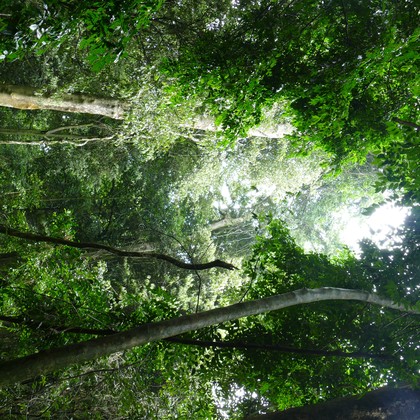
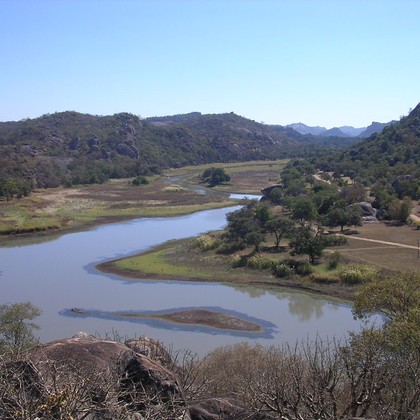
Dense thicket, sand forest, dry lowland forest and riverine forest, and the understorey of mopane and mixed woodland at low elevations, often around termite mounds with dense bushes. Forages on the ground through leaf litter and along thicket edges for insects, spiders and other invertebrates.
Where the bird is most at home, classified by the vegetation units of southern Africa.

Range and movements
In the region in Mozambique, eastern and northern Zimbabwe (Zambezi valley and lowveld), eastern Zambia (Luangwa valley), southern Malawi, northern Botswana (Okavango and Chobe) and the Caprivi in Namibia, and in South Africa in the lowveld of Limpopo and Mpumalanga (Kruger) and Maputaland in northern KwaZulu-Natal, as well as Eswatini. Beyond the region along the east coast of Africa north to Kenya and Somalia.
- Resident
- Summer visitor (c. Oct–Mar)
- Winter visitor (c. Apr–Sep)
- Passage (Mar–Apr, Oct–Nov)
- dark = core range, pale = thinly spread
How and when to look
In Kruger, Punda Maria, Pafuri and the riverine forest along the Sabie are good sites; in Maputaland the sand forest of Mkhuze and Tembe. Listen for the loud song and look high in the tree, not in the shrub layer. In the Okavango it is numerous in riverine forest around islands.
Conservation status
Not threatened. The species is locally common and the population is stable. Clearance of dry lowland forest and sand forest for charcoal and farming in Mozambique and Maputaland threatens local populations.
Scientific name
Tychaedon quadrivirgata | (Reichenow, 1879) (GBIF: Erythropygia quadrivirgata)
Reichenow described the species in 1879 as Thamnobia quadrivirgata; because it was later moved to another genus, the author and year stand in brackets. The genus Tychaedon was introduced in 1917 by Richmond. Tychaedon combines the Greek tukhē, 'chance, luck', with aēdōn, 'nightingale, songstress'; the name replaced the preoccupied Aedonopsis in 1917. quadrivirgata is Latin for 'four-striped', from quadri-, 'four', and virgatus, 'striped' — for the head stripes. The specimen the first description was based on came from Kipini, lower Tana River, Kenya.