All species › Passerines › Chats and flycatchers › Miombo Scrub Robin
Miombo Scrub Robin | Tychaedon barbata
Baardwaaierstaart | Alzacola Barbudo
The Miombo Scrub Robin is the scrub robin of miombo woodland in the north of the region. It lives in dense bushes and undergrowth between the miombo trees and, like its sister species in the lowveld, sings loudly and melodiously from a tall tree.
Voice
The song is a loud, clear and varied series of whistled phrases with repeated motifs and mimicry, very like that of Bearded Scrub Robin, from a hidden song post high in a miombo tree. The call is a harsh, hoarse chrr, with a sharp tchik in alarm.
No recording with a suitable Creative Commons licence is available for this species yet.
Identification
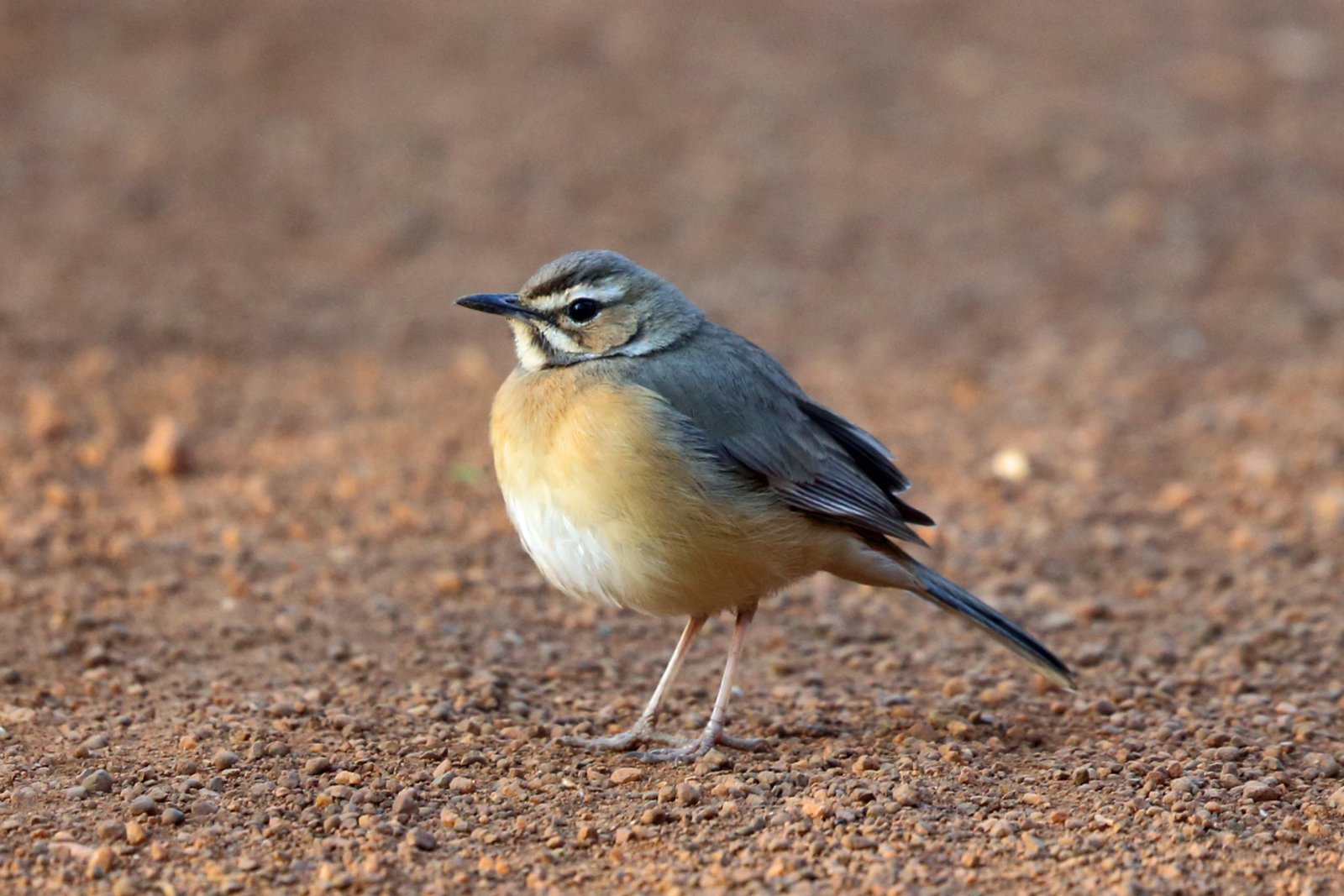
A medium-sized scrub robin of 17 cm. The upperparts are dark olive-brown with a rufous rump. The head is boldly marked: a white supercilium with a black stripe above it, a black eye-stripe, a white throat and a broad black malar stripe. There are two narrow white lines on the wing. The breast and flanks are warm orange-brown and the belly white. The tail is blackish with white tips. The sexes are alike.
Confusion species
Bearded Scrub Robin (Tychaedon quadrivirgata) is very similar but paler and warmer brown above, with a narrower malar stripe and paler orange on the breast; it lives in low-lying thicket, sand forest and riverine forest, whereas Miombo Scrub Robin is tied to miombo. Where both occur, in Malawi, eastern Zambia and northern Mozambique, habitat and elevation are the best guide. White-Browed Scrub Robin (Cercotrichas leucophrys) has a streaked breast and lives in open savanna. In western Angola, Forest Scrub Robin (Tychaedon leucosticta) lives in dense forest and shows rows of white wing spots.
Habitat
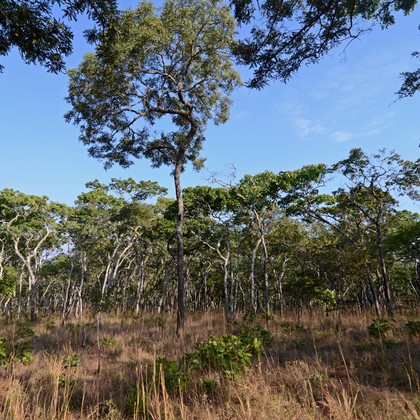
Miombo woodland with a dense shrub layer, especially around termite mounds with thicket, in small ravines and along the edges of dambos and streamside woodland within miombo. Forages on the ground for insects and other invertebrates, usually under cover.
Where the bird is most at home, classified by the vegetation units of southern Africa.
Range and movements
In the region in central and eastern Angola, much of Zambia, Malawi (mainly in the centre and north) and northern Mozambique (Niassa and surroundings). The southernmost occurrence is at the edge of the miombo in northern Zimbabwe, where the species is reported only sparsely. Beyond the region in southern DR Congo and south-western Tanzania.
- Resident
- dark = core range, pale = thinly spread
How and when to look
In Zambia the miombo woodlands around Kasanka, Mutinondo and the Copperbelt are suitable; in Malawi, Dzalanyama and Nkhotakota. Listen in the early morning for the loud song, then scan high in the trees; when disturbed the bird dives into the dense bushes around termite mounds.
Conservation status
Not threatened. The species is locally common but depends on miombo with intact undergrowth. Large-scale clearance of miombo for charcoal, tobacco curing and farming, especially in Malawi and Zambia, is locally removing its habitat.
Scientific name
Tychaedon barbata | (Hartlaub & Finsch, 1870)
Hartlaub & Finsch described the species in 1870 as Cossypha barbata; because it was later moved to another genus, the author and year stand in brackets. The genus Tychaedon was introduced in 1917 by Richmond. Tychaedon combines the Greek tukhē, 'chance, luck', with aēdōn, 'nightingale, songstress'; the name replaced the preoccupied Aedonopsis in 1917. barbata is Latin for 'bearded' — for the dark malar stripe beside the white throat. The specimen the first description was based on came from Caconda, Benguela, Angola.