All species › Birds of prey › Hawks, eagles and kites › Brown Snake Eagle
Brown Snake Eagle | Circaetus cinereus
Bruine slangenarend | Culebrera Sombría
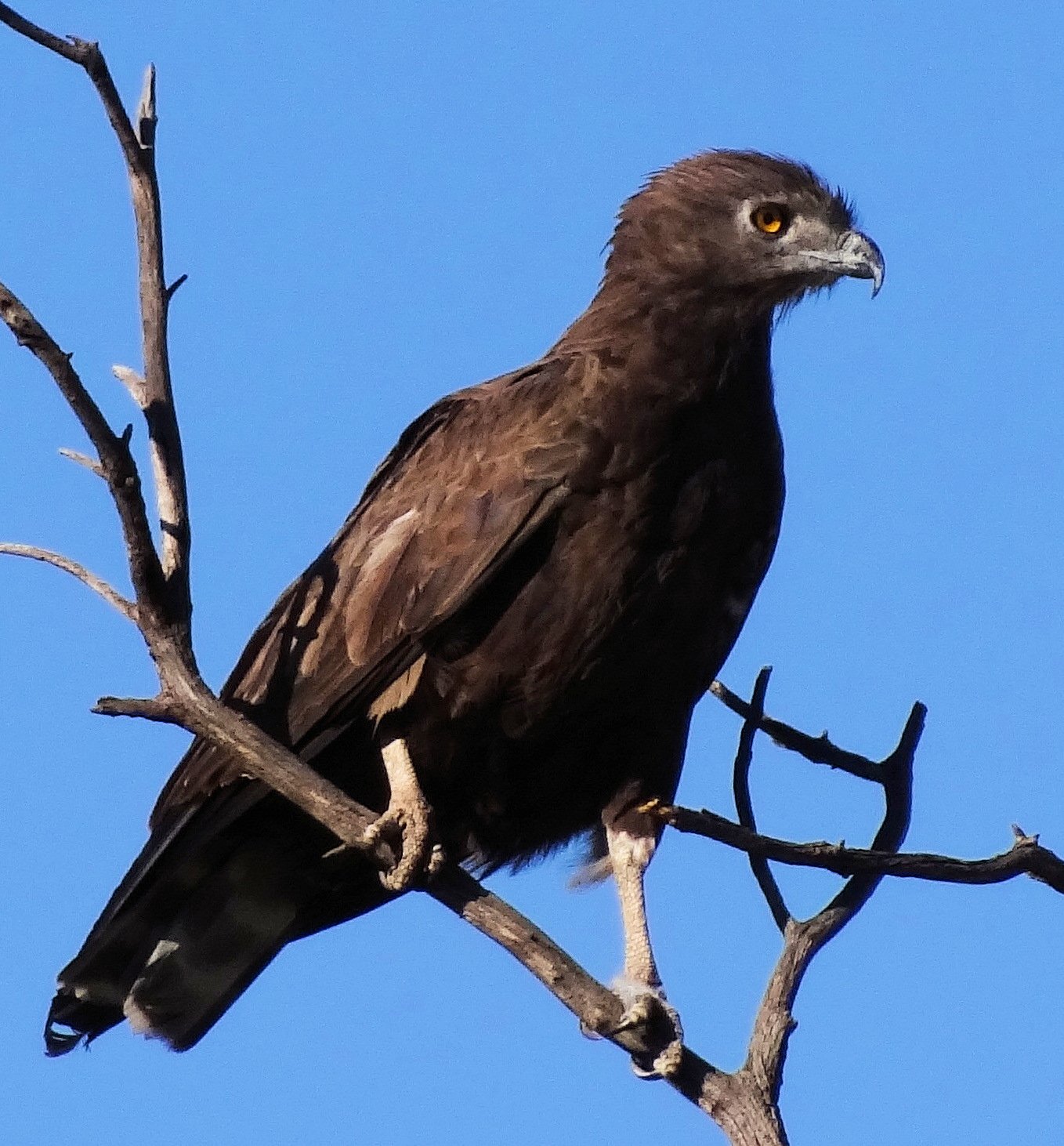
The Brown Snake Eagle is the largest snake eagle in the region: a uniform dark brown eagle with a large, round, owl-like head and bright yellow eyes, which sits upright for hours on the bare top of a tree. It also kills large venomous snakes such as cobras and mambas.
Voice
Mostly silent. Occasionally a hoarse, croaking hok-hok-hok-hok or a long, plaintive kaaaaow, mainly around the nest.
Recording: Donovan — CC BY-NC-SA 4.0 · converted to mono · xeno-canto
Identification
71–76 cm, wingspan 155–175 cm. Entirely dark chocolate-brown, with a large round head, big bright yellow eyes and long, bare, greyish-white legs. The tail is dark with three narrow greyish-white bands. In flight the dark underwing coverts contrast strongly with the silvery-grey, finely barred flight feathers; the wings are broad with a slightly rounded trailing edge. When perched, the upright stance and pale legs stand out. The sexes are alike. Juveniles are slightly paler and warmer brown, sometimes with white spotting on the head and belly.
Confusion species
Tawny Eagle (Aquila rapax) has feathered legs, a smaller head without big yellow eyes and a paler, more variable colour. Juvenile Black-Chested Snake Eagle (Circaetus pectoralis) is warmer rufous-brown and has a pale underwing. The juvenile Bateleur has a very short tail. Wahlberg's Eagle is smaller, with a narrow, square tail and a small crest.
Habitat
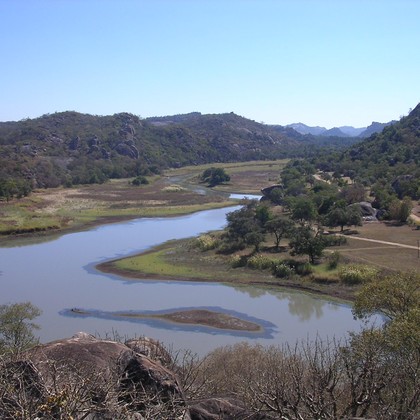
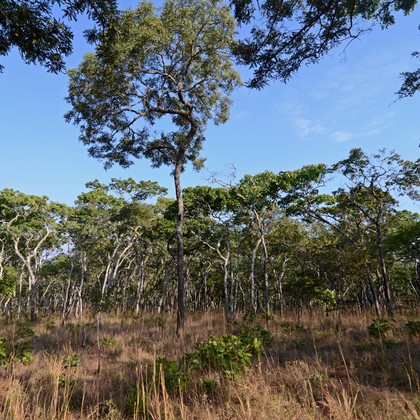
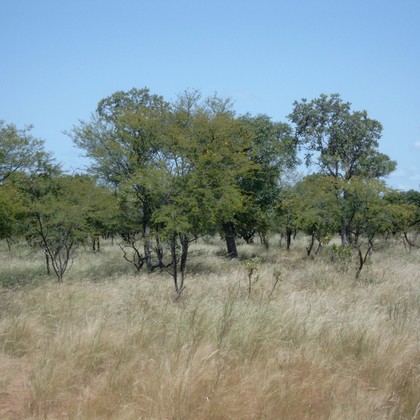
Wooded savanna and woodland: mixed broadleaf woodland, miombo, mopane and denser parts of acacia savanna, often on hills and along rivers. It avoids open grassland, desert and dense forest. It hunts from a high, exposed perch and drops onto its prey; snakes of more than two metres are killed. The nest is small and placed in the crown of a tree, sometimes an old nest of another raptor.
Where the bird is most at home, classified by the vegetation units of southern Africa.
Range and movements
Most of the region except the dry south-western deserts and the Karoo: the north and east of South Africa (Limpopo, Mpumalanga, KwaZulu-Natal, scarce in the Eastern Cape), Eswatini, Zimbabwe, Mozambique, Botswana, northern Namibia, Zambia, Malawi and Angola. Beyond the region throughout Africa south of the Sahara, from Senegal to Ethiopia and Somalia.
- Resident
- Summer visitor (c. Oct–Mar)
- Winter visitor (c. Apr–Sep)
- Passage (Mar–Apr, Oct–Nov)
- dark = core range, pale = thinly spread
How and when to look
In the Lowveld, as in Kruger, check every dead treetop along the road: an upright, dark eagle with an owl-like head and pale legs is almost certainly this species. The bird often sits for hours at the same spot. In flight the contrast between the dark coverts and the silvery flight feathers is easy to see.
Conservation status
Not threatened. Widespread, but everywhere at low density. Locally a victim of electrocution on power pylons and of the loss of woodland.
Scientific name
Circaetus cinereus | Vieillot, 1818
Vieillot described the species in 1818 and placed it straight away in the genus where it still stands. The genus Circaetus was introduced in 1816 by Vieillot. Circaetus is Greek, from kirkos, a kind of hawk, and aetos 'eagle'. cinereus is Latin for 'ash-grey', from cinis, 'ash' — for the uniformly dark grey-brown plumage. The specimen the first description was based on came from Senegal.