All species › Birds of prey › Hawks, eagles and kites › Black-Chested Snake Eagle
Black-Chested Snake Eagle | Circaetus pectoralis
Zwartborstslangenarend | Culebrera Pechinegra
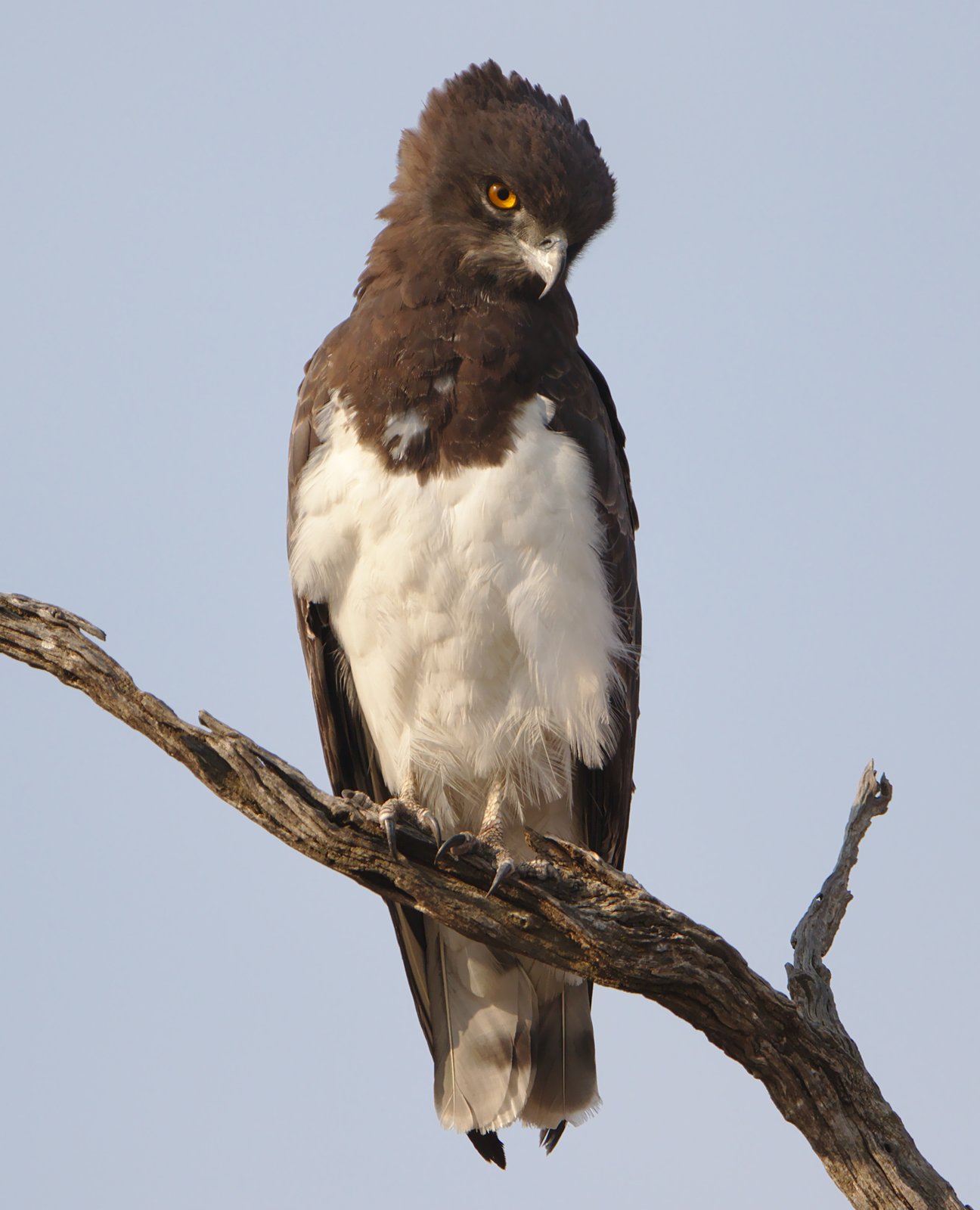
The Black-Chested Snake Eagle is the snake eagle of open country: a sizeable eagle with a black head and chest above a spotless white belly, which hovers high over grassland and savanna and then drops with dangling legs onto a snake. The big yellow eyes give it an owl-like stare.
Voice
Mostly silent. In the breeding season a melodious, whistled kwo-kwo-kwo-kweeeu, often in flight, and a soft kwo at the nest.
No recording with a suitable Creative Commons licence is available for this species yet.
Identification
63–68 cm, wingspan 160–185 cm. Head, breast and upperparts dark blackish brown; belly, thighs and undertail coverts pure white and unmarked. Large, bright yellow eyes in a round head; bare, greyish-white legs. In flight the underwing coverts are white and the flight feathers white with three to four narrow black bars; the tail has three broad dark bands. The sexes are alike, the female slightly larger. The juvenile is plain warm rufous-brown, with paler, rusty-brown underparts; immatures in their second and third year are blotched brown and white.
Confusion species
Martial Eagle (Polemaetus bellicosus) is much larger, with a dark underwing, small dark spots on the white belly and feathered legs. Brown Snake Eagle (Circaetus cinereus) is entirely dark brown, also below; young Black-Chested Snake Eagles are warmer rufous-brown and have a paler underwing. Osprey has a white head with a black eye-stripe.
Habitat
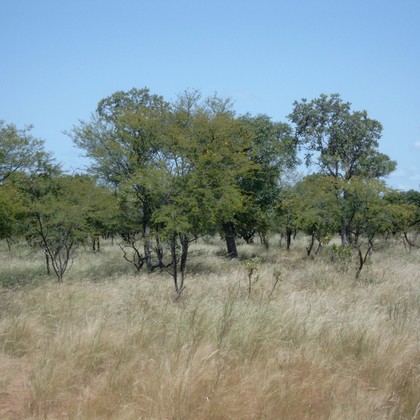
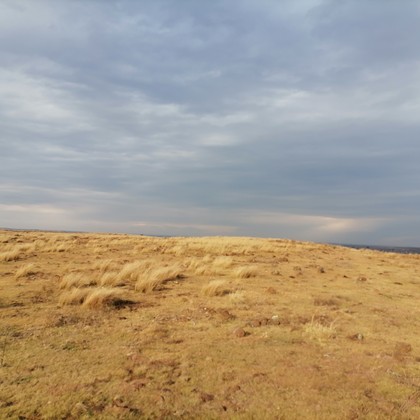
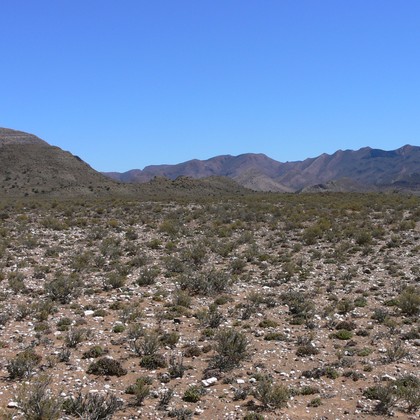
Open and semi-open country: acacia savanna, grassland, Karoo and semi-desert with scattered trees, also open woodland. It is the only eagle in the region that regularly hovers for long periods over one spot. It eats mainly snakes, including venomous ones, as well as lizards and occasionally small mammals. The nest is small and placed on top of a low, flat tree, often an acacia or euphorbia.
Where the bird is most at home, classified by the vegetation units of southern Africa.
Range and movements
Widespread over almost the whole region: South Africa (scarce in the Western Cape and the highest parts of the Drakensberg), Eswatini, Lesotho (rare), Namibia, Botswana, Zimbabwe, Mozambique, Zambia, Malawi and Angola. In dry years birds turn up outside their usual range. Beyond the region in East Africa to Ethiopia and Sudan.
- Resident
- Summer visitor (c. Oct–Mar)
- Winter visitor (c. Apr–Sep)
- Passage (Mar–Apr, Oct–Nov)
- dark = core range, pale = thinly spread
How and when to look
On drives through open savanna and grassland, watch for a large eagle hanging in the air on rapidly beating wings: that is almost always this species. Perched birds choose the top of a power pylon or a tree with a clear view. An unspotted white belly and bare legs separate it from Martial Eagle.
Conservation status
Not threatened. The species is widespread and fairly common. Locally, birds are killed by electrocution and collisions with power lines.
Scientific name
Circaetus pectoralis | Smith, 1829
Smith described the species in 1829 as Circaeetus pectoralis; because it was later moved to another genus, the author and year stand in brackets. The genus Circaetus was introduced in 1816 by Vieillot. Circaetus is Greek, from kirkos, a kind of hawk, and aetos 'eagle'. pectoralis is Latin for 'of the breast', from pectus — for the dark breast contrasting sharply with the white belly. The specimen the first description was based on came from South Africa (not specified).