All species › Passerines › Bushshrikes › Brubru
Brubru | Nilaus afer
Broebroe | Brubrú
The Brubru is a small, compact shrike of the treetops in savanna and woodland, with a broad white supercilium and a rufous stripe along the flank. It is best known for its call: a drawn-out rolling trill that carries through the bushveld like a distant telephone.

Voice
The male gives a drawn-out, level trill, trrrrrrrrr or prrrrrr-oo, lasting a few seconds and often repeated at long intervals. The female sometimes answers with a plaintive nasal tieuw, producing a duet. Also harsh rasping contact calls.
Recording: Kileo Jumah — CC0 · converted to mono · xeno-canto
Identification
14–15 cm. The male has a black crown and a black eye-stripe, separated by a broad white supercilium. The back is black with white spots and streaks, and the wing is black with a long white panel across the coverts and tertials. The underparts are white with a striking chestnut-rufous stripe along the flanks. The bill is short, thick and black with a small hook. The female is duller, dark brown instead of black, with less rufous on the flank and fine dark streaks on the throat and breast. Juveniles are browner and spotted. It searches leaves and twigs slowly and methodically in the canopy, often high in acacias.
Confusion species
Chinspot Batis Batis molitor and Pririt Batis Batis pririt are smaller and slimmer, with a grey back, a black breast band and no rufous flank stripe. Black-Backed Puffback Dryoscopus cubla lacks the white supercilium, has a red eye and grey-white flanks without rufous. Southern Fiscal Lanius collaris is larger, with a long tail, and perches openly on wires and branches.
Habitat
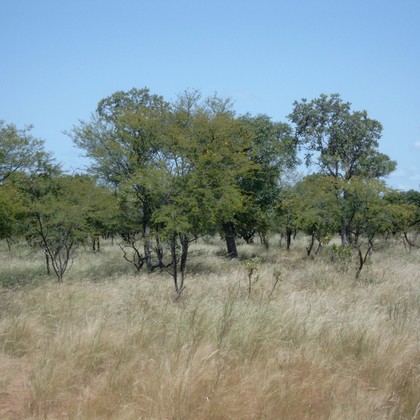
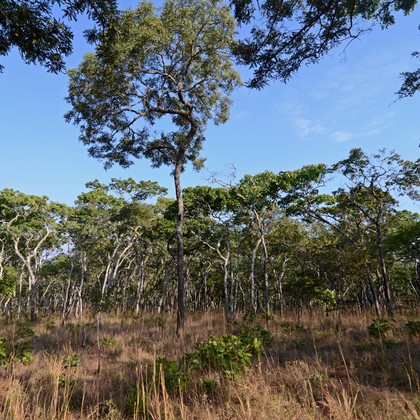
Open to semi-open woodland with tall trees: acacia savanna and thornveld, miombo, mopane and mixed woodland, as well as riverine woodland and large gardens in savanna areas. It forages in the canopy for caterpillars, beetles and other insects, and outside the breeding season joins mixed flocks of tits, batises and other shrikes. The nest is a small cup bound with cobweb in a horizontal fork high in a tree.
Where the bird is most at home, classified by the vegetation units of southern Africa.

Range and movements
Widespread in the north and east of the region: Angola, Zambia, Malawi, Mozambique, Zimbabwe, Botswana and Namibia (except the Namib), and in South Africa in Limpopo, Mpumalanga, North West, the Kalahari of the Northern Cape and northern KwaZulu-Natal; also in Eswatini. Absent from Lesotho, the Western Cape and most of the Karoo. Beyond the region it occurs in savanna over almost all of sub-Saharan Africa, from Senegal to Ethiopia and Somalia.
- Resident
- Summer visitor (c. Oct–Mar)
- Winter visitor (c. Apr–Sep)
- Passage (Mar–Apr, Oct–Nov)
- dark = core range, pale = thinly spread
How and when to look
Year-round; the trill is the best field mark and carries far. Follow the sound and search high in the crown of an acacia or mopane for a small bird that sits still for long spells and then shifts a short way. In the dry season it joins mixed foraging flocks, and anyone following such a flock often sees it at close range.
Conservation status
Not threatened; common to fairly common in suitable woodland and distributed over a very large range. Locally it suffers from the felling of large trees for firewood and agriculture, but there is no evidence of a marked decline.
Scientific name
Nilaus afer | (Latham, 1801)
Latham described the species in 1801 as Lanius afer; because it was later moved to another genus, the author and year stand in brackets. The genus Nilaus was introduced in 1827 by Swainson. Nilaus is an anagram of Lanius, the genus name of the true shrikes. afer is Latin for 'African'. The specimen the first description was based on came from Senegal.