All species › Passerines › Rockjumpers › Drakensberg Rockjumper
Drakensberg Rockjumper | Chaetops aurantius
Roodborstrotsspringer | Saltarrocas del Drakensberg
The Drakensberg Rockjumper is the high-mountain counterpart of the Cape Rockjumper: a long-tailed, boldly patterned bird that bounds over boulders and grassy slopes rather than flying. It lives in small family groups in which young from earlier broods help. The species is confined to Lesotho and the surrounding Drakensberg.
Voice
A high, piercing series of whistles, pee-pee-pee-pee, often slightly descending, carrying far across the slopes, though its direction is poorly defined. Group members keep in touch with a dry, rapid rattle chrrrr. When alarmed they call loudly from a prominent boulder.
Recording: Lynette Rudman — CC BY-NC-SA 4.0 · converted to mono · xeno-canto
Identification
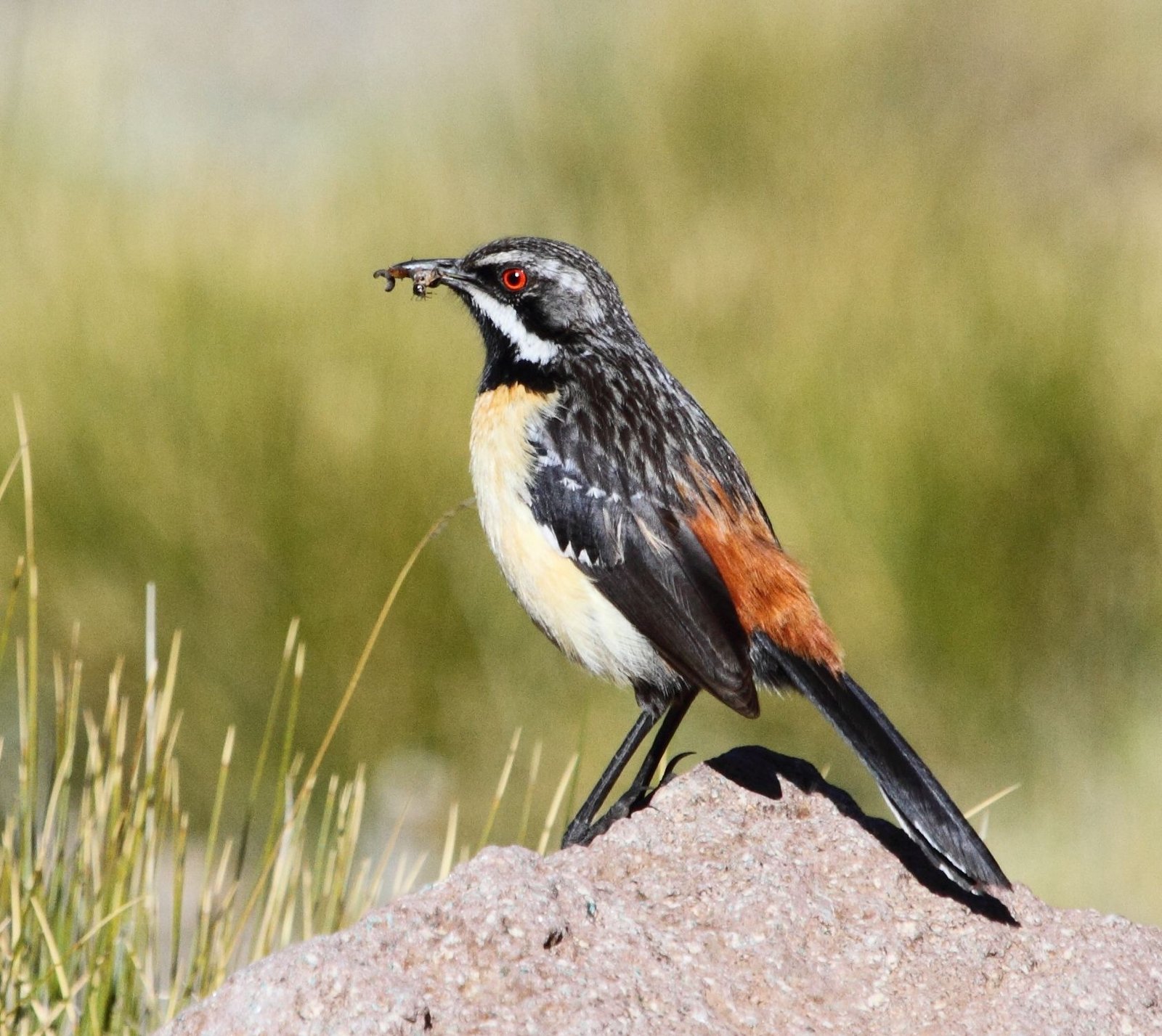
21–25 cm, much of it tail. The male has a grey crown, a black face and throat with a narrow white eyebrow and a broad white malar stripe. Mantle and back are grey streaked with black, the wings dark. Breast, belly and rump are bright orange to orange-buff. The long tail is black with white tips to the outer feathers. The eye is red, the bill and legs black. The female lacks the black on the throat and face: she is grey-brown above and pale buff to pale orange below, with an orange rump. It moves in long bounds over the rocks, often with the tail cocked.
Confusion species
Cape Rockjumper Chaetops frenatus is deeper rufous below with a darker back; the ranges do not meet, so locality settles it. Sentinel Rock Thrush Monticola explorator and Cape Rock Thrush Monticola rupestris have a blue-grey head without white on the face, a shorter orange tail, and fly readily. Buff-Streaked Chat Campicoloides bifasciatus also has a black face with white stripes, but a short tail and cinnamon-buff underparts, lacking the long black-and-white tail.
Habitat
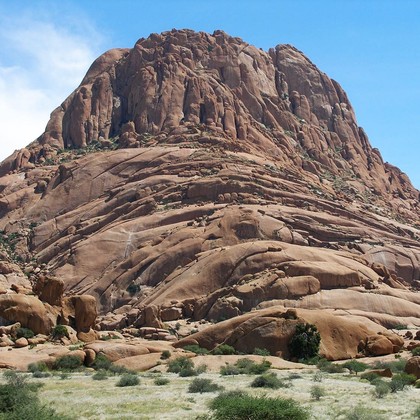
Rocky slopes and ridges with short grassland and low heath of ericas and Helichrysum, mostly above about 2000 metres, locally lower in the Eastern Cape. Forages on the ground among stones and grass tufts for insects, spiders and small lizards.
Where the bird is most at home, classified by the vegetation units of southern Africa.

Range and movements
Endemic to the Lesotho highlands and the adjoining Drakensberg in South Africa: the KwaZulu-Natal escarpment, the highlands of the north-eastern Eastern Cape (Witteberge, Barkly East, around Rhodes and Naude's Nek) and the edges of the eastern Free State. It occurs nowhere outside this area.
- Resident
- Summer visitor (c. Oct–Mar)
- dark = core range, pale = thinly spread
How and when to look
The best-known site is the top of Sani Pass, where groups often sit beside the road just below and above the border post; the passes around Rhodes (Naude's Nek, Tiffindell) are also reliable. Come early on a calm morning and listen for the high whistles. In mist and strong wind the birds stay silent among the rocks.
Conservation status
Near Threatened. The range is small and numbers appear to be declining. The species is tied to cool high plateaus and vulnerable to climate warming, which pushes suitable habitat onto ever higher, smaller areas. Overgrazing and too-frequent fires also degrade the low vegetation.
Scientific name
Chaetops aurantius | Layard, 1867
Layard described the species in 1867 and placed it straight away in the genus where it still stands. The genus Chaetops was introduced in 1832 by Swainson. Chaetops comes from the Greek khaitē, 'hair', and ōps, 'face': 'bristle eye', referring to the presence of eyelashes (Hockey et al., 2005). aurantius is Latin for 'orange' — for the male's orange breast and belly. The specimen the first description was based on came from Near Graaff-Reinet, Eastern Cape, South Africa.