All species › Passerines › Chats and flycatchers › Buff-Streaked Chat
Buff-Streaked Chat | Campicoloides bifasciatus
Streeptapuit | Tarabilla Sudafricana
The Buff-Streaked Chat is a boldly marked chat of rocky grassy slopes along the eastern escarpment, one of the endemics of South Africa, Lesotho and Eswatini. Pairs sit on boulders and stone walls, flick their wings and deliver a rich, varied song.
Voice
A loud, melodious and varied song of clear whistles and chattering runs, with much mimicry of other birds, often sung in duet or from a boulder. The call is a short chak or chik; when disturbed a repeated chak-chak.
Recording: Tristan Spurway — CC BY-NC-SA 4.0 · converted to mono · xeno-canto
Identification
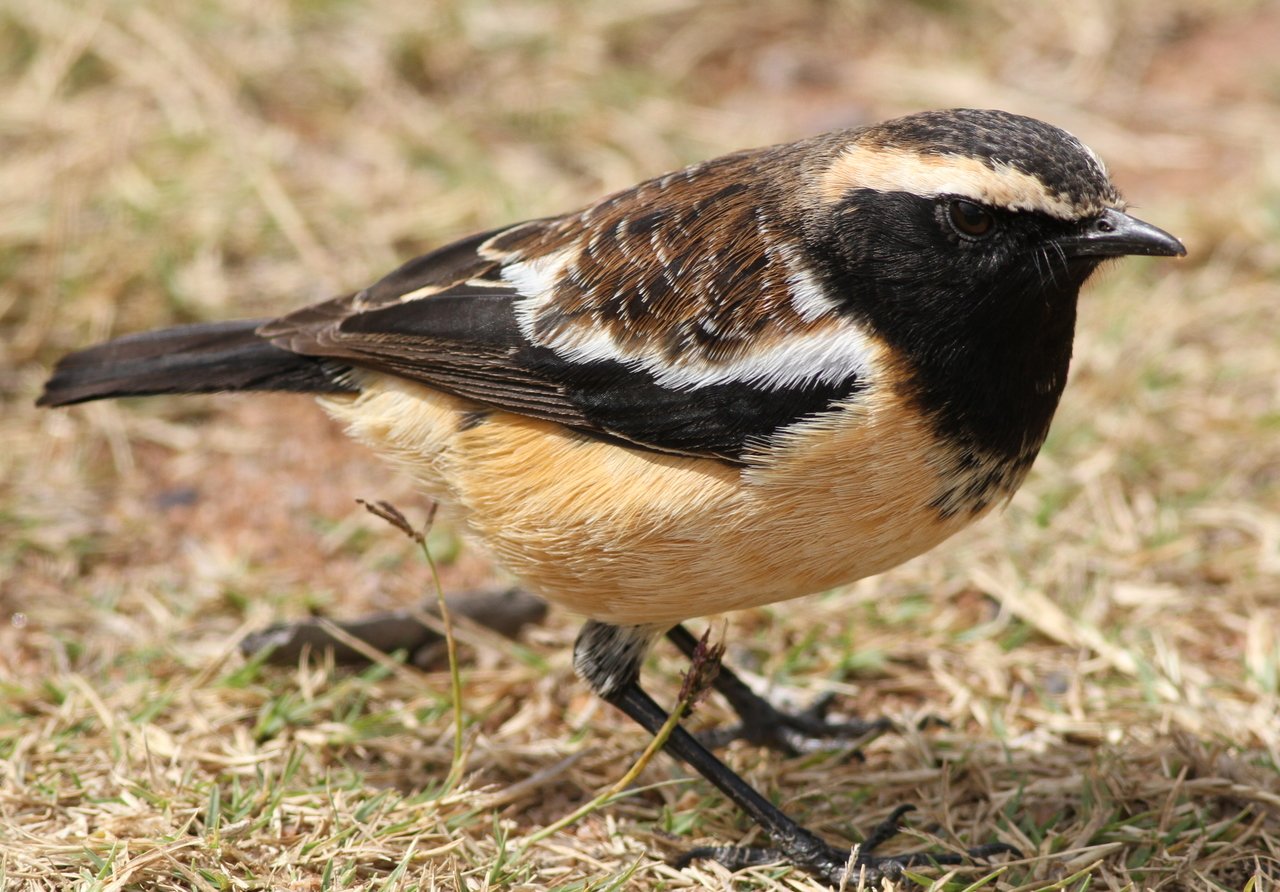
16–17 cm, a fairly large, upright chat. The male has a black face and throat, bordered by a broad whitish-buff supercilium that continues as a pale band along the side of the mantle; crown and back are grey-brown with dark streaks, the wings blackish-brown. The underparts are warm buff, the rump and uppertail coverts pale buff and the tail black. The female lacks the black face: she is brown with dark streaks on head and back, paler buff below with fine dark streaks on the breast, and has the same buff rump and black tail. Juveniles resemble the female but are spotted. It perches on rocks and flicks its wings.
Confusion species
Mountain Chat (Myrmecocichla monticola) shares rocky slopes but has white tail sides and a white rump; the male is black or grey with a white shoulder patch and the female plain dark brown without streaks. Female African Stonechat (Saxicola torquatus) is smaller, with an orange-brown breast and a white wing patch. Capped Wheatear (Oenanthe pileata) of bare, short-grazed ground has a black breast band, a white supercilium and a white rump.
Habitat
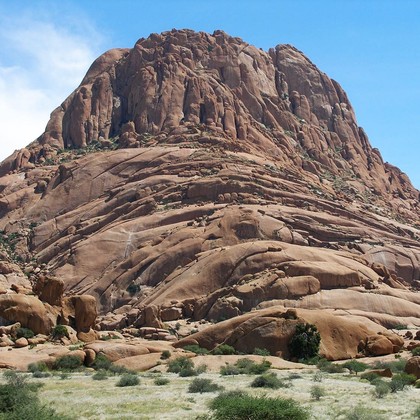
Rocky slopes and ridges in montane grassland with loose boulders, sheet rock and dry-stone walls, mostly between 1000 and 2000 m. It forages on the ground for insects, also taking small fruits and seeds. The nest is placed in a crevice or under a stone, often in a stone wall or a road cutting.
Where the bird is most at home, classified by the vegetation units of southern Africa.

Range and movements
Endemic to the region: along the eastern escarpment and highlands of South Africa, from the Haenertsburg area in Limpopo through Mpumalanga, Eswatini, KwaZulu-Natal and the eastern Free State into the Eastern Cape, and in western and northern Lesotho. It occurs nowhere else.
- Resident
- Summer visitor (c. Oct–Mar)
- Winter visitor (c. Apr–Sep)
- dark = core range, pale = thinly spread
How and when to look
Look for it along mountain roads on rocky grassy ridges, for example around Dullstroom and Wakkerstroom and in the Drakensberg foothills. Scan loose boulders and walls; the birds are tame, often in pairs and frequently heard first. They sing most in the breeding season from September to January.
Conservation status
Not threatened. The species is locally common within its limited range. Afforestation of grassy ridges and overly frequent burning can degrade habitat locally, but it remains well represented in extensively grazed grassland.
Scientific name
Campicoloides bifasciatus | (Temminck, 1829)
Temminck described the species in 1829 as Saxicola bifasciata; because it was later moved to another genus, the author and year stand in brackets. The genus Campicoloides was introduced in 1922 by Roberts. Campicoloides means 'resembling Campicola' (Swainson, 1827, an old genus name for wheatears), with the Greek -oidēs, 'resembling'. From its appearance and behaviour the species has in the past been treated both as a wheatear (Oenanthe) and as a chat (Saxicola). bifasciatus comes from the Latin bi-, 'two', and fasciatus, 'banded' — for the male's two pale back stripes. The specimen the first description was based on came from Eastern Cape, South Africa.