All species › Passerines › Chats and flycatchers › Mocking Cliff Chat
Mocking Cliff Chat | Thamnolaea cinnamomeiventris
Roodbuikkliftapuit | Roquero Imitador
The Mocking Cliff Chat is a large chat of wooded rocky hills and gorges, with a long tail that it slowly raises and fans. The male is glossy black with a white shoulder patch and a chestnut belly; its song, full of mimicry, echoes off the rock faces.

Click a thumbnail to switch the photo above.
Voice
A loud, rich and melodious song of whistles and short phrases, with much mimicry of other birds such as robin-chats, bulbuls and raptors; pairs often sing in duet. The call is a harsh chak or chook; when alarmed, a series of high notes.
Recording: Daan van der Hoeven — CC BY-NC-SA 4.0 · shortened to the first 60 s, mono · xeno-canto
Identification
20–21 cm, a large, long-tailed chat. The male is glossy blue-black on head, back, breast, wings and tail, with a conspicuous white patch on the lesser wing coverts and a deep chestnut belly, rump and undertail coverts. The female has a dark slate-grey head, back and breast and a warm rufous belly and rump, without the white shoulder patch. Bill and legs are black. Juveniles resemble the female. It hops and runs nimbly over rocks, raising the tail slowly and lowering it spread.
Confusion species
Boulder Chat (Pinarornis plumosus) of the granite koppies of Zimbabwe and Botswana is brownish-black without a rufous belly, with white spots in the wing and on the tail tip. Cape Rock Thrush (Monticola rupestris) has a blue-grey head and a rufous-orange tail. Red-Winged Starling (Onychognathus morio) is larger, wholly glossy black, with rufous primaries that show mainly in flight. Arnot's Chat (Myrmecocichla arnotti) has a white crown or throat and no rufous belly.
Habitat
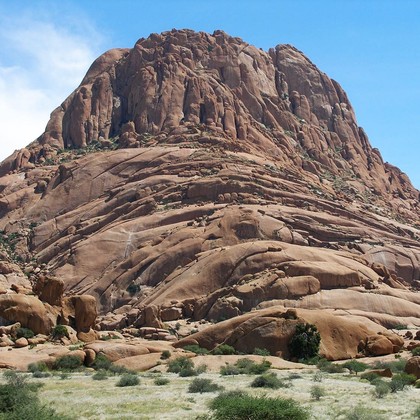
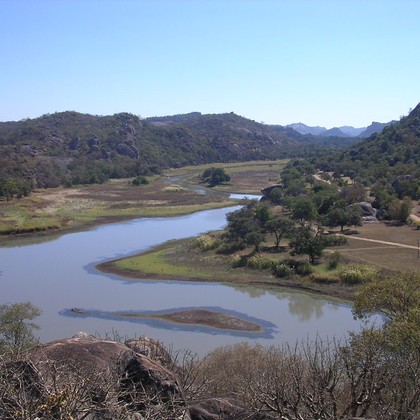
Rocky wooded hills, koppies, gorges and steep riverbanks with large boulders, in savanna and woodland; also around buildings and camps in rocky terrain, where it can become tame. It forages on the ground and among rocks for insects, and also takes fruit and nectar. It often breeds in a disused swallow's mud nest, otherwise in a cup in a rock crevice.
Where the bird is most at home, classified by the vegetation units of southern Africa.
Range and movements
In the region mainly in the east and north: Limpopo, Mpumalanga and inland KwaZulu-Natal, Eswatini, eastern Botswana, much of Zimbabwe, western Mozambique, Malawi and eastern and southern Zambia. Beyond the region locally in rocky country of East Africa to Ethiopia, with related forms in West Africa.
- Resident
- Summer visitor (c. Oct–Mar)
- Winter visitor (c. Apr–Sep)
- Passage (Mar–Apr, Oct–Nov)
- dark = core range, pale = thinly spread
How and when to look
Regularly seen in the Matobo Hills in Zimbabwe, in the rocky hills around Pafuri and Punda Maria in Kruger National Park and in the Magaliesberg. Search the foot of wooded rock faces and gorges and listen for the rich song with mimicry. Around camps and picnic sites it often comes close to look for crumbs.
Conservation status
Not threatened. The species is locally common and its rocky habitat is little threatened. It benefits from buildings and bridges where swallows nest, as it takes over their nests.
Scientific name
Thamnolaea cinnamomeiventris | (de Lafresnaye, 1836)
De Lafresnaye described the species in 1836 as Turdus cinnamomeiventris; because it was later moved to another genus, the author and year stand in brackets. The genus Thamnolaea was introduced in 1851 by Cabanis. Thamnolaea comes from the Greek thamnos, 'bush', and laios, 'thrush' — a 'bush thrush'. cinnamomeiventris comes from the Latin cinnamomeus, 'cinnamon-coloured', and venter, 'belly' — for the cinnamon-rufous belly. The specimen the first description was based on came from Cape Province, South Africa.