All species › Passerines › Batises and wattle-eyes › Cape Batis
Cape Batis | Batis capensis
Bruinflankvliegenvanger | Batis del Cabo
Cape Batis is the batis of southern Africa's forests: a small, busy bird with a black mask and warm rufous flanks that moves through the foliage in pairs. From the coastal forests of the Cape to the mist forests of eastern Zimbabwe and Malawi it is a regular member of mixed flocks.

Voice
A soft, repeated choo-wee or a series of chink-chink-chink, and a dry, whirring chrrr when alarmed. Pairs keep in contact with clicks and wing-fripping (frrrt) as they move through the foliage.
Recording: Walter Wallner — CC BY-NC-SA 4.0 · converted to mono · xeno-canto
Identification
12–13 cm. The male has a grey crown, a black mask with a small white spot above the lores, an olive-brown-washed back and a broad rufous wing stripe. The throat and belly are white, a broad black band crosses the breast and the flanks are warm rufous. The female has a rufous chin spot and a narrower rufous breast band. The eye is yellow-orange to red, reddest in birds of the Eastern Highlands of Zimbabwe. Birds from the mountains of Malawi and northern Mozambique (form dimorpha) are darker and less rufous. Juveniles resemble the female but are duller.
Confusion species
Chinspot Batis Batis molitor is paler grey above, with a white (not rufous) wing stripe, a distinct white eyebrow and white flanks; it lives in open woodland. Woodwards' Batis Batis fratrum of lowland forest in north-eastern KwaZulu-Natal and Mozambique lacks a breast band and has an orange-washed breast. Dark Batis Batis crypta in northern Malawi is darker and shorter-tailed, with a red eye and, in the male, a white wing stripe.
Habitat
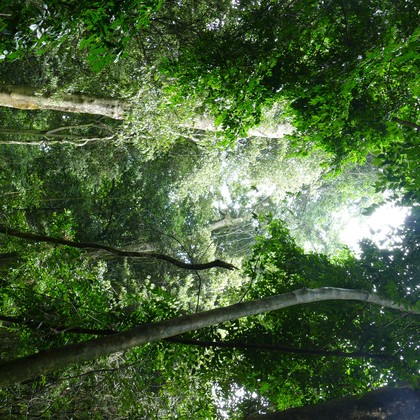
Indigenous forest from sea level high into the mountains: Afromontane forest, coastal and riverine forest, wooded ravines, dense thicket and well-wooded gardens; locally also old plantations with indigenous undergrowth. It forages in the middle and upper strata and often joins mixed flocks.
Where the bird is most at home, classified by the vegetation units of southern Africa.


Range and movements
In the region from the Western Cape along the southern and eastern seaboard through the Eastern Cape and KwaZulu-Natal, and along the Drakensberg and the eastern escarpment through Eswatini, Mpumalanga and Limpopo. Isolated populations live in the Eastern Highlands of Zimbabwe and adjacent Mozambique, in the montane forests of Malawi and northern Mozambique (including Mulanje, Zomba and Namuli) and on the Nyika Plateau into the far north-east of Zambia. It does not occur outside southern Africa.
- Resident
- Summer visitor (c. Oct–Mar)
- Passage (Mar–Apr, Oct–Nov)
- dark = core range, pale = thinly spread
How and when to look
Year-round. Almost any well-developed forest in southern and eastern South Africa will do, from Kirstenbosch and the forests around Knysna to Hogsback, Karkloof and Magoebaskloof; in Zimbabwe the Bvumba highlands, in Malawi the Zomba Plateau. Watch for the clicks and whirring of a pair travelling with a mixed flock.
Conservation status
Not threatened; common in suitable forest, with no sign of decline. The species tolerates some disturbance and also uses gardens and plantations with indigenous undergrowth, but the isolated populations in Malawi and Mozambique depend on shrinking montane forest patches.
Scientific name
Batis capensis | (Linnaeus, 1766)
Linnaeus described the species in 1766 as Muscicapa capensis; because it was later moved to another genus, the author and year stand in brackets. The genus Batis was introduced in 1833 by Boie. Batis is a Greek word for an unidentified worm-eating bird mentioned by Aristotle; Boie applied the name to these small African flycatchers in 1833. capensis means 'of the Cape', for the Cape of Good Hope, where the first specimen came from. The specimen the first description was based on came from Cape of Good Hope.