All species › Passerines › Batises and wattle-eyes › Woodwards' Batis
Woodwards' Batis | Batis fratrum
Woodwards vliegenvanger | Batis de Woodward
Woodwards' Batis is a batis of the warm lowland forest of the south-east coast. It differs from other batises in lacking a breast band: both sexes have a soft orange-washed breast. Its range is small and lies almost entirely within the region.

Voice
A slow series of pure, even whistles, hoo-hoo-hoo-hoo, often sustained at length from cover, and a soft, descending two-note phrase. Also chirping chik notes and a dry rattle when alarmed.
Recording: Niall Perrins — CC BY-NC-SA 4.0 · converted to mono · xeno-canto
Identification
11–12 cm. The male has a grey crown and back, a short white eyebrow, a black mask, a white wing stripe and a white chin and throat; the breast and upper belly are pale rufous-orange, without a dark band. The female is browner and more olive-grey above, with a rufous-brown wing stripe and a more extensive rufous-orange wash below. The eye is orange-red. It moves quietly through the middle stratum, usually in pairs, and sallies briefly after insects.
Confusion species
Cape Batis Batis capensis and Chinspot Batis Batis molitor have a black (male) or rufous (female) breast band. Pale Batis Batis soror in Mozambique is smaller and paler, with a narrow breast band and a yellow eye. The female Blue-Mantled Crested Flycatcher Trochocercus cyanomelas is greyer, with a small crest and a longer tail.
Habitat
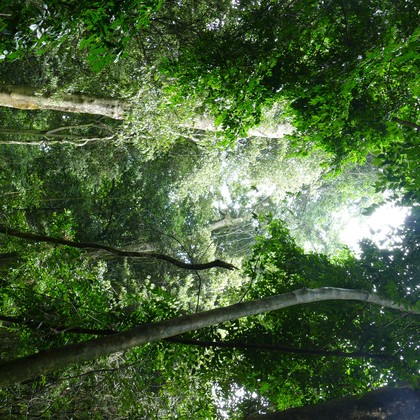
Lowland and coastal forest, sand forest and riverine forest, dense acacia thicket and, in Mozambique and Malawi, also dense miombo; up to about 600 m. It forages in the middle and lower strata, often in mixed flocks.
Where the bird is most at home, classified by the vegetation units of southern Africa.

Range and movements
From north-eastern KwaZulu-Natal, south to around Eshowe and Mtunzini, north through the coastal plain and lowlands of Mozambique into the north of that country, with extensions to the lowland forests of eastern Zimbabwe (Haroni and Rusitu) and southern Malawi. It does not occur outside the region.
- Resident
- Summer visitor (c. Oct–Mar)
- Winter visitor (c. Apr–Sep)
- Passage (Mar–Apr, Oct–Nov)
- dark = core range, pale = thinly spread
How and when to look
Year-round. Dlinza Forest at Eshowe, with its canopy boardwalk, and Ngoye Forest are classic sites; also the sand forest of Tembe and Mkhuze. Listen for the slow whistled series and search the middle stratum; the bird is often confiding.
Conservation status
Not threatened; locally common. Its range is small and the coastal forest of KwaZulu-Natal and Mozambique is being fragmented by agriculture, logging and development, but part of it lies in protected areas.
Scientific name
Batis fratrum | (Shelley, 1900)
Shelley described the species in 1900 as Pachyprora fratrum; because it was later moved to another genus, the author and year stand in brackets. The genus Batis was introduced in 1833 by Boie. Batis is a Greek word for an unidentified worm-eating bird mentioned by Aristotle; Boie applied the name to these small African flycatchers in 1833. fratrum is Latin for 'of the brothers', for the English missionaries and bird collectors Robert and John Woodward in Zululand. The specimen the first description was based on came from Lake St Lucia, KwaZulu-Natal, South Africa.