All species › Passerines › Batises and wattle-eyes › Chinspot Batis
Chinspot Batis | Batis molitor
Witflankvliegenvanger | Batis Molitor
Chinspot Batis is the batis of open woodland and the most widespread in the region. The male wears a black breast band, the female a chestnut chin spot and breast band, and its descending three-note whistle is heard throughout the savanna.

Voice
The familiar call is a slow, whistled, descending series of three notes, tee-choo-choo, often likened to ‘Three Blind Mice’; two-note variants also occur. It also gives sharp chik-chik-cherrr calls and audible wing-fripping when excited.
Recording: Tim Cockcroft — CC BY-NC-SA 4.0 · converted to mono · xeno-canto
Identification
12–13 cm. The male has a grey crown and back, a narrow white eyebrow, a black mask, a white wing stripe and pure white underparts with a broad, glossy black breast band; the flanks are white. The female has a sharply defined chestnut chin spot and a chestnut breast band. The eye is yellow. Juveniles are faintly scaled, with a buffy wash on the breast and wing stripe. It moves quickly through canopies and bushes, often in pairs or in mixed flocks.
Confusion species
Pririt Batis Batis pririt of the drier western savannas has black-spotted flanks in the male, and the female lacks a defined chin spot: throat and breast are evenly washed buff-cinnamon. Pale Batis Batis soror of Mozambique and Malawi is smaller and paler, with a narrower breast band and, in the female, a pale, poorly defined chin spot. Cape Batis Batis capensis of forest has rufous flanks and a rufous wing stripe.
Habitat
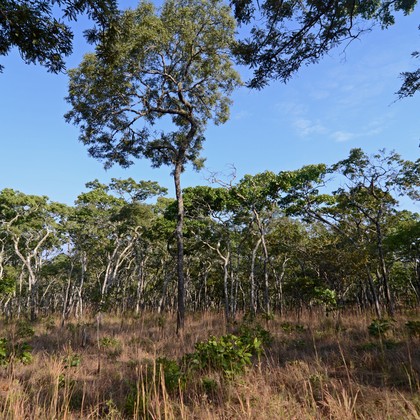
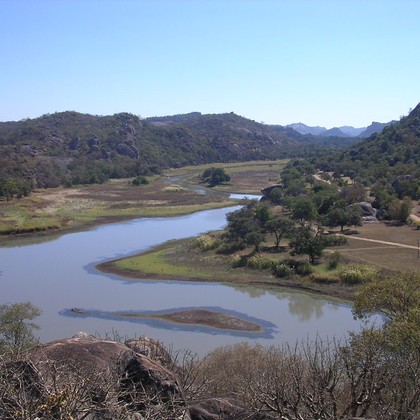
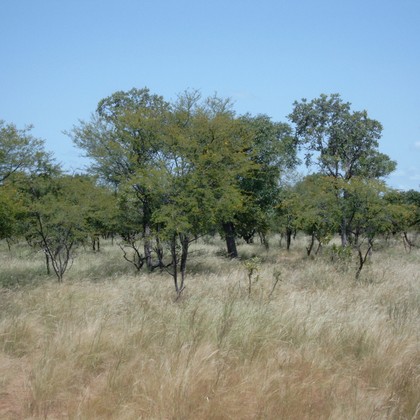
All kinds of woodland: miombo, mixed broadleaf woodland, acacia savanna, mopane, riverine woodland and rough edges of farmland and gardens; absent from dense forest and the driest areas. It gleans insects from leaves and twigs and takes them in short sallies.
Where the bird is most at home, classified by the vegetation units of southern Africa.
Range and movements
In the region widespread in Angola (except the arid south-west), Zambia, Malawi, Mozambique and Zimbabwe, in northern and eastern Botswana, north-eastern Namibia (Kavango and Caprivi), Eswatini and northern and eastern South Africa into the Eastern Cape. Beyond the region north to Uganda and Kenya and west through southern DR Congo.
- Resident
- Summer visitor (c. Oct–Mar)
- Winter visitor (c. Apr–Sep)
- Passage (Mar–Apr, Oct–Nov)
- dark = core range, pale = thinly spread
How and when to look
Year-round and found everywhere in the woodland of Kruger, Hwange or South Luangwa. Learn the descending three-note whistle; once recognised you will hear it all day. In eastern Botswana and north-western South Africa, where it meets Pririt Batis, it is mainly the females that differ clearly.
Conservation status
Not threatened; common to very common across a large range. It adapts well to disturbed woodland and plantings; no significant threats are known.
Scientific name
Batis molitor | (Küster, 1850)
Küster described the species in 1850 as Muscicapa molitor; because it was later moved to another genus, the author and year stand in brackets. The genus Batis was introduced in 1833 by Boie. Batis is a Greek word for an unidentified worm-eating bird mentioned by Aristotle; Boie applied the name to these small African flycatchers in 1833. molitor is Latin for 'miller'; the name goes back to Levaillant's 'Môlenar' (Cape Dutch moolenar), the name the Cape colonists gave the bird because the male's song sounds like the noise of a hand mill. The specimen the first description was based on came from Baviaans River, Eastern Cape, South Africa.