All species › Passerines › Larks › Cape Clapper Lark
Cape Clapper Lark | Corypha apiata
Klapperleeuwerik | Alondra Aplaudidora del Cabo
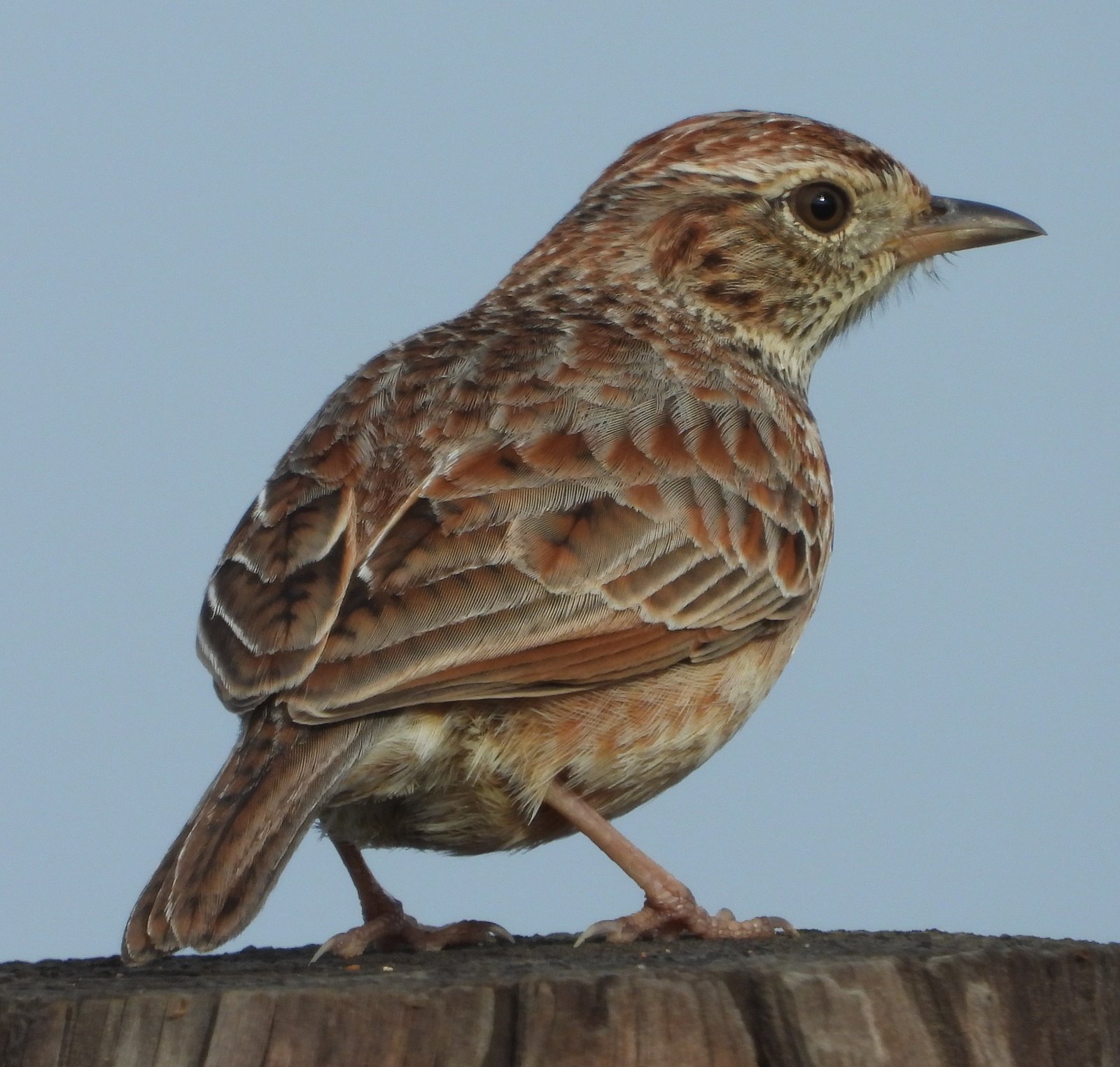
Cape Clapper Lark is a rufous lark of fynbos, renosterveld and the western Karoo that makes itself known mainly by sound: the male rises clapping its wings and then drops with a long, rising whistle. Since the 'Clapper Lark' was split into two species, it has been confined to south-western South Africa and the extreme south-west of Namibia.
Voice
In display the male rises steeply with a burst of slow, dry wing claps, roughly prrrp-prrrp-prrrp, and then descends with a long, strongly rising whistle peeeeeeu. The clapping is slower and the whistle longer than in Eastern Clapper Lark. Rarely heard from the ground.
No recording with a suitable Creative Commons licence is available for this species yet.
Identification
15 cm. A compact lark with a fairly stout bill and a short tail. The upperparts of the nominate form are greyish brown, heavily mottled and scaled with black and rufous; birds of the Agulhas Plain (marjoriae) are darker brown. The supercilium is buff. The underparts are warm rufous to cinnamon, with fine spots on the breast. The wings are rufous. The sexes are alike. Outside display it sits inconspicuously among the shrublets.
Confusion species
Eastern Clapper Lark Corypha fasciolata, which lives east of the central Karoo and north into the Kalahari, is often paler and claps in a faster rhythm, with a shorter whistle that rises less. Flappet Lark Amirafra rufocinnamomea also claps, but does not occur within the range of Cape Clapper Lark. Karoo Lark Calendulauda albescens has a crisp white supercilium and black breast streaks. Rufous-Naped Lark Corypha africana is larger, with a crest. Large-Billed Lark Galerida magnirostris has a crest and a heavy, yellow-based bill.
Habitat
Renosterveld, fynbos and Succulent Karoo shrubland with open patches between low shrublets, also fallow fields with regrowth. It avoids tall, dense fynbos and woodland.
Where the bird is most at home, classified by the vegetation units of southern Africa.


Range and movements
Endemic to south-western Africa: the Western Cape (Swartland, West Coast, Overberg and the Agulhas Plain) and the western Northern Cape (Namaqualand, Knersvlakte and the western Karoo), extending along the lower Orange River into the extreme south-west of Namibia. East of the central Karoo it is replaced by Eastern Clapper Lark.
- Resident
- Summer visitor (c. Oct–Mar)
- Winter visitor (c. Apr–Sep)
- Passage (Mar–Apr, Oct–Nov)
- dark = core range, pale = thinly spread
How and when to look
Best from July to November on calm mornings, when the males display. Good sites are the renosterveld of the Overberg, West Coast National Park and the shrubland of Namaqualand. Listen for the clapping and the long, rising whistle; where the two clapper larks meet in the Karoo, the rhythm of the clapping is the best feature.
Conservation status
Not threatened. The species is locally common, although much renosterveld in the Western Cape has been converted to wheat fields and vineyards. The remaining patches of renosterveld and the Karoo provide ample habitat.
Scientific name
Corypha apiata | (Vieillot, 1816)
Vieillot described the species in 1816 as Alauda apiata; because it was later moved to another genus, the author and year stand in brackets. The genus Corypha was introduced in 1840 by Gray. Corypha derives from the Greek koruphos, an unidentified bird mentioned by Hesychius of Alexandria and usually assumed to be a lark. apiata is a French onomatopoeic rendering of the whistles the bird gives in its display flight, as described by Vieillot (1816). The specimen the first description was based on came from Malmesbury district, Western Cape, South Africa.