All species › Passerines › Larks › Spike-Heeled Lark
Spike-Heeled Lark | Chersomanes albofasciata
Sjirpleeuwerik | Alondra Espolada
The Spike-Heeled Lark is a short-tailed, upright lark with a long, slightly decurved bill and a strikingly white throat. It runs in small parties over bare ground and flushes with a soft purring call. The Dutch name refers to that trilling call; the English name to the long, straight hind claw.

Voice
A soft, purring trill, trrrrp or trrr-trrr-trrr, especially on take-off and during the short, low flight. The song is a simple series of similar trills, given from a stone or a shrublet or in a short flight. There is no high display flight.
Recording: Dawie de Swardt — CC BY-NC-SA 4.0 · converted to mono · xeno-canto
Identification
14–16 cm. The posture is distinctive: upright, like a small pipit with a very short tail. The bill is fairly long, slightly decurved and pale at the base. Upperparts are dark-mottled on a ground colour that varies strongly by region, from dark rufous-brown in the east through grey-brown in the Karoo to pale sandy on the edge of the Namib. The throat is pure white and contrasts sharply with the breast, which is buff to rufous with dark spots. The short dark tail has a narrow white terminal band and white outer edges, well visible in flight. The hind toe bears a long, almost straight claw. The sexes are alike.
Confusion species
Karoo Long-Billed Lark Certhilauda subcoronata is much larger, with a longer tail lacking the white tip and a longer, more decurved bill. Short-Clawed Lark Certhilauda chuana is larger and longer-tailed and sings in a high display flight. Red-Capped Lark Calandrella cinerea has a rufous cap and breast patches and a short, pointed bill. Most reliable are the very short-tailed silhouette, the white throat, the purring flight call and the habit of running in groups.
Habitat
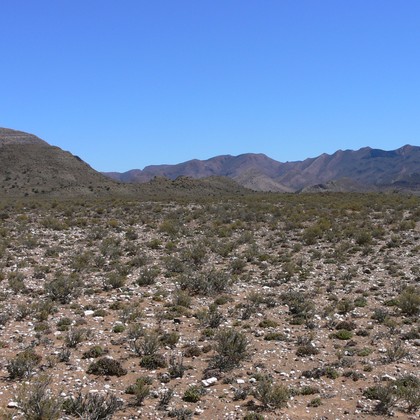
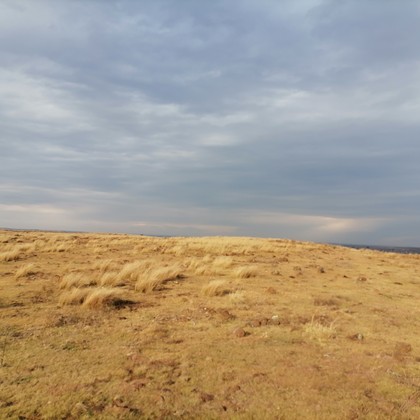
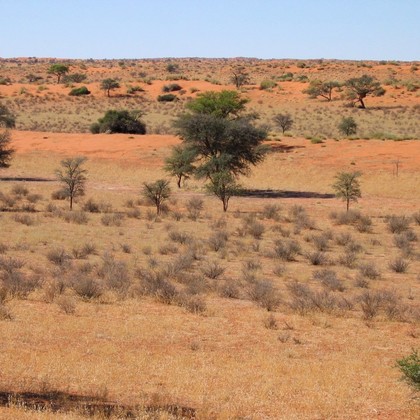
Open, bare to sparsely vegetated ground: Karoo scrub, gravel plains, heavily grazed highveld grassland, pan edges and bare patches in Kalahari thornveld. It avoids tall grass and dense scrub. It runs fast over the ground, taking insects, especially ants and termites, and seeds, often digging with the bill in loose soil.
Where the bird is most at home, classified by the vegetation units of southern Africa.
Range and movements
Widespread in the west and centre of the region: almost all of Namibia (except the north-east and the loose dunes), most of Botswana except the north, south-western Angola (Namibe and Huíla), and in South Africa the Northern Cape, the Karoo, the Free State, North West and the western highveld, east into Gauteng, Mpumalanga and western KwaZulu-Natal; also Lesotho. The isolated form in northern Tanzania is now usually treated as a separate species, Beesley's Lark.
- Resident
- Summer visitor (c. Oct–Mar)
- Winter visitor (c. Apr–Sep)
- Passage (Mar–Apr, Oct–Nov)
- dark = core range, pale = thinly spread
How and when to look
Year-round on bare plains in the Karoo and on the highveld; watch for small parties running ahead of the car and flushing with a soft purr. The upright stance, very short tail and white throat are distinctive even at range. Regional colour variation is large, so silhouette and voice are more reliable than plumage colour.
Conservation status
Not threatened; common and widespread. It benefits locally from grazing that keeps the vegetation short. No large-scale threats are known.
Scientific name
Chersomanes albofasciata | (de Lafresnaye, 1836)
De Lafresnaye described the species in 1836 as Certhilauda albofasciata; because it was later moved to another genus, the author and year stand in brackets. The genus Chersomanes was introduced in 1851 by Cabanis. Chersomanes comes from the Greek chersos, 'dry land', and -manēs, 'fond of' — for its liking for dry, open plains. albofasciata is Latin for 'white-banded', from albus, 'white', and Late Latin fasciatus, 'banded' (from fascia, 'band'). The specimen the first description was based on came from Deelfontein, Northern Cape, South Africa.