All species › Passerines › Larks › Eastern Clapper Lark
Eastern Clapper Lark | Corypha fasciolata
Oostelijke klapperleeuwerik | Alondra Aplaudidora Oriental
Eastern Clapper Lark is a compact, rufous lark usually noticed only when it displays: a steep climb under a rattling clap of the wings, a long rising whistle at the top and then a parachute descent with dangling legs. It has been treated as a separate species only since the split of the clapper larks, and telling it from the Cape form rests largely on the display.

Voice
The display is the key: the bird climbs at an angle under a fast, even wing-clapping, a dry prrrrrt, and gives a long, ascending whistle at the top, pooooeeeee, before floating down with spread wings and dangling legs. This may be repeated dozens of times in succession, mainly at sunrise and towards evening, and also by moonlight. Mostly silent outside display.
No recording with a suitable Creative Commons licence is available for this species yet.
Identification
14–16 cm. Compact, with a short tail and a fairly strong, slightly curved bill. The upperparts are warm rufous-brown with fine dark and pale barring and scaling; the crown is rufous with dark streaks and there is a pale supercilium. The flight feathers are conspicuously rufous, giving a warm wing in flight. The underparts are deep buff to cinnamon, with fine dark spots on the breast and a pale throat. Sexes alike. When disturbed it crouches or runs off between the tussocks; on the ground it is inconspicuous and rarely in view for long.
Confusion species
Cape Clapper Lark Corypha apiata of the western and south-western Cape and the Karoo is smaller, with a darker, more slender bill, more heavily barred upperparts and mainly grey-brown rather than rufous flight feathers; its wing-clapping accelerates during display, whereas that of Eastern Clapper Lark stays even. In the narrow contact zone in the eastern Karoo and Eastern Cape identification without display is often impossible. Flappet Lark Amirafra rufocinnamomea of bushveld and miombo displays high and for long periods with short bursts of wing-rattling, but without a whistle. Rufous-Naped Lark Corypha africana is larger, has a small crest and sings from a post or bush.
Habitat
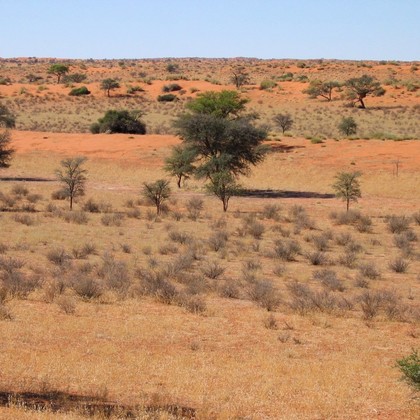
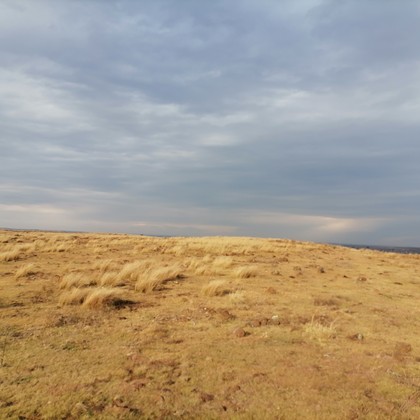
Open, dry grassland and grassy plains with scattered low shrubs, Kalahari savanna on sand, and the grassy margins of the eastern Karoo. It avoids dense woodland and tall, closed grass. It forages on the ground for insects and seeds.
Where the bird is most at home, classified by the vegetation units of southern Africa.
Range and movements
Near-endemic to southern Africa. In South Africa from the Eastern Cape and eastern Karoo through the Free State and the eastern Northern Cape to North West Province, and locally in Mpumalanga, Gauteng and the interior of KwaZulu-Natal; also in the lowlands of Lesotho. Further in the Kalahari of Botswana and in eastern Namibia. Outside the region only in south-western Zambia.
- Resident
- Summer visitor (c. Oct–Mar)
- Passage (Mar–Apr, Oct–Nov)
- dark = core range, pale = thinly spread
How and when to look
In the summer months, on clear, calm days, visit open grassland or Kalahari savanna just after sunrise or in the last hour before sunset and listen for the dry wing-rattle followed by the rising whistle. Watch for the rufous wings in the descending flight. In the transition zone with Cape Clapper Lark, note how the clapping runs, even or accelerating, and record the locality.
Conservation status
Not threatened; common in many places. Overgrazing, bush encroachment in grassland and conversion to cropland can cause local declines, but the range is large and largely stable.
Scientific name
Corypha fasciolata | (Sundevall, 1850)
Sundevall described the species in 1850 as Alauda fasciolata; because it was later moved to another genus, the author and year stand in brackets. The genus Corypha was introduced in 1840 by Gray. Corypha derives from the Greek koruphos, an unidentified bird mentioned by Hesychius of Alexandria and usually assumed to be a lark. fasciolata comes from the Latin fasciola, 'small band' — for the fine barring on the upperparts. The specimen the first description was based on came from interior north of the Vaal River, South Africa.