All species › Passerines › Sparrows › Cape Sparrow
Cape Sparrow | Passer melanurus
Kaapse mus | Gorrión del Cabo
The Cape Sparrow is the native sparrow of the dry south and west of the region, the male with a striking black-and-white head. It is as much at home in farmyards, villages and suburban gardens as in open Karoo and thornveld, and is endemic to southern Africa.

Click a thumbnail to switch the photo above.
Voice
A busy, loud and metallic chirping, chissip or chirrup, and as song a repeated cheereep-choo, cheereep-choo. Flocks give a continuous chatter; alarm is a churring churrrr.
Recording: Walter Wallner — CC BY-NC-SA 4.0 · shortened to the first 60 s, mono · xeno-canto
Identification
14 to 16 cm. The male has a black head and throat with a broad white C-shaped band curving from behind the eye down the side of the neck; the black throat extends into a bib on the breast. Mantle, shoulders and rump are bright chestnut, the wing blackish with a white wingbar. The underparts are pale grey to dirty white. The female has a grey head on which the C-pattern reappears as a ghost in paler grey and white, without a black bib, and likewise a chestnut back. The bill is black in the male, horn-coloured in the female. Juveniles resemble the female.
Confusion species
The male House Sparrow (Passer domesticus), an introduced species, has a grey crown, a brown stripe behind the eye and greyish-white cheeks with no white C-band. Female House Sparrow is buffier, with a pale eyebrow and a streaked, brown rather than chestnut back. Great Sparrow (Passer motitensis) has a grey crown, a rufous band from eye to nape and only a small black throat patch. The male is unmistakable; in females look for the grey head with its faint pale half-circle and the chestnut shoulders.
Habitat
Dry, open country: Karoo, thornveld, dry grassland, the edges of fynbos and renosterveld, and especially farmyards, fields, villages and suburban gardens. It forages on the ground for seeds, grain, buds and insects, at times in large flocks outside the breeding season. The nest is an untidy ball of grass in a thorn bush or tree, sometimes in a cavity in a building.
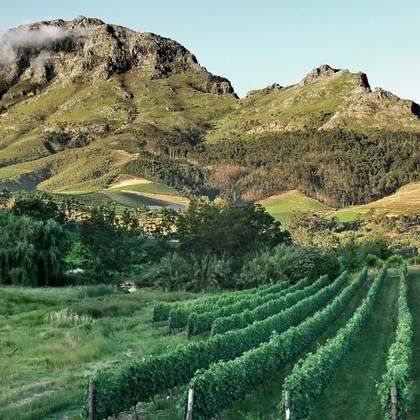
Where the bird is most at home, classified by the vegetation units of southern Africa.


Range and movements
Endemic to the region: virtually all of South Africa (scarcer in the humid east of KwaZulu-Natal and the Lowveld), Lesotho, western Eswatini, Namibia (not in the north-east), most of Botswana except the north, south-western Zimbabwe and the extreme south-west of Angola. Not found outside the region.
- Resident
- Winter visitor (c. Apr–Sep)
- Passage (Mar–Apr, Oct–Nov)
- dark = core range, pale = thinly spread
How and when to look
In Cape Town, the Karoo and along the main roads of the interior it is almost everywhere, often next to House Sparrows: a good opportunity to compare the two side by side. With flocks of females, look for the grey head and chestnut shoulders of Cape Sparrow against the browner head and eyebrow of House Sparrow.
Conservation status
Not threatened. Common to very common and benefiting from agriculture and settlement. It is locally regarded as a pest of grain and fruit. There is no evidence of large-scale displacement by House Sparrow.
Scientific name
Passer melanurus | (Müller, 1776)
Müller described the species in 1776 as Loxia melanura; because it was later moved to another genus, the author and year stand in brackets. The genus Passer was introduced in 1760 by Brisson. Passer is the Latin word for 'sparrow'. melanurus comes from the Greek melas, 'black', and oura, 'tail' — 'black-tailed'. The specimen the first description was based on came from Cape Town, South Africa.