All species › Passerines › Wagtails and pipits › Cape Wagtail
Cape Wagtail | Motacilla capensis
Kaapse kwikstaart | Lavandera del Cabo
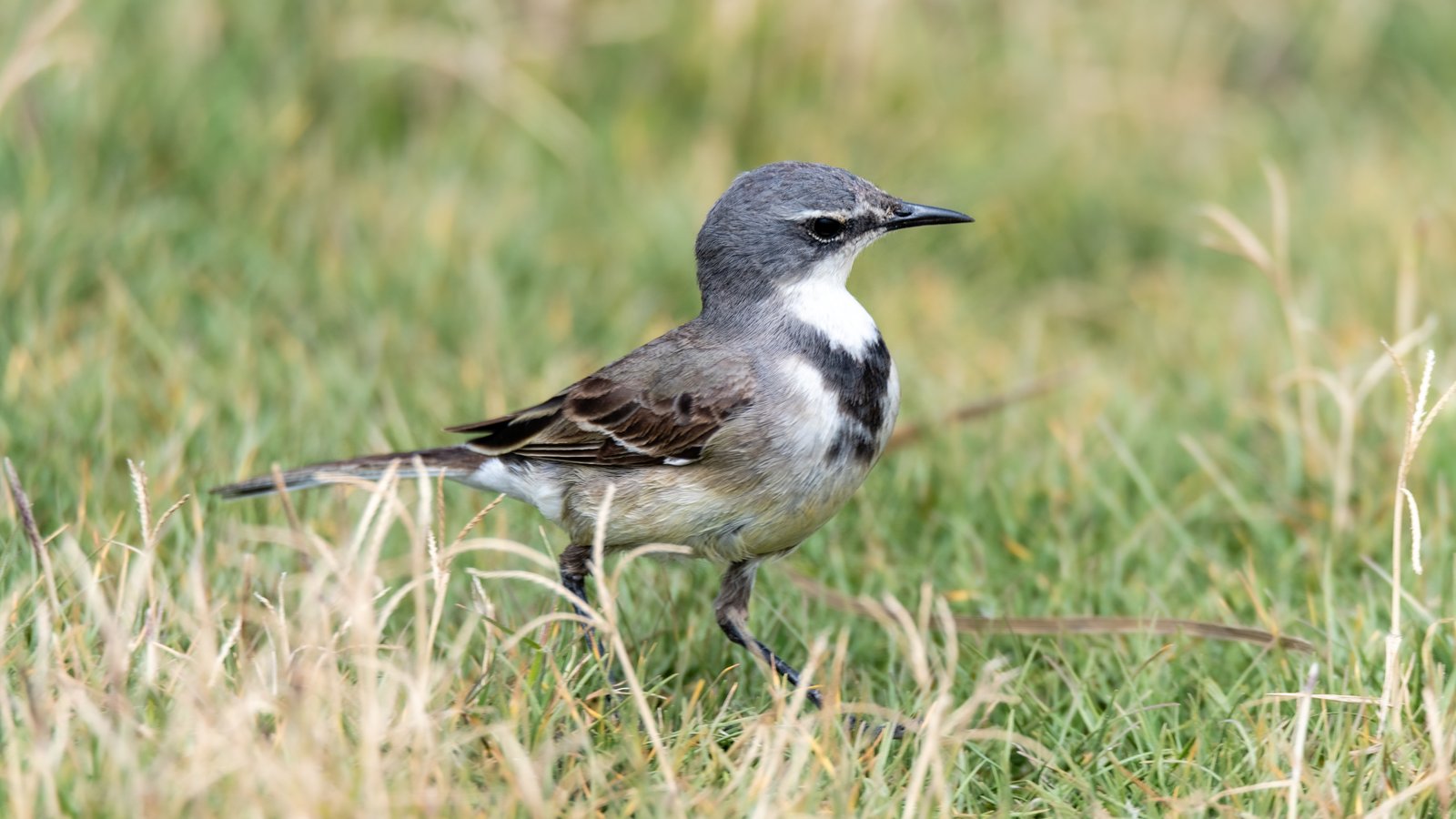
The Cape Wagtail is the common grey-brown wagtail of southern Africa, as much at home on riverbanks and lagoons as on lawns, car parks and school grounds. With its constantly wagging tail and unflappable behaviour it is for many people the first bird they know by name.
Voice
The call is a clear, penetrating chisseek or tsee-tsee-tee, often in flight. The song is a cheerful series of clear trills and whistles, chee-chee-chee-chweee, from a roof, post or stone.
Recording: African Bioacoustics Community — CC BY-NC-SA 4.0 · shortened to the first 60 s, mono · xeno-canto
Identification
18 to 20 cm, slender and long-tailed. The upperparts are plain olive grey-brown, the wings with only narrow pale edgings; a short white supercilium. The underparts are dull white with a narrow dark breast band and greyish, sometimes buff-tinged flanks. The outer tail feathers are white. The sexes are alike. Juveniles are browner, with pale yellowish underparts and a faint breast band. In the northern subspecies simplicissima (Angola, northern Botswana, Zambia) the breast band is very narrow or broken.
Confusion species
Mountain Wagtail (Motacilla clara) is paler blue-grey above, has a much longer tail, pure white underparts with a very thin breast band and a white wing panel, and lives only along fast-flowing forest streams. Grey Wagtail (Motacilla cinerea) has a yellow rump and undertail and no breast band. Young African Pied Wagtails (Motacilla aguimp) are grey-brown but have a large white wing patch. Western Yellow Wagtail (Motacilla flava) in dull plumage has a greener back, no breast band and black legs.
Habitat
Margins of rivers, dams, vleis and sewage works, lagoons and rocky shores, but also lawns, sports fields, gardens and farmyards, up to high in the Drakensberg. It catches insects walking and with short sprints, sometimes in the air. It nests in a hollow in a bank, among creepers, in a gutter or among driftwood along the water.
Where the bird is most at home, classified by the vegetation units of southern Africa.


Range and movements
Common throughout South Africa, Lesotho and Eswatini and over much of Namibia, Botswana (especially the south and east and the Okavango), Zimbabwe and southern and central Mozambique. Further north more local: in Zambia, Malawi and Angola mainly on plateaus and along rivers. Beyond the region in southern DR Congo, with an isolated subspecies in East Africa (Kenya, Uganda and Tanzania).
- Resident
- Winter visitor (c. Apr–Sep)
- Passage (Mar–Apr, Oct–Nov)
- dark = core range, pale = thinly spread
How and when to look
The reference species for all other wagtails: knowing it well makes an odd bird stand out at once. Young Cape Wagtails with a yellowish wash are often mistaken for Western Yellow Wagtails in summer; check the brown back, the hint of a breast band and the call. Pairs are territorial year-round and can be watched at close range in gardens and campsites.
Conservation status
Not threatened. One of the commonest birds of the region, benefiting from gardens, dams and sewage works. Locally sensitive to drying out of margins and to pesticides, but with no evidence of decline.
Scientific name
Motacilla capensis | Linnaeus, 1766
Linnaeus described the species in 1766 and placed it straight away in the genus where it still stands. The genus Motacilla was introduced in 1758 by Linnaeus. Motacilla was the Roman name for the wagtail; it is really a diminutive of motare 'to move about', but from medieval times -cilla was wrongly taken to mean 'tail'. capensis means 'of the Cape', for the Cape of Good Hope. The specimen the first description was based on came from Cape of Good Hope.