All species › Passerines › Wagtails and pipits › Grimwood's Longclaw
Grimwood's Longclaw | Macronyx grimwoodi
Grimwoods langklauw | Bisbita de Grimwood
Grimwood's Longclaw is a little-known pink-throated longclaw of the high grasslands and dambos on the borders of Angola, Zambia and DR Congo. Described only in 1955, it is one of the specialities that draw birders to north-western Zambia.

Voice
A clear whistled tchoo-wee and a series of rapid, thin whistles, tsee-tsee-tsee-tchoo, from a termite mound or in song flight over the grassland. The alarm is a mewing meew. The song is poorly documented.
No recording with a suitable Creative Commons licence is available for this species yet.
Identification
A robust longclaw of 20 to 21 cm with a heavy bill and a long hind claw. The upperparts are buff to greyish-brown with heavy dark streaks. Throat and upper breast are deep pink to salmon-pink, bordered by a narrow black necklace that is sometimes broken; the rest of the underparts are warm buff with streaked flanks and only a faint pink wash. The outer tail feathers are white. The female has a paler pink throat and a less distinct necklace. Juveniles are buff with a spotted breast and hardly any pink.
Confusion species
Rosy-Throated Longclaw (Macronyx ameliae) is slimmer and smaller, with a broader necklace and pink on the breast and belly as well; it lives on wetter floodplains and barely overlaps with Grimwood's Longclaw in north-western Zambia. Fülleborn's Longclaw (Macronyx fuelleborni), which shares the same grassland, has a yellow throat. Juveniles of all three are often inseparable in the field.
Habitat
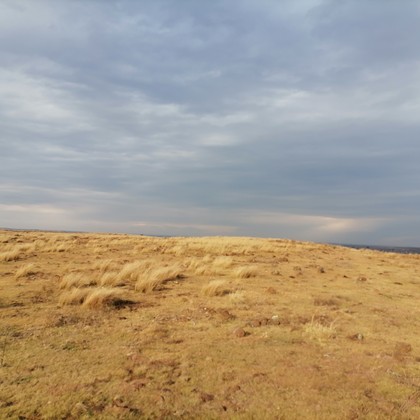
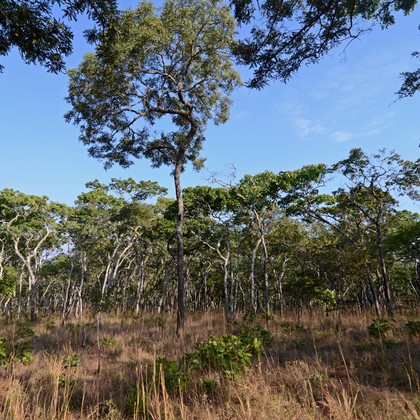
Short, open grassland on plateaus and in broad, seasonally wet dambos, often on freshly burnt or closely grazed patches, between 1000 and 1500 m and surrounded by miombo. It forages on foot for insects.
Where the bird is most at home, classified by the vegetation units of southern Africa.

Range and movements
In the region in eastern Angola (Moxico and the Lunda provinces) and in north-western Zambia, including around Mwinilunga. Beyond the region only in adjacent southern DR Congo. The total range is small.
- Resident
- dark = core range, pale = thinly spread
How and when to look
The grassy plains and dambos around Mwinilunga are the best place. Go at the start of the rainy season, from October to December, when males are singing and the grass is still short after burning; a bird on a termite mound with a pink throat and narrow necklace can then be studied well.
Conservation status
Not threatened, although the range is small and poorly surveyed. The species seems fairly common locally. Possible threats are the conversion of dambos to cultivation and too frequent burning.
Scientific name
Macronyx grimwoodi | Benson, 1955
Benson described the species in 1955 and placed it straight away in the genus where it still stands. The genus Macronyx was introduced in 1827 by Swainson. Macronyx comes from the Greek makros, 'long', and onux, 'claw' — for the very long hind claw of these birds. grimwoodi honours the British Major Ian Robert Grimwood (1912–1990), game warden in Northern Rhodesia (now Zambia) and later Kenya. The specimen the first description was based on came from Chitunta plain, Mwinilunga, Zambia.