All species › Passerines › Sunbirds › Carmelite Sunbird
Carmelite Sunbird | Chalcomitra fuliginosa
Karmeliethoningzuiger | Suimanga Carmelita
The Carmelite Sunbird is a dark chocolate-brown sunbird of the West African coast that occurs in the region only in north-western Angola. The male has a violet-glossed forecrown and throat, visible only in good light.

Voice
A hard, dry tchek or tchip call, often repeated. The song is a fast, rather monotonous series of squeaky and twittering notes.
Recording: Bram Piot — CC BY-NC-SA 4.0 · converted to mono · xeno-canto
Identification
A medium-sized sunbird of 13 to 14 cm with a long, decurved bill and a short tail. The male is deep chocolate to sooty brown, with a metallic violet to lilac forecrown, a violet-glossed throat and a purple shoulder patch; the wings sometimes show pale edges. Outside the breeding season and in young males the brown is paler and duller. The female is olive-brown above and paler yellowish-brown below with faint mottling, and has a pale supercilium.
Confusion species
The male Amethyst Sunbird (Chalcomitra amethystina) is velvet-black rather than brown and has a green, not violet, crown. The male Green-Throated Sunbird (Chalcomitra rubescens) of forested areas is also blackish-brown but has a green crown and throat. Scarlet-Chested Sunbird (Chalcomitra senegalensis) has a scarlet breast. Mangrove Sunbird (Anthreptes gabonicus) is much smaller, grey-brown above and white below.
Habitat
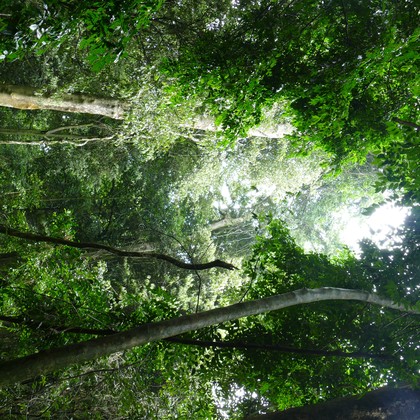
Coastal lowlands: coastal scrub, secondary forest, mangrove edges, savanna with oil palms, plantations, villages and gardens, mostly within a few tens of kilometres of the sea. It visits flowering trees such as coral trees and Spathodea, often in small groups.
Where the bird is most at home, classified by the vegetation units of southern Africa.


Range and movements
Within the region only in north-western Angola: in Cabinda and along the coast and in the coastal lowlands south to about Luanda and the mouth of the Cuanza. Beyond the region along the coast of West and Central Africa, from Liberia to the Republic of the Congo and western DR Congo.
- Resident
- dark = core range, pale = thinly spread
How and when to look
Look in Cabinda and around Luanda in coastal thickets and gardens with flowering trees. At a distance the bird appears plain dark brown; wait until it sits in the sun to see the violet crown and throat, and note the brown rather than black ground colour to rule out Amethyst Sunbird.
Conservation status
Not threatened. The species is locally common within its coastal range and adapts to farmland and gardens. Habitat is lost locally to coastal urbanisation and the clearing of mangroves.
Scientific name
Chalcomitra fuliginosa | (Bechstein, 1811)
Bechstein described the species in 1811 as Certhia fuliginosa; because it was later moved to another genus, the author and year stand in brackets. The genus Chalcomitra was introduced in 1854 by Reichenbach. Chalcomitra comes from the Greek khalkos, 'bronze, copper', and mitra, 'headband, diadem' — for the metallic sheen on the males' head and throat. fuliginosa is Latin for 'sooty', from fuligo, 'soot' — for the male's dark brown plumage. The specimen the first description was based on came from Malembo, Cabinda, Angola.