All species › Passerines › Sunbirds › Green-Throated Sunbird
Green-Throated Sunbird | Chalcomitra rubescens
Groenkeelhoningzuiger | Suimanga Gorjiverde
The Green-Throated Sunbird is a dark sunbird of the Central African rainforest zone that reaches only the northern margins of the region, in northern Angola and north-western Zambia. It lives high in the canopy of forest and gallery forest.

Click a thumbnail to switch the photo above.
Voice
A sharp, high tchip or tseep, and a fast, high and rather high twittering song, often from the crown of a tall tree.
Recording: Étienne Leroy — CC BY-NC-SA 4.0 · converted to mono · xeno-canto
Identification
A compact sunbird of 12 to 13 cm with a fairly short tail and a long, decurved bill. The male is sooty black to blackish-brown, with a metallic green crown and throat and a narrow violet band below on the upper breast; the green throat does not run into a red or purple breast. The female is dark olive-brown above and paler below with heavy dark mottling and streaking on the throat and breast; the throat is often darkest. Young birds resemble the female.
Confusion species
The male Amethyst Sunbird (Chalcomitra amethystina) has a green crown but a purple-violet throat and lives in more open woodland. The male Scarlet-Chested Sunbird (Chalcomitra senegalensis) has a bright scarlet breast below the green throat. The male Carmelite Sunbird (Chalcomitra fuliginosa) is browner with a violet crown and throat. The females of these species are very alike; note the company, the habitat and the heavy mottling of throat and breast.
Habitat
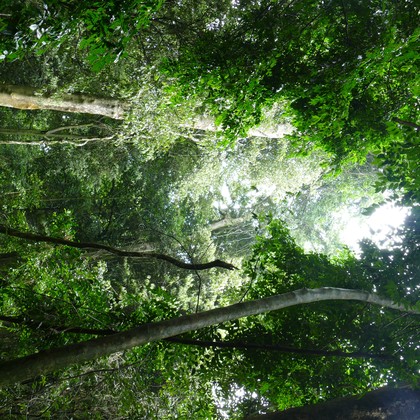
Edges and clearings of moist forest, riverine gallery forest, secondary forest and old plantations, mostly in the canopy. It visits flowering trees and creepers and gleans insects among the foliage.
Where the bird is most at home, classified by the vegetation units of southern Africa.

Range and movements
Within the region confined to northern Angola (Cabinda, Uíge and the Lunda provinces) and north-western Zambia, mainly Mwinilunga District. Beyond the region from Nigeria and Cameroon east through the Congo Basin to Uganda, western Kenya and north-western Tanzania.
- Resident
- dark = core range, pale = thinly spread
How and when to look
In Zambia best found in the gallery forests around Mwinilunga, where it forages with other canopy species. Look up from a clearing or riverbank at flowering trees and wait for a male to sit in the sun to see the green throat.
Conservation status
Not threatened and common over most of its range. In the region it is scarce and depends on the survival of gallery forest and forest edges, which are under pressure from logging and farming.
Scientific name
Chalcomitra rubescens | (Vieillot, 1819)
Vieillot described the species in 1819 as Cinnyris rubescens; because it was later moved to another genus, the author and year stand in brackets. The genus Chalcomitra was introduced in 1854 by Reichenbach. Chalcomitra comes from the Greek khalkos, 'bronze, copper', and mitra, 'headband, diadem' — for the metallic sheen on the males' head and throat. rubescens is Latin for 'reddening, reddish'; what the name refers to is unclear, as the male is mostly blackish brown with a green throat. The specimen the first description was based on came from lower Congo River (former kingdoms of Kongo and Kakongo).