All species › Passerines › Sunbirds › Grey Sunbird
Grey Sunbird | Cyanomitra veroxii
Grijze honingzuiger | Suimanga Ratonil
The Grey Sunbird is a plain grey sunbird of East African coastal forest, which within the region inhabits the east coast of South Africa and Mozambique. It lacks any metallic gloss, but has scarlet pectoral tufts and a loud, clear song.

Voice
A harsh, sharp tchek and a high tcheep. The song is a loud, clear, descending series of three to six whistled notes, tchee-tchee-tchoo-tchoo, often repeated for long periods from dense forest.
Recording: Walter Wallner — CC BY-NC-SA 4.0 · shortened to the first 60 s, mono · xeno-canto
Identification
13 to 14 cm, with a long, decurved bill. Both sexes are grey above, with a greenish wash on wings and tail, and pale grey below; the head is plain. When the wings are raised, scarlet pectoral tufts show, larger in the male than in the female. The tail is fairly long with pale tips. Juveniles are more olive and lack the tufts. The bird often swings its tail from side to side and flicks its wings.
Confusion species
Olive Sunbird (Cyanomitra olivacea) has the same build, but is olive-green rather than grey and has yellow rather than red pectoral tufts; the two species occur together in KwaZulu-Natal. Female Amethyst Sunbird (Chalcomitra amethystina) is browner, with a pale eyebrow and mottled underparts.
Habitat
Coastal and dune forest, dense coastal thicket, mangroves and riverine forest on the coastal plain, and also well-wooded gardens in coastal towns. Mostly in the mid-storey and undergrowth; it takes nectar and many insects and spiders, which it sometimes picks from spider webs.
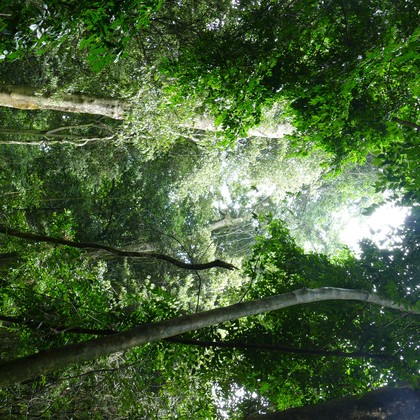
Where the bird is most at home, classified by the vegetation units of southern Africa.


Range and movements
Along the east coast of South Africa, from the Garden Route around Knysna eastwards through the Eastern Cape and KwaZulu-Natal, inland to eastern Eswatini, and on through the coastal plain of Mozambique. Beyond the region along the East African coast north through Tanzania and Kenya to southern Somalia.
- Resident
- Summer visitor (c. Oct–Mar)
- Winter visitor (c. Apr–Sep)
- Passage (Mar–Apr, Oct–Nov)
- dark = core range, pale = thinly spread
How and when to look
The coastal forests of KwaZulu-Natal, such as around Durban, St Lucia and Kosi Bay, and the Eastern Cape coastal forests are the best sites. Listen for the clear, falling whistled series and watch for a grey sunbird flicking its wings: the red pectoral tufts settle the identification.
Conservation status
Not threatened. The species is common in suitable coastal forest and also occurs in gardens. Coastal development and clearance of coastal and dune forest reduce the habitat locally.
Scientific name
Cyanomitra veroxii | (Smith, 1832)
Smith described the species in 1832 as Cinnyris veroxii; because it was later moved to another genus, the author and year stand in brackets. The genus Cyanomitra was introduced in 1853 by Reichenbach. Cyanomitra comes from the Greek kuanos, 'dark blue, greenish blue', and mitra, 'headband, diadem' — for the glossy blue or green head or throat of many species. veroxii honours the French natural-history dealer Jean Baptiste Édouard Verreaux (1810–1868); the name was later also spelled verreauxi, verreauxii and verroxii. The specimen the first description was based on came from Eastern Cape, South Africa.