All species › Waders, gulls and terns › Plovers and lapwings › Caspian Plover
Caspian Plover | Anarhynchus asiaticus
Kaspische plevier | Chorlito Asiático
The Caspian Plover is a slender, long-legged plover of the Asian steppes that winters in southern Africa, not at the water's edge but on dry, closely grazed or freshly burnt grassland. Small flocks stand upright and motionless in the grass and are often noticed only when they fly off.

Voice
A short, sharp chup or kwit, often repeated on take-off, and a soft whistled tuu-it within the flock.
No recording with a suitable Creative Commons licence is available for this species yet.
Identification
19–22 cm. Slim, with long legs and a thin, pointed black bill. In non-breeding plumage, the one most often seen in the region, the upperparts are plain grey-brown with pale fringes, the broad supercilium and forehead are white to pale buff, and a broad, nearly complete grey-brown band crosses the breast. In breeding plumage, appearing from February, the male has a chestnut breast band with a narrow black lower border and a clean white face. The legs are yellowish-green to greyish-green. In flight there is a narrow white wing bar, a greyish underwing and little white at the tail sides.
Confusion species
The Greater Sand Plover Anarhynchus leschenaultii has a much heavier bill, only lateral breast patches and a white underwing, and keeps to the coast. The Siberian Sand Plover Anarhynchus mongolus is smaller, shorter-legged and likewise tied to tidal flats. The Pacific Golden Plover Pluvialis fulva is larger and spangled with gold. Temminck's Courser Cursorius temminckii also favours burnt ground, but is rufous with a black belly patch and a black-and-white head stripe.
Habitat
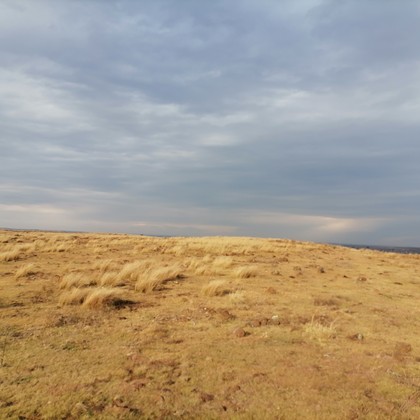
Short grassland, overgrazed pasture, freshly burnt veld, floodplain grasslands and the margins of dry pans; also airstrips and sports fields. Often kilometres from open water. It feeds in short dashes on termites, beetles and grasshoppers, in typical plover fashion: run, stop, peck.
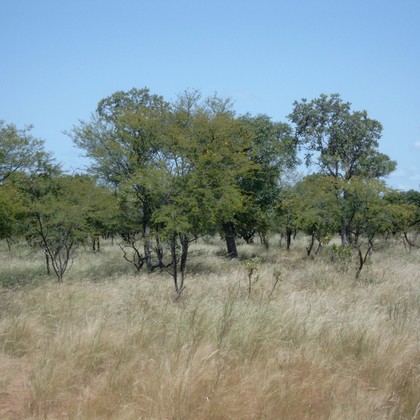
Where the bird is most at home, classified by the vegetation units of southern Africa.
Range and movements
Mainly in the north of the region: northern Botswana, Zimbabwe, Zambia, the Zambezi Region and northern Namibia (Etosha) and southern Angola; scarce in Limpopo and North West and a rarity elsewhere in South Africa. It breeds in the steppes and semi-deserts from the Caspian Sea to Kazakhstan and western China and winters in eastern and southern Africa.
- Summer visitor (c. Oct–Mar)
- Passage (Mar–Apr, Oct–Nov)
- dark = core range, pale = thinly spread
How and when to look
Search freshly burnt flats and closely grazed grasslands from November to February, especially in northern Botswana, Hwange and the Zambian floodplains. The birds crouch and are hard to see in sandy-coloured grass; drive slowly and scan the ground in low sun. Late in the summer males moult into breeding plumage.
Conservation status
Not threatened. The breeding range in the Central Asian steppes is large, but numbers are falling locally as steppe is converted to cropland. In southern Africa numbers vary greatly from year to year, depending on rainfall and fires.
Scientific name
Anarhynchus asiaticus | (Pallas, 1773)
Pallas described the species in 1773 as Charadrius asiaticus; because it was later moved to another genus, the author and year stand in brackets. The genus Anarhynchus was introduced in 1832 by Quoy & Gaimard. Anarhynchus is Greek, from ana- 'backward' and rhunkhos 'bill', after the sideways-bent bill of the wrybill, the type species of the genus. asiaticus is Latin for 'Asian', after the breeding grounds in the Central Asian steppes. The specimen the first description was based on came from the salt lakes of the Central Asian steppes.