All species › Passerines › Chats and flycatchers › Cassin's Flycatcher
Cassin's Flycatcher | Muscicapa cassini
Cassins vliegenvanger | Papamoscas de Cassin
Cassin's Flycatcher is a dark slate-grey flycatcher that is strictly tied to forested rivers and streams. Within the region it occurs only in the far north-west of Zambia and in northern Angola, where it perches on rocks, branches and snags above running water.
Voice
A thin, high tseep or tsst, often repeated, and a soft chipping. The song is a short, reedy series of high, hissing and chirping notes, inconspicuous against the noise of the water.
Recording: BurBenj — CC BY-NC-SA 4.0 · converted to mono · xeno-canto
Identification
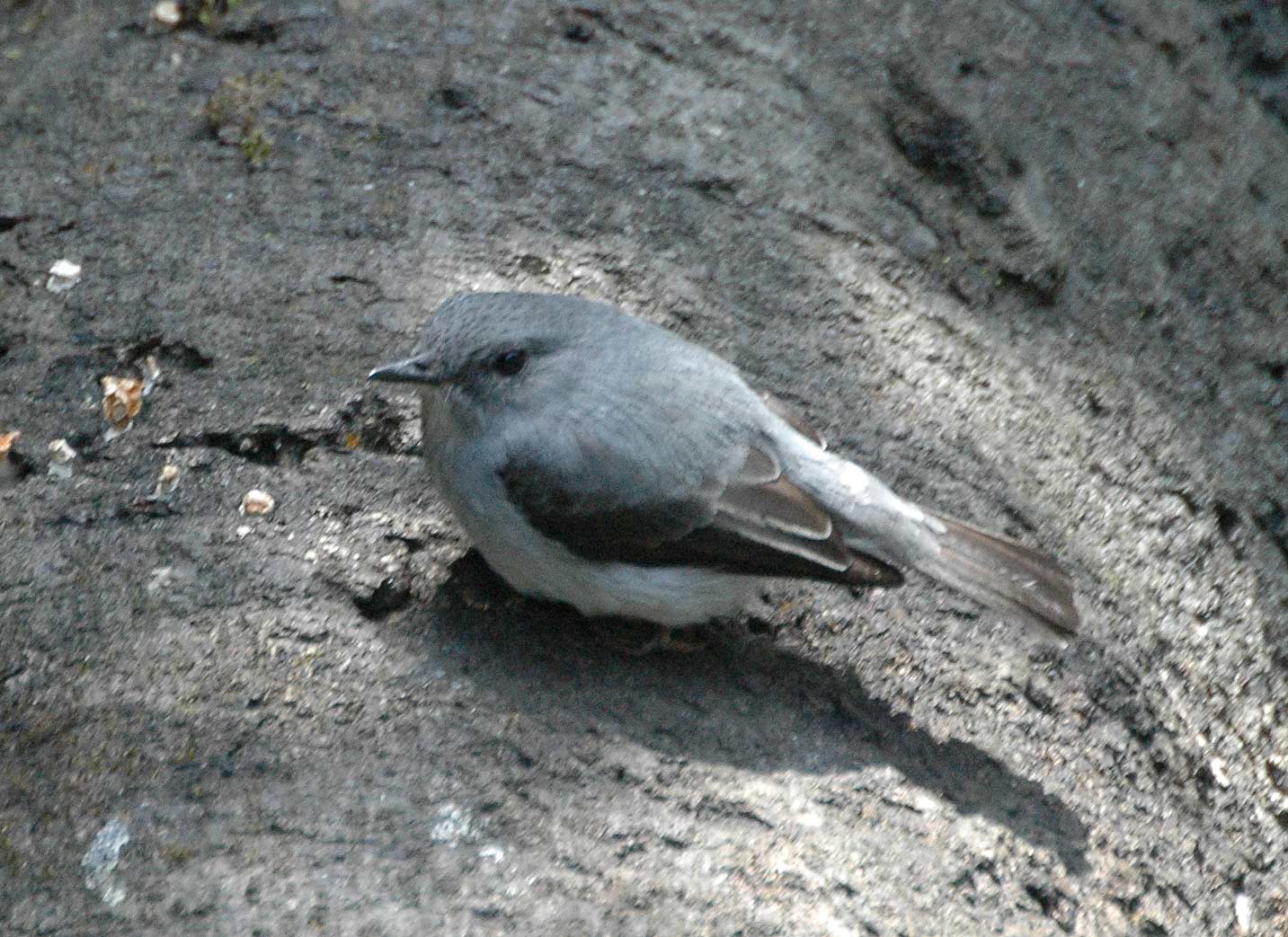
13–14 cm, a compact flycatcher with a fairly large head and a broad black bill. Head and upperparts are dark slate-grey, the wings and tail blackish. The throat is white and contrasts sharply with a broad, plain grey breast band; the belly is white. A narrow white eye-ring and a white loral spot are visible at close range. The sexes are alike; juveniles are spotted pale above. It perches upright, flicks its wings and tail a great deal and hunts in short flights over the water.
Confusion species
Swamp Flycatcher Muscicapa aquatica is browner, with a brownish breast band, and perches in reeds and papyrus along lakes and swamps; in northern Zambia the two occur not far apart but rarely on the same water. Ashy Flycatcher Fraseria caerulescens is paler blue-grey, greyer below without a sharp white throat, has a black loral line and lives in the forest canopy. African Dusky Flycatcher Muscicapa adusta is brown and faintly mottled, without a contrasting breast band. Its constant presence above running water in forest is the best clue.
Habitat
Rivers and streams with gallery forest and overhanging vegetation, with rocks, fallen trunks and bare branches over or in the water. It hunts low over the surface for midges, mayflies and other insects rising from the water. The nest is built on a stump, a branch over the water or among roots along the bank.
Where the bird is most at home, classified by the vegetation units of southern Africa.


Range and movements
Within the region only in north-western Zambia, mainly in Mwinilunga and along the upper Zambezi and Kabompo and their tributaries, and in northern Angola in Cuanza Norte, Uíge, Bengo and Malanje provinces. Beyond the region in the forest zone of West and Central Africa, from Guinea and Sierra Leone through the Congo Basin to Uganda.
- Resident
- dark = core range, pale = thinly spread
How and when to look
Walk or boat along a forested river in Mwinilunga or northern Angola and scan the rocks and snags in mid-stream. The bird is present all year and not shy, but often sits low in the shade of overhanging trees. Look for the sharply defined white throat above the grey breast.
Conservation status
Not threatened. The species is widespread in Africa's rainforest zone. On the southern edge of its range, in Zambia and Angola, it depends on gallery forests, which are locally degraded by logging, cultivation and fire.
Scientific name
Muscicapa cassini | Heine, 1860
Heine described the species in 1860 and placed it straight away in the genus where it still stands. The genus Muscicapa was introduced in 1760 by Brisson. Muscicapa is Latin, from musca 'fly' and capere 'to catch'. cassini honours the American ornithologist John Cassin (1813–1869) of the Academy of Natural Sciences in Philadelphia. The specimen the first description was based on came from Sette Cama, Gabon.