All species › Passerines › Chats and flycatchers › Spotted Flycatcher
Spotted Flycatcher | Muscicapa striata
Grauwe vliegenvanger | Papamoscas Gris
The Spotted Flycatcher is a Palearctic migrant that is spread across almost the whole region from October to April, from woodland and savanna to gardens and parks. It perches upright on a lookout, sallies in a looping flight after a flying insect and often returns to the same branch with a flick of wings and tail.
Voice
Almost silent on the wintering grounds. The call is a sharp, high tseee and, when agitated, tseee-tek-tek, with clicking final notes. The song, rarely heard in Africa, is a soft, irregular series of scratchy and squeaky notes.
Recording: Robin et Julien SOURIOU — CC BY-NC-SA 4.0 · converted to mono · xeno-canto
Identification
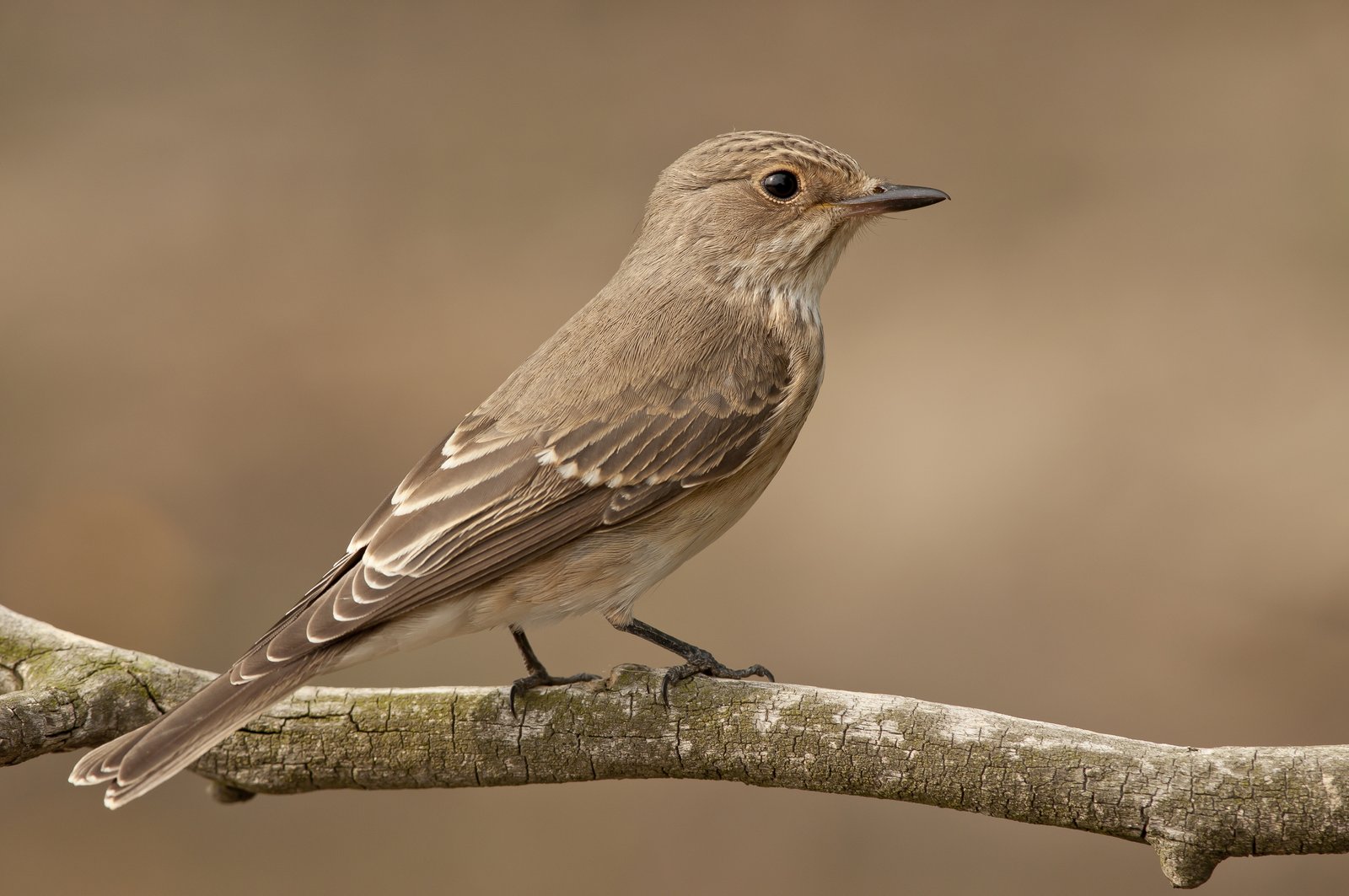
14 cm, a slim, long-winged flycatcher with a flat crown and a fairly long, broad black bill. The upperparts are plain grey-brown; the crown is finely streaked dark. The underparts are dirty white, with narrow, diffuse brown streaks on the throat, breast and flanks. The long primaries project well beyond the tertials, and the coverts and tertials have narrow pale edges. The sexes are alike; first-year birds have paler wing edgings. It often perches high and in the open and flicks its wings on landing.
Confusion species
African Dusky Flycatcher Muscicapa adusta is smaller, stockier and darker, with shorter wings, an unstreaked crown and a blurred, mottled breast; it is present year-round and perches low in the shade of forest edges. Pale Flycatcher Agricola pallidus is larger and plain sandy brown, with no streaking on crown or breast. Grey Tit-Flycatcher Fraseria plumbea is blue-grey and constantly fans its white-edged tail. Females of European Pied Flycatcher Ficedula hypoleuca and Collared Flycatcher Ficedula albicollis have a white wing patch and an unstreaked crown.
Habitat
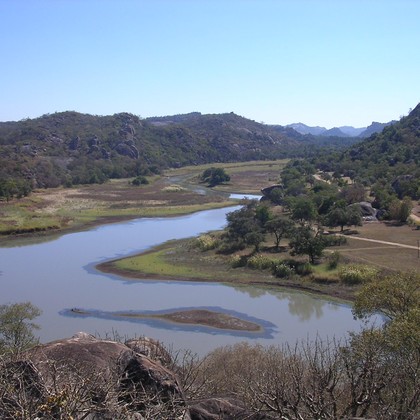
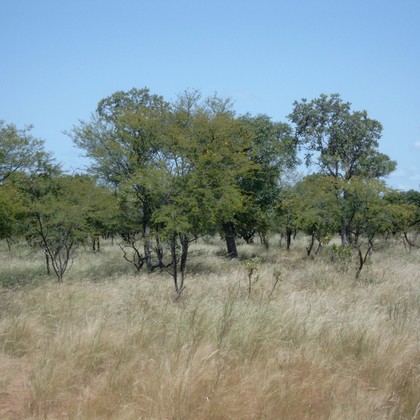
Open woodland and savanna with scattered tall trees, forest edges, riverine woodland, thornveld along dry riverbeds, plantations, parks and gardens. It avoids closed forest, treeless grassland and true desert. It hunts flying insects such as flies, bees and wasps from an open perch, often at the edge of a clearing or over water.
Where the bird is most at home, classified by the vegetation units of southern Africa.

Range and movements
Spread over almost the whole region: Angola, Zambia, Malawi, Mozambique, Zimbabwe, Botswana, northern and central Namibia and South Africa to the Eastern and Western Cape; most numerous in the north and east, scarce in the Namib, the western Karoo and Cape fynbos. It breeds from Europe and north-west Africa to Central Asia and winters in Africa south of the Sahara, mainly south of the equator.
- Resident
- Summer visitor (c. Oct–Mar)
- Passage (Mar–Apr, Oct–Nov)
- dark = core range, pale = thinly spread
How and when to look
From late October to early April, most numerous from December to February. Watch for a grey-brown flycatcher perched on an open branch, fence or wire that keeps making short flights and returning. The streaked crown and long wings separate it from the resident species; in gardens and camps in the bushveld it is often confiding.
Conservation status
Not threatened, with a very large global population. In Europe the species has declined sharply since the 1970s, probably through fewer large insects and changes on the wintering and passage grounds. In southern Africa wintering numbers appear stable.
Scientific name
Muscicapa striata | (Pallas, 1764)
Pallas described the species in 1764 as Motacilla striata; because it was later moved to another genus, the author and year stand in brackets. The genus Muscicapa was introduced in 1760 by Brisson. Muscicapa is Latin, from musca 'fly' and capere 'to catch'. striata is Latin for 'striated', from striatus, after the streaking on crown and breast. The specimen the first description was based on came from Holland.